
Most real estate brands spend their entire digital budget on lead volume. They run Google Ads. They boost Meta posts. They list on property portals. And then the sales team complains that 80% of the leads are unqualified.
The problem isn’t spending. The problem is sequencing. Digital marketing for real estate works only when the funnel is designed to qualify before it converts, not after.
Every year, Indian real estate developers collectively waste hundreds of crores on campaigns that generate form fills rather than walk-ins. The lead looks good on the dashboard. The CRM is full. But the site visit rate is 3%, the booking rate is lower, and nobody can explain the gap between volume and value.
Here is what is actually happening. When you run a generic digital marketing for real estate campaign without segmenting by buyer intent, investor versus end-user, ready-to-buy versus just exploring, you attract everyone and convert almost no one. The algorithm delivers impressions. The landing page catches them all. And then a sales executive calls someone who filled out a form out of casual curiosity, three times, on a Saturday.
That is not a lead problem. That is a funnel architecture problem. And fixing it starts with the right diagnosis, not more ad spend.
Direct answer: Most real estate digital campaigns measure cost-per-lead, not cost-per-qualified-lead. That distinction, which sounds small, is responsible for most wasted budgets in the sector.
When a real estate marketing agency evaluates your campaign’s health, the first question it should ask is not “what is your CPL?” but “what percentage of your leads become site visits?” If that number is below 15%, you have a qualification problem, not a volume problem.
Here is what gets measured incorrectly and what should replace it:
Optimising for lead form fills (wrong approach): Lead volume looks good on reports. But a Rs. 200 CPL with a 2% site visit rate is more expensive than a Rs. 1,200 CPL with a 25% site visit rate.
Optimising for qualified lead rate (right approach): Define qualification criteria before running a single campaign. Ready-to-buy signals include a specific configuration asked for, a project name mentioned, and a realistic budget shared.
Running identical campaigns for all buyer segments (wrong approach): An investor researching rental yield has entirely different search behaviour from a family looking for a 2BHK in their catchment area. One creative does not serve both.
Segmenting by buyer persona from day one (right approach): Build separate ad groups, landing pages, and remarketing pools for investors, end-users, NRI buyers, and commercial prospects. Every segment needs its own messaging.
74% of Indian homebuyers conduct digital research before visiting a property site, meaning the digital journey determines the quality of the walk-in before your sales team ever picks up the phone.
The brands that solve this at the diagnostic layer, before burning budget, are the ones that generate lead quality rather than just lead quantity. Everything that follows depends on getting this layer right first.
Direct answer: A qualified real estate lead funnel begins with intent segmentation on the search side, dedicated landing pages per segment, and a qualification layer built into the form before a lead reaches the CRM.
Most real estate brands run a single Google Search campaign targeting broad-match keywords like “3BHK in Mumbai” or “luxury apartments Pune.” The result is a wide net that catches everyone from active buyers with six months to purchase to researchers with two years of runway.
The better approach, used by every effective digital marketing agency for real estate, is to build keyword clusters by funnel stage. Transactional queries like “book flat in [location]” or “register for site visit” should have dedicated campaigns with direct CTAs. Consideration queries like “upcoming projects in [location]” or “which developer is good in [location]” warrant a different message, typically a comparison or proof-led landing page. Awareness queries like “property investment in India 2026” are better served by SEO and content rather than paid search.
This isn’t a theory. One leading Mumbai channel partner running digital marketing for real estate through Bright Brain hit a 10% CTR on Google Search, Rs. 6K–9K CPL and 95% impression share. Those results came from restructuring keyword intent clusters, not from increasing budget.
The single highest-leverage fix in digital marketing for real estate is the landing page. Most developers send all traffic to the homepage or a generic project page. Both are wrong.
A qualified landing page does two things: it filters out low-intent visitors through the specificity of its messaging, and it collects qualification data within the form itself. Fields like “your timeline to purchase,” “preferred configuration,” and “approximate budget range” are not friction. They are qualification signals that save your sales team from hundreds of wasted calls.
Landing pages with 3–5 form fields convert 25% better than those with 8 or more fields. Shorter, smarter forms outperform the exhaustive ones most real estate brands use by default.
A dedicated digital marketing agency for real estate should own this layer. Landing page architecture, A/B testing, form flow, and mobile responsiveness are not optional extras. They are the foundation on which all paid media performance rests.
Direct answer: For real estate lead generation, the highest-performing channel combination is Google Search for high-intent buyers, Meta Ads for re-engagement and investor audiences, and YouTube pre-roll for project launches and trust-building. Portals like 99acres and MagicBricks belong in the mix but should not anchor the strategy.
Google Search is where buyers with active intent announce themselves. These are the people who are ready to visit a site, register for a launch, or speak to a sales representative. No other channel captures buyer readiness the same way. The key for a real estate marketing agency managing Google campaigns is to run Performance Max alongside dedicated Search campaigns, rather than letting PMax swallow the budget blindly.
Digital marketing services for real estate via Google also include Display remarketing, which is severely underused in the sector. Visitors who spend more than 90 seconds on a project page and do not convert are warm leads who left without registering. A structured remarketing campaign targeting those visitors specifically, with social proof, testimonials, or offer messaging, consistently generates conversion rates 3–5x higher than cold traffic.
Meta, across Instagram and Facebook, is where digital marketing for real estate brands builds emotional preference before the buyer is ready to search. A buyer who has seen your project walk-through, a resident testimonial, and a fly-through of the location three times over two weeks is not the same buyer who sees a generic “book now” ad once and scrolls past.
The formats that work best include Reels with real resident stories, carousel ads showing configuration options and price ranges, and lead-gen forms prefilled with audience data for site visit bookings. A social media marketing agency for real estate running this layer correctly should be building warm audiences that feed the remarketing pool for Google Search.
Paranjape Schemes generated over 5,000 leads and 1,200 site walk-ins through a combined paid-social and paid-search strategy managed by Bright Brain, not by spending more, but by connecting the Meta warm audience pool to the Google Search remarketing layer.

Direct answer: In real estate, the decision to book is ultimately a trust decision. Social proof such as resident testimonials, construction progress updates, and developer track record content reduces the perceived risk of a high-ticket, long-commitment purchase. Brands that neglect this layer find their CPL rising every quarter, even when their ads are technically well-built.
A digital marketing company for real estate focused only on paid media is leaving a significant channel unbuilt. Organic search for real estate queries like “flats in [area] 2026,” “property investment ROI in Mumbai,” or “upcoming projects near [metro line]” generates traffic that does not stop when the media budget pauses. Unlike paid campaigns, SEO-driven content compounds over 12–18 months, building topical authority that positions a developer or broker as the credible reference point in their geography.
The digital marketing strategies for real estate that age best are the ones that combine paid for immediate lead flow and SEO for pipeline quality over time. The brands that only run paid media are dependent on budget. The brands that combine both own their category.
Organic search delivers 5.66x more clicks than paid search. This is why the most cost-efficient real estate digital marketing systems always have a content and SEO layer running alongside paid campaigns.
The highest-intent visitor in your funnel is someone who has been to your website twice, viewed a project page, watched a video, and has not converted. That person is not lost. That person needs a single, well-timed message at the right moment to tip into a booking.
A fully built real estate marketing agency campaign will have a remarketing strategy that segments by engagement depth: first-time visitors, repeat visitors, video viewers, form abandoners, and walk-in no-shows. Each segment gets a different message. The developer with a 25-day purchase timeline gets urgency messaging. The investor, still in research mode, gets ROI data and rental yield proof.
Kalpataru achieved an 85% drop in CPL
After Bright Brain restructured their campaigns across Google and Meta, not by changing creative, but by realigning audience segmentation, funnel stages, and landing page architecture. The Cliff Garden, another Bright Brain real estate client, generated 5,000+ leads with a 35% qualification rate and 25 bookings. That is the result of the same intent-first approach applied at every layer.
This kind of result is what separates a generic best digital marketing agency for real estate claims from one backed by a verifiable, repeatable system.

Direct answer: Start with buyer intent architecture and landing page qualification before running a single campaign. Every rupee spent without these layers in place costs more than it needs to.
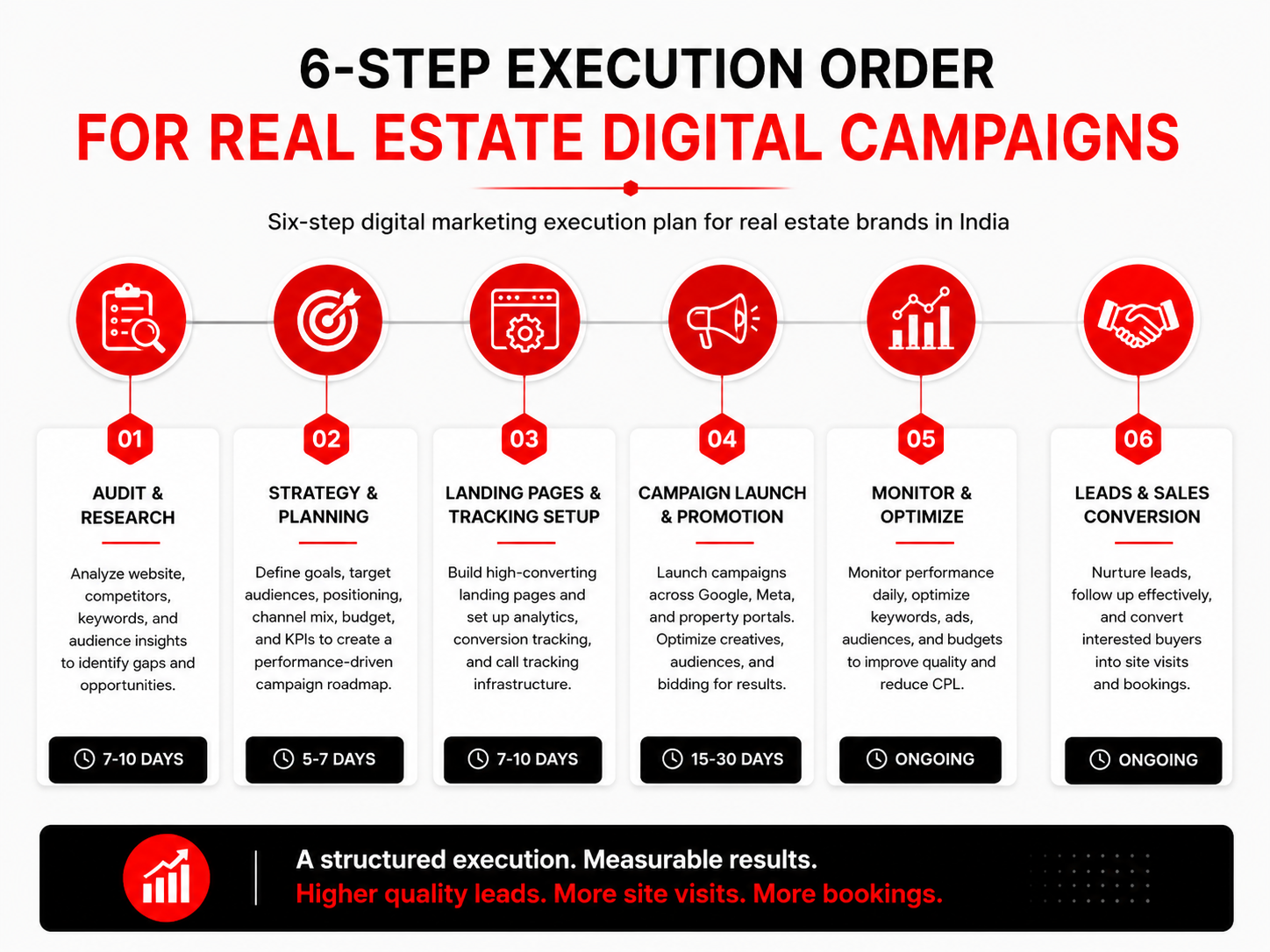
Most real estate brands want to start with ads because ads are visible and fast. The instinct is understandable. But without the diagnostic layer built first, you are spending to fill a leaky bucket. The sequence matters more than the speed.
Q: What is digital marketing for real estate and why does it matter in India?
Digital marketing for real estate is the use of paid media, SEO, content, and social channels to generate qualified buyer and investor leads for property developers, brokers, and channel partners. In India, where 74% of buyers research online before a site visit, digital is now the primary lead generation channel for the sector, not a supplement to traditional marketing.
Q: How much should a real estate brand spend on digital marketing in India?
There is no fixed number, but a minimum viable budget for a real estate marketing agency to run meaningful campaigns across Google Search, Meta Ads, and remarketing in a single city is typically Rs. 2–3 lakhs per month. Developers launching new projects in multiple cities or targeting NRI audiences should plan for significantly more. What matters more than total spend is how the budget is split across funnel stages.
Q: What is the average CPL for real estate digital marketing in India?
CPL varies by geography, project type, and funnel structure. In Mumbai, a well-run digital marketing agency for real estate campaigns will typically target a CPL of Rs. 600–1,200 for mid-income projects and Rs. 1,500–4,000 for luxury or commercial. A leading Mumbai channel partner working with Bright Brain achieved Rs. 6K–9K CPL at 10% CTR, which was extremely efficient given the ticket size of the product.
Q: Which digital channels work best for real estate lead generation?
Google Search drives the highest-intent leads. Meta Ads across Instagram and Facebook build preference and generate walk-in bookings through remarketing. YouTube is effective for project launches and trust-building. Property portals like 99acres and MagicBricks generate volume, but often of lower quality. The best digital marketing strategies for real estate combine all of these in a structured funnel, not as isolated campaigns.
Q: How do you improve lead quality in real estate digital campaigns?
Improving lead quality starts with three fixes: segment audiences by buyer type before running campaigns, use landing pages with qualification fields rather than generic contact forms, and separate remarketing audiences by engagement depth. A well-structured real estate marketing agency approach can improve site visit rates from 5–8% to 20–30% without increasing media spend.
Q: What should I look for in the best digital marketing agency for real estate?
Look for a digital marketing agency for real estate that can show you vertical-specific case studies covering CPL improvements, walk-in rates, and booking conversions, not just impressions and click data. Ask about their landing page process, audience segmentation methodology, and how they define and track a qualified lead. A Google Elevator Partner with real estate case studies across multiple developers is a significantly stronger signal than a general agency with one or two property clients.