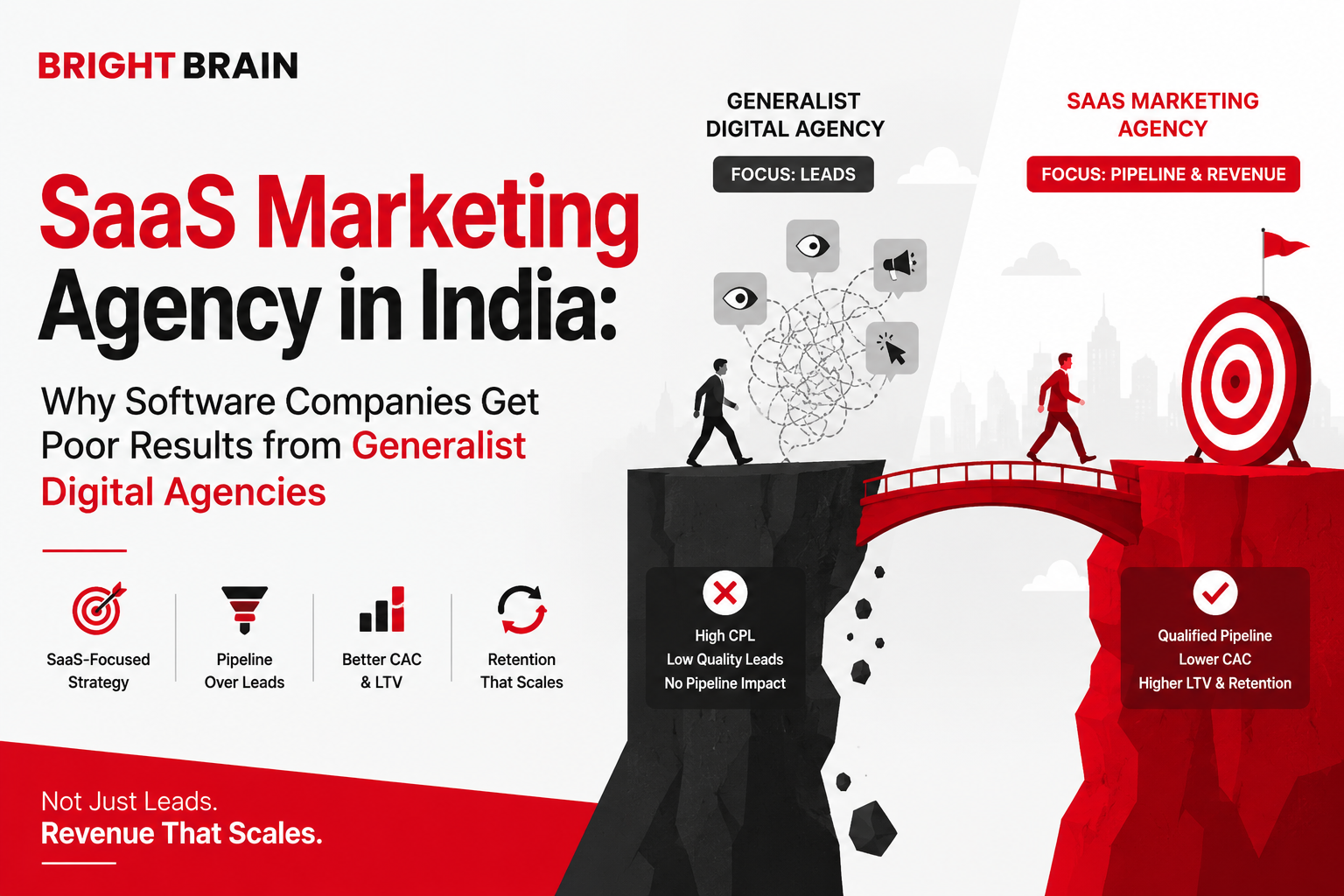
India crossed 1,000 funded SaaS companies in 2026. Most of them are targeting the US, Europe, and APAC markets simultaneously. Nearly all of them are working through the same realisation: a generalist digital agency that helped a real estate developer generate leads or pushed an FMCG brand on Instagram is not equipped to market software with a 90-day sales cycle, a free trial funnel, and a churn rate that compounds quarterly.
This is not a criticism of generalist agencies. They are built for a different job. The problem arises when a SaaS founder hires the wrong tool for the wrong task, burns six months of runway on the wrong metrics, and concludes that “digital marketing doesn’t work for SaaS.” It works. The agency just has to understand the model.
This piece is for SaaS founders, VPs of Marketing, and heads of growth at Indian software companies evaluating their agency options. It explains what separates a real SaaS marketing agency from a generalist, names the specific failure modes that drain SaaS marketing budgets, and gives you the questions to ask before you sign a retainer.
Most digital marketing principles transfer across industries. Create demand, capture intent, convert, retain. The SaaS model, however, changes the economics at every stage in ways a generalist agency is rarely calibrated to handle.
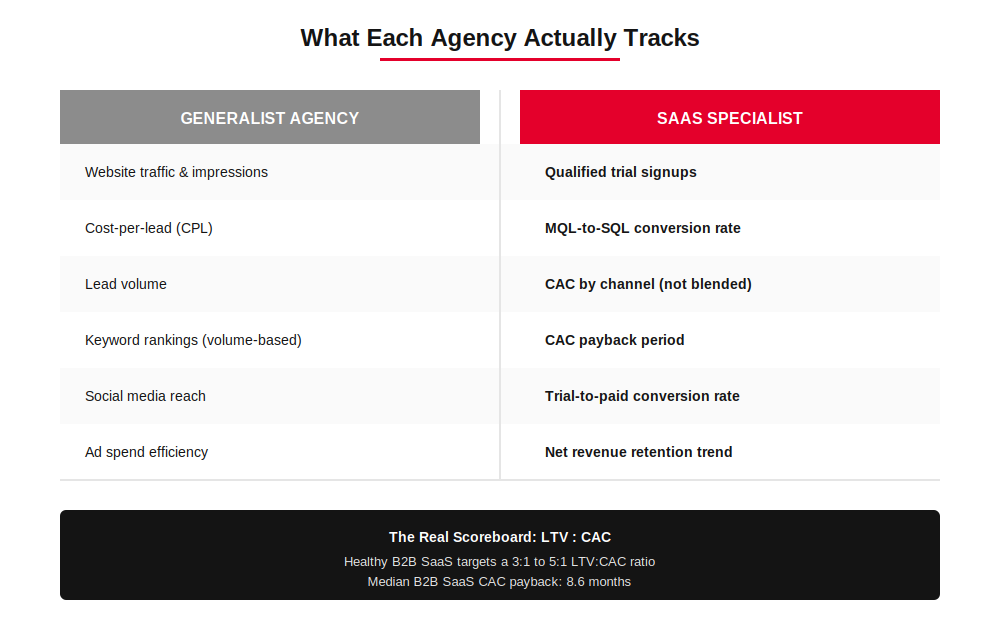
The metrics are different. A generalist agency reports cost-per-lead, traffic, and impressions. A SaaS marketing agency reports MQL-to-SQL conversion rate, trial-to-paid conversion, CAC payback period, and net revenue retention. A campaign that drives 500 leads at a low CPL can simultaneously destroy SaaS unit economics if none of those leads convert to paying subscribers.
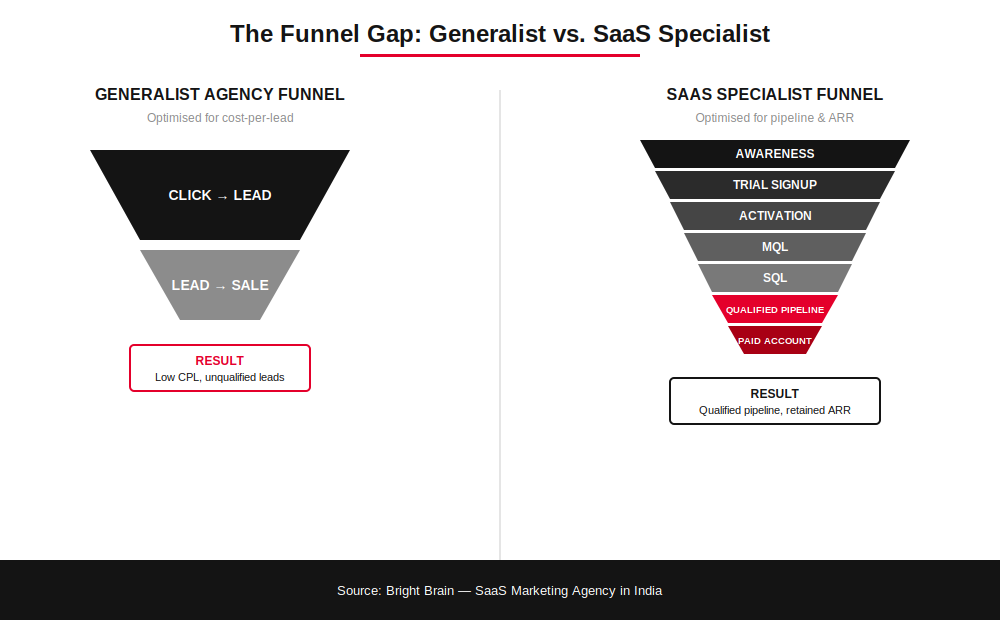
The funnel is longer and more complex. B2B SaaS buyers research in committees. They read comparison articles on G2 and Capterra. They start free trials, evaluate against three competitors, loop in a procurement team, and sometimes take three months to make a decision worth less than ₹5 lakhs annually. A generalist agency is typically optimised for a two-step funnel: click to lead, lead to sale. SaaS needs a seven-step funnel managed across every touchpoint.
The content requirements are technical. SaaS content marketing requires a writer who understands the product category deeply enough to write the comparison article a buyer is actually searching for. Generalist writers produce content that reads competently but says nothing a competitor could not also say. SaaS buyers can tell immediately.
Churn changes everything. In a SaaS business, a customer who churns in month three is often a loss-making account after factoring in acquisition cost and onboarding. A generalist agency does not think about churn. Its job ends at the lead. A specialist digital marketing agency for SaaS treats churn reduction as a marketing problem, not just a customer success problem.
The LTV: CAC ratio is the real scoreboard. Healthy B2B SaaS companies operate at a 3:1 to 5:1 LTV: CAC ratio. The median B2B SaaS CAC payback is 8.6 months. A generalist agency rarely tracks either number and cannot connect its campaigns to either outcome.
SaaS founders who have worked with generalist agencies tend to describe a consistent set of frustrations. They trace to four structural failure modes.
Failure mode 1: Optimising for the wrong funnel stage. A generalist agency is built to fill the top of the funnel: traffic, leads, MQLs. A SaaS marketing agency is built to move leads through a multi-stage funnel to a qualified pipeline and paid accounts. When a generalist agency succeeds at its job, it delivers a volume of leads the SaaS company’s sales team cannot close because the leads are unqualified, poorly nurtured, or at the wrong ICP.
Failure mode 2: Keyword strategy misaligned to buyer intent. SaaS SEO is not the same as e-commerce SEO or local services SEO. A SaaS buyer at the bottom of the funnel searches for things like “best project management software for construction teams” or “Salesforce alternative for mid-market B2B.” A generalist agency with no SaaS category expertise will build a keyword strategy around the highest-volume terms, not the highest-intent ones, producing traffic that never converts.
Failure mode 3: Paid media optimised for CPL, not for trial conversion. Google Ads for SaaS companies should be calibrated against trial signups, MQL quality, and eventually closed ARR, not against raw lead volume or CPL benchmarks. A generalist agency will bid to a CPL target that has no connection to the SaaS company’s actual unit economics, reporting impressively low CPLs alongside a pipeline that never fills.
Failure mode 4: Content that generates activity but not pipeline. A generalist content team produces articles that rank for awareness-stage queries, accumulate traffic, and generate zero qualified pipeline. A SaaS content marketing agency builds its content strategy from the buyer journey backwards, starting with the decision-stage queries that close deals and working up to the awareness-stage content that feeds them.
The difference between a generalist and a specialist is most visible in the metrics they own.
A generalist agency typically owns: website traffic, social media reach, cost-per-lead, lead volume, keyword rankings, and ad spend efficiency. All of these are real metrics. None of them tells you whether the marketing is working for a SaaS business.
A specialist SaaS marketing agency owns a different set: qualified trial signups, MQL-to-SQL conversion rate, CAC by channel (not blended), CAC payback period, trial-to-paid conversion rate, and net revenue retention trend. These metrics connect marketing spend to revenue outcomes in a way that makes the agency’s contribution to the business legible and accountable.
The best way to test an agency before you hire them is to ask what metrics they will own and how they will connect those metrics to your ARR. If the answer involves traffic and leads but not trial conversions or CAC payback, you are talking to a generalist.
SaaS SEO is a category where the gap between generalist and specialist execution is widest and most consequential. Organic search is the only growth channel that compounds without a proportional increase in spend.
A generalist SaaS SEO agency typically builds a content calendar around a keyword research spreadsheet: one article per keyword, published at a consistent cadence. This produces results in year one. In years two and three, traffic plateaus because the content does not create topical authority.
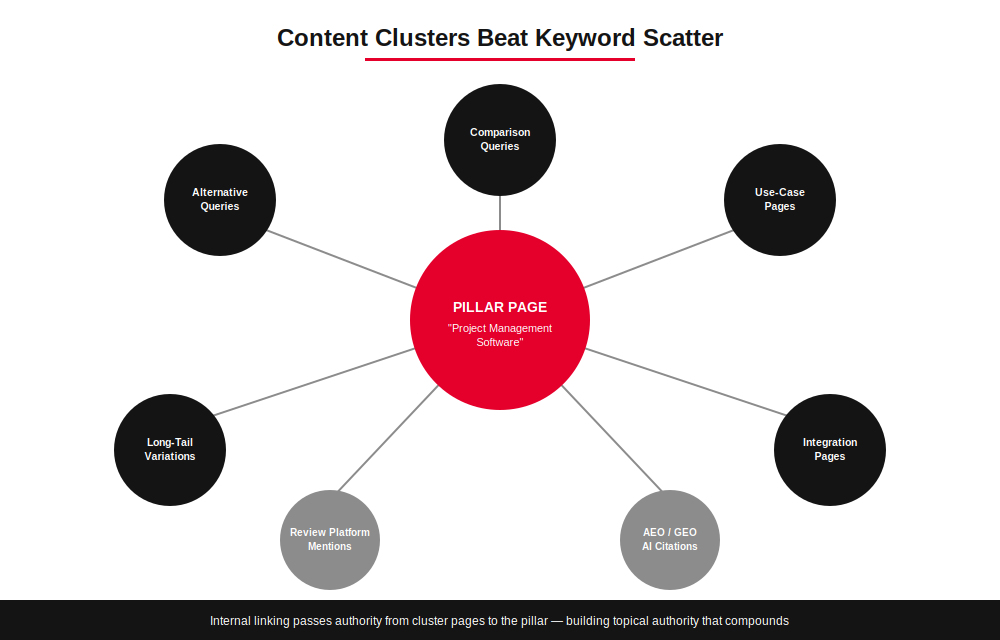
A specialist B2B SaaS SEO agency builds content clusters, not keyword lists. One pillar page owns the primary topic comprehensively. A set of cluster pages owns the long-tail variations, comparison queries, and use-case-specific questions a buyer searches across the research phase. Internal linking passes authority from cluster to pillar, and the site develops topical authority that compounds.
The second structural difference is buyer-journey mapping: awareness, consideration, or decision. A specialist agency builds the content ratio deliberately, weighted toward consideration and decision content because those readers are closer to a trial signup.
The third difference is AI search visibility. In 2026, SaaS buyers increasingly start their research on ChatGPT, Perplexity, and Google AI Overviews. A specialist agency doing SaaS SEO today is thinking about AEO and GEO alongside traditional rankings. Bright Brain’s work with Wright Research, where the team drove over 600 organic users from ChatGPT, Perplexity, and Gemini citations, is one example of what SaaS SEO looks like when executed with AI search in mind.
SaaS performance marketing is where the generalist agency problem becomes most expensive, fastest.
Paid media for SaaS has a structural complexity most generalist agencies do not fully account for: the conversion goal is not a lead; it is a qualified trial signup or a booked demo. A lead is an email address. A trial signup is someone who has committed enough attention to evaluate your product. The gap between the two is where most SaaS paid media budgets disappear.
A generalist agency running Google Ads for SaaS companies will typically target high-volume category keywords, drive traffic to a generic landing page, and optimise toward form submissions, many of them low-intent. The agency reports strong lead volume; the sales team reports poor pipeline quality.
A specialist SaaS Google Ads company approaches the funnel differently: landing pages built specifically for trial or demo conversion, bidding strategies built around trial-to-paid conversion data fed back from CRM, and campaign structures segmented by ICP, since SMB versus enterprise buyers behave very differently. A ₹1,500 CPL that converts at 40% to a qualified trial is a better campaign than a ₹400 CPL that converts at 5%.
SaaS performance marketing also requires reading intent signals specific to the category: comparison queries (“product A vs product B”), alternative queries (“alternative to [market leader]”), and review platform queries (G2, Capterra, SaaSworthy) are often higher-intent than the primary category keyword.
The market for SaaS marketing services in India has grown significantly. There are now genuine specialists available alongside generalists who have added SaaS to their service offering without changing how they work. These questions help you tell the difference:
The right partner for a SaaS company thinks in ARR, CAC payback, and net revenue retention. They build their reporting structure around your board metrics, not their own vanity metrics. And they have case studies that connect their work directly to revenue outcomes, not just to traffic and lead volume.
At Bright Brain, we have worked with SaaS-adjacent and software-first businesses to build marketing systems that compound. Our work with Wright Research produced 600 organic users from AI citations (ChatGPT, Perplexity, Gemini), an 18% improvement in signups, and a 33% subscription spike in two months by combining AEO, GEO, and SEO into a single integrated programme. We are a Google Elevator Partner, 1 of 15 agencies selected from 8,000 in India, and we bring that credentialing and technical depth to every SaaS marketing engagement.
A SaaS marketing agency is a specialist firm that builds marketing systems for software companies. A regular digital agency optimises for traffic, leads, and CPL; a SaaS marketing agency optimises for trial signups, MQL-to-SQL conversion, CAC payback period, and net revenue retention, because SaaS businesses have longer sales cycles, more complex funnels, and a recurring-revenue model that changes the unit economics of every campaign.
Four structural reasons: they optimise for the wrong funnel stage (lead volume over qualified trial signups); their SEO strategy is built on keyword volume rather than buyer intent; their performance marketing is optimised for CPL rather than trial-to-paid conversion; and their content generates activity but not pipeline because it isn’t mapped to the buyer journey.
Expertise in content cluster architecture (not just keyword-level articles), buyer-journey mapping for keyword prioritisation, technical SEO for SaaS products, and AI search visibility (AEO and GEO for ChatGPT, Perplexity, and Google AI Overviews). Ask for case studies connecting organic content to pipeline and trial signups, not just traffic growth.
Three key differences: the conversion goal is a qualified trial signup or booked demo, not a raw lead; the attribution model must connect front-end paid activity to trial-to-paid conversion data from CRM; and audience segmentation must account for the difference between SMB and enterprise buyers.
Qualified trial signups or booked demos by channel, MQL-to-SQL conversion rate, CAC by channel (not blended), CAC payback period, trial-to-paid conversion rate, and net revenue retention trend. Traffic, keyword rankings, and impressions are secondary metrics that should support the revenue story, not replace it.
SaaS content marketing requires depth generalist content teams rarely have. The content that drives trial signups is comparison content, alternative content, use-case-specific content, and integration-specific content: query types that require genuine category knowledge. Strategy is built from the buyer journey backwards, starting with decision-stage queries.
Healthy B2B SaaS companies target a 3:1 to 5:1 LTV: CAC ratio, with CAC payback under 12–18 months. The right agency affects this ratio by reducing CAC (efficient channel mix, qualified traffic, trial conversion optimisation) and improving LTV (content that sets accurate expectations, reducing early churn).
Ask what SaaS-specific metrics they’ll own, for a content case study tracing content to pipeline, how their SaaS SEO differs from e-commerce SEO, what their SaaS Google Ads landing page architecture looks like, and what a month-three report looks like. A real specialist will have confident, specific answers to all five.