Walk into any mid-size developer’s weekly review, and you will hear the same sentence: “Leads are up, but quality is down.” Spend climbs every quarter. CPL creeps upward. The sales team complains about unqualified inquiries. The MD blames the agency. The agency blames the inventory or the market.
The real problem is structural. Most digital marketing for real estate is built around campaigns, not systems. An agency runs a Google Ads flight for a project launch, generates volume, and moves on. There is no audience-building phase before the launch. There is no retargeting architecture after. There is no CRM handoff protocol. The moment the campaign ends, so does the momentum.
Compare this to a property brand that has partnered with a real estate marketing agency that treats marketing as a system. They run pre-launch audience seeding six to eight weeks out. They build project-specific landing pages with conversion rate optimisation baked in, not bolted on. They connect ad platforms to CRM natively. They track site-visit bookings, not just lead form submissions. The result is not a better campaign. It is a better business.
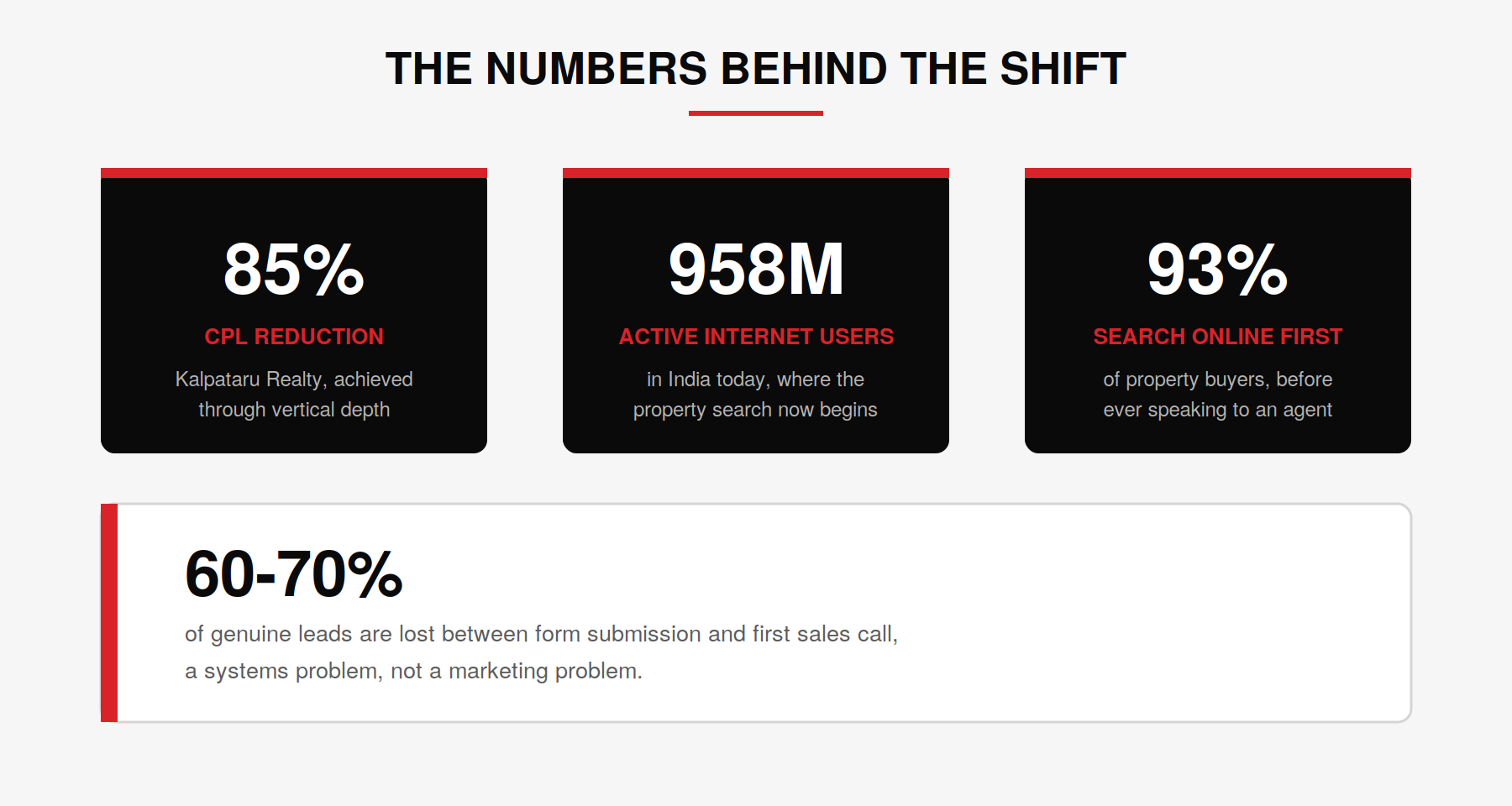
India now has over 958 million active internet users. More than 93% of property buyers begin their search online before speaking to an agent. The buyer journey has shifted entirely. What has not shifted, in most cases, is how developers structure their marketing investment. They are still buying campaigns when they should be building infrastructure.
The developers and channel partners that compound year-on-year share a recognisable profile. They are not necessarily the biggest spenders. They are the most systematic.
Here is what scaling looks like in practice:
Cost per lead comes down as the funnel matures. In the early months, CPL is high because the audience is cold and landing pages are being tested. By month four or five, the best-performing digital marketing for real estate agents starts to benefit from retargeting warmth, quality score improvements, and landing page optimisation. CPL trends downward as the system learns.
Lead quality improves, not just lead volume. A scaling brand has site-visit conversion rates above 15%. Their sales team is spending time on warm leads, not cold inquiries from people who clicked an ad by mistake. Digital marketing for real estate companies that produce volume without qualification is a cost, not an investment.
Brand search queries grow independently. When Bright Brain ran the Atlas University campaign, brand search queries rose 95%. The same dynamic applies to real estate. A developer running digital real estate marketing at scale starts to see organic brand searches climb alongside paid activity. That is compound interest on marketing spend.
The marketing function becomes a retention lever, not just an acquisition tool. Referrals from past buyers increase. Resale enquiries from existing customers come in through digital channels. The brand has a content presence that answers buyer questions before the sales team has to.
None of this happens without a real estate marketing agency that understands the full-funnel journey, not just the top-of-funnel ad spend.
The most effective real estate digital marketing strategy is not a single tactic. It is a five-layer system where each layer feeds the next.
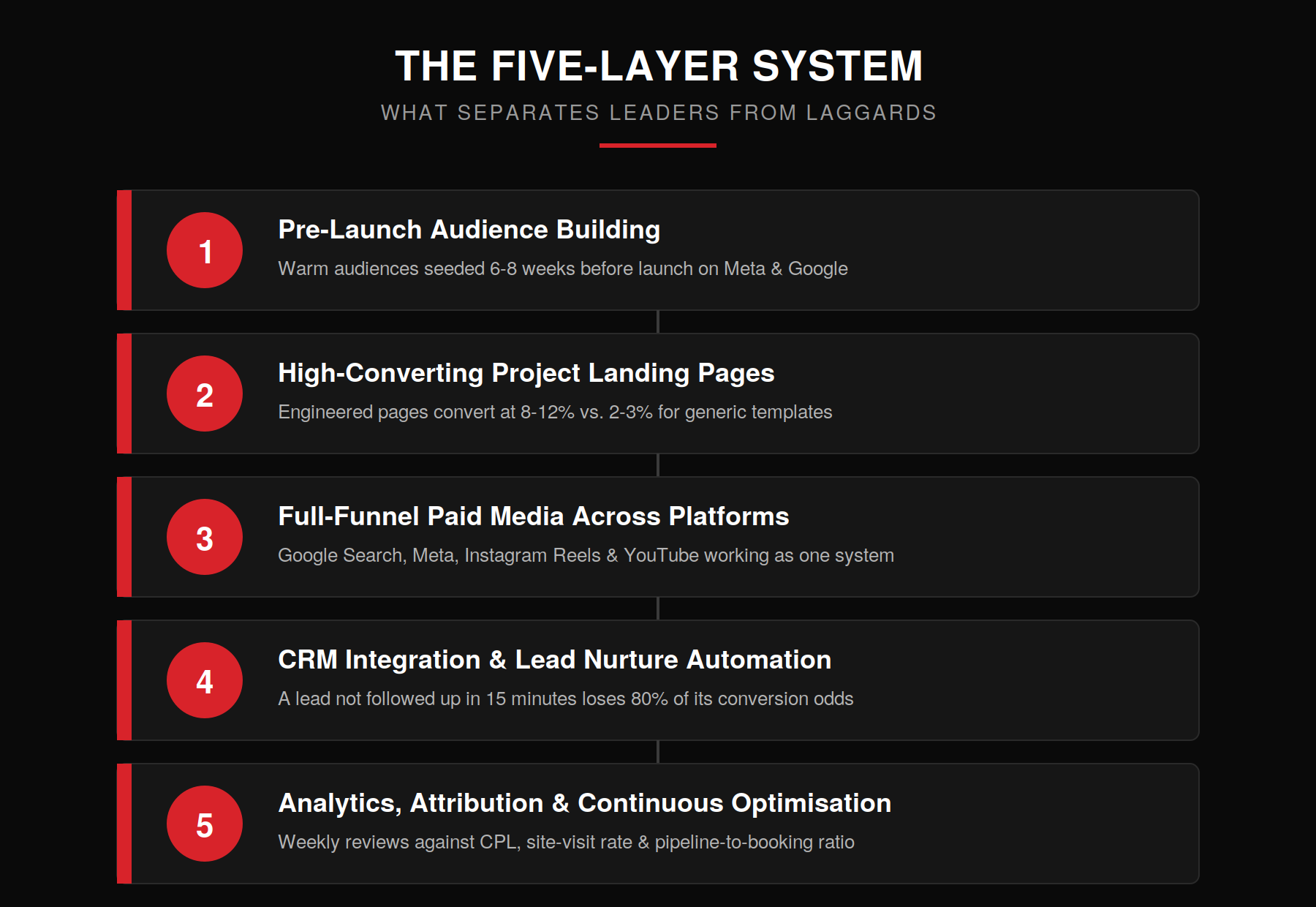
Layer 1: Pre-launch Audience Building. Most developers start marketing at launch. The brands that scale start eight weeks earlier. Pre-launch activity builds warm audiences on Meta and Google using project teasers, location-interest content, and lifestyle video. By launch day, the retargeting pool is already populated with high-intent prospects. The first week of a launch with pre-built audiences outperforms three weeks of cold traffic every time.
Layer 2: High-Converting Project Landing Pages. The landing page is where most digital marketing for real estate spend goes to die. A generic landing page with a contact form and a price list converts at 2 to 3%. A landing page engineered for the specific buyer segment, with a compelling headline, a virtual tour embed, social proof from past buyers, and a frictionless WhatsApp CTA, converts at 8 to 12%. The difference is not design. It is buyer psychology translated into page architecture.
Layer 3: Full-Funnel Paid Media Across Platforms. The best digital marketing strategies for real estate do not rely on a single platform. Google Search captures high-intent buyers who are actively researching. Meta and Instagram Reels build brand consideration among buyers who are not yet in active search mode. YouTube pre-roll builds project awareness for premium inventory. The mix shifts by project stage: awareness-heavy at launch, conversion-heavy as the project moves toward RERA deadlines.
Layer 4: CRM Integration and Lead Nurture Automation. A lead that is not followed up within 15 minutes loses 80% of its conversion probability. The best digital marketing for real estate companies is wired directly into CRM systems, whether that is Salesforce, LeadSquared, or a custom build. Automated WhatsApp sequences deliver project information, address common objections, and book site visits without manual intervention. Digital real estate marketing that stops at the form submission is only half a system.
Layer 5: Analytics, Attribution, and Continuous Optimisation. The final layer is the one that most agencies skip. Weekly performance reviews against CPL, site-visit conversion rate, and pipeline-to-booking ratio allow the system to adapt in real time. Budget is reallocated from underperforming campaigns to high-ROI channels. Creative is refreshed before fatigue sets in. Digital marketing strategies for real estate that run on autopilot deliver autopilot results.
There is a significant difference between a generalist digital agency that takes on real estate clients and a real estate marketing agency with genuine vertical depth.
Real estate has a buying cycle unlike any other category. A first-time homebuyer in their early thirties takes six to eighteen months from initial awareness to booking. An NRI investor buying a second property may compress that to two months. A channel partner evaluating a sub-broker relationship has entirely different buying signals. Each of these journeys requires different creative, different platform strategy, and different CRM nurture sequences.
A generalist agency treats all of these as “leads.” A vertically deep social media marketing agency for real estate knows that a buyer who watches a virtual site tour for more than 90 seconds is six times more likely to convert than one who clicks a static ad. They know that WhatsApp opt-in rate is a stronger early signal than cost per inquiry. They know that the RERA registration number in an ad creative increases form-fill rate among serious buyers because it signals legitimacy.
This is the difference between data and knowledge. A best digital marketing agency for real estate brings both. They have historical campaign benchmarks from vertical-specific work. They know what CPL looks like for a luxury high-rise in Mumbai versus plotted development in Tier-2 cities. They know which creative formats convert for NRI audiences on Meta. They have seen enough launch campaigns to know when CPL will fall and when it will not.
Bright Brain’s work with Kalpataru Realty is a proof point. An 85% reduction in cost per lead was not achieved by spending more. It was achieved by applying vertical knowledge: better audience segmentation, sharper creative for each buyer persona, and a landing page architecture built for property buyer psychology. Digital marketing for real estate agents at that level requires context that cannot be copied from a competitor’s case study.
Understanding digital marketing for real estate as a funnel clarifies where most brands are losing money.
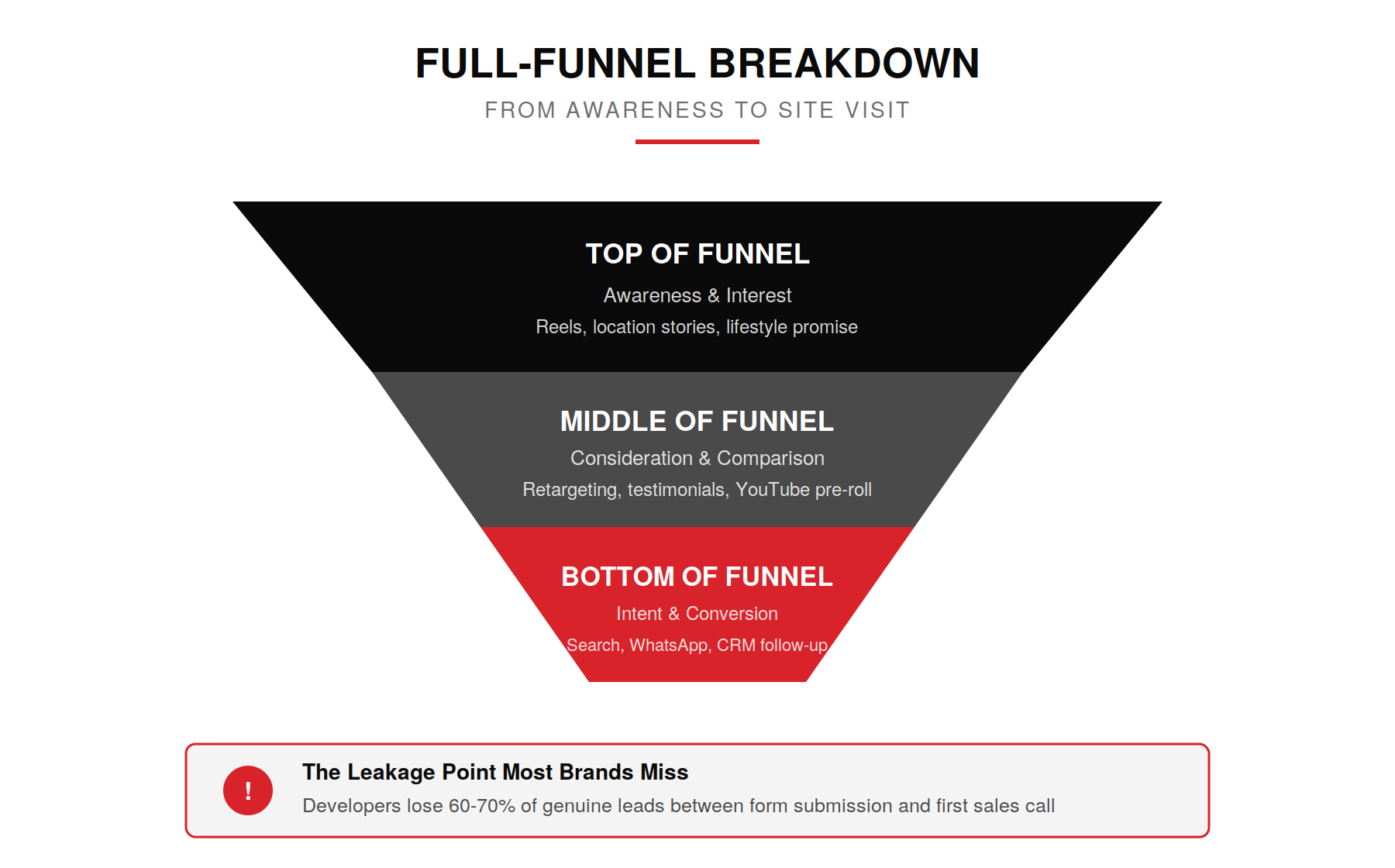
Top of Funnel: Awareness and Interest. Buyers in this stage are exploring. They are watching Instagram Reels of properties in neighbourhoods they find aspirational. They are searching “2BHK in [location]” on Google without a firm budget or timeline. The job at the top of funnel is to get your project into their consideration set before they become price-sensitive. Digital real estate marketing at this stage is about brand, location story, and lifestyle promise, not pricing.
Middle of Funnel: Consideration and Comparison. This is where the real estate digital marketing strategy must shift from awareness to substance. Buyers are now comparing two or three shortlisted projects. They are reading reviews, watching walkthrough videos, and looking for social proof. Retargeting campaigns, testimonial videos, Google Display ads, and YouTube pre-roll all serve this stage. The landing page needs to answer the top five objections every buyer in this segment carries.
Bottom of Funnel: Intent and Conversion. The buyer is ready to book a site visit or speak to a sales consultant. Google Search campaigns targeting high-intent keywords, WhatsApp automation sequences, and CRM-triggered follow-up calls are the tools here. A best digital marketing agency for real estate knows that conversion at this stage is less about creative and more about speed, relevance, and friction reduction.
The Leakage Point Most Brands Mis:s The average developer loses 60 to 70% of genuine leads between the form submission and the first sales call. This is not a marketing problem. It is a systems problem. Digital marketing strategies for real estate that are designed without CRM integration produce leads that evaporate. A genuinely full-funnel real estate marketing agency closes this loop before it becomes a complaint in your weekly sales review.
Even brands with significant budgets make the same set of errors. Recognising these is the first step toward fixing them.
Optimising for CPL instead of CPSite-Visit CPL is a vanity metric when lead quality is poor. The number that matters is cost per qualified site visit. A social media marketing agency for real estate that reports on CPL alone is optimising for the wrong thing. Ask your agency for CPSite-Visit data. If they cannot provide it, they are not connected to the part of the funnel that matters.
Running Project-Level Campaigns Without Brand Equit:y A developer with no brand equity pays more for every lead. When a buyer searches for an apartment in a specific area and recognises your brand name, they convert faster and at lower cost. Brands that run digital marketing for real estate exclusively at the project level, without any brand-building investment, are permanently on the treadmill.
Ignoring the Post-Lead Nurture Window: Research consistently shows that most property decisions take weeks, not days. A buyer who submits a form today may be ready to book three months from now. If your nurture sequence ends after three WhatsApp messages, you are handing that conversion to the next developer who stays in touch.
Choosing an Agency on Price, Not Proof. The cheapest digital marketing for real estate companies available is almost always the most expensive in the long run. The right question when evaluating a real estate marketing agency is not “what is your monthly retainer?” It is “show me a case study in my vertical with verified CPL benchmarks.”
Treating Digital Real Estate Marketing as a Campaign, Not Infrastructure. A campaign has a start date and an end date. A marketing system runs continuously, learns, and compounds. Brands that treat digital marketing strategies for real estate as a series of project launches rather than a permanent infrastructure investment will always be starting from zero when the next project goes on sale.
Before you sign a contract with any real estate marketing agency, ask these five questions:
Ask for verified CPL and site-visit conversion data from a project in your exact segment: luxury, affordable, plotted, or commercial. A luxury high-rise in Mumbai and a plotted development in a Tier-2 city behave nothing alike, so a case study from the wrong segment tells you very little about what the agency can do for you. If they cannot produce one, they have not done the work in your category.
This question separates agencies that run ads from agencies that run systems. Ask exactly what the lead handoff protocol looks like: which fields sync, how fast a new lead reaches your sales team, and whether the connection is native or held together with manual exports. An agency without a clear answer here is not wired into the part of the funnel where most leads are actually lost.
CPL should fall as a campaign matures, driven by retargeting warmth, quality score improvements, and landing page optimisation. Ask the agency to name a timeline, typically month four or five, and to explain what specifically drives the improvement. Vague answers like “it depends on the market” usually mean the agency has not run enough campaigns in your vertical to know.
The strongest campaigns start building warm audiences six to eight weeks before launch, not on launch day. Ask how far in advance their process begins, what content they use to seed interest, and how that pre-launch audience feeds into the retargeting pool once the campaign goes live. An agency that only thinks about marketing after the project is ready to sell is starting from zero every time.
The answer should be site visits booked, not leads generated. Ask what metric they report on weekly, whether they track cost per qualified site visit, and how they define a “quality” lead versus a raw form submission. An agency that reports on lead volume alone is optimising for the wrong number.
A real estate marketing agency that answers all five with specifics is worth your time. One that deflects with generalities is not.
The brands that scale in Indian real estate are not doing something exotic. They are doing the fundamentals at a high level, consistently, with a partner who understands the vertical. That is the whole story. The question is whether your current setup is delivering it.
A real estate marketing agency designs and executes the full end-to-end marketing system for property developers, channel partners, and brokerages. This includes paid media (Google and Meta Ads), SEO, landing page development, CRM integration, content marketing, social media, and performance analytics. The best agencies measure their work against business outcomes, site visits booked and units sold, not just lead volume.
Digital marketing for real estate operates on longer buying cycles, higher ticket values, and more complex buyer psychology than most consumer categories. A buyer purchasing a ₹1.5 crore apartment is not making an impulse decision. They are doing months of research, comparing multiple projects, and managing significant financial and emotional risk. Effective digital marketing for real estate agents and developers must be built for this journey, not against it.
For individual agents and channel partners, digital marketing for real estate agents means building a credible personal brand on LinkedIn and Instagram, running highly targeted paid campaigns for specific inventory, and maintaining a nurture system that keeps warm leads engaged over a multi-month cycle. The agents who scale are the ones who invest in their digital presence consistently, not just when they have a project to sell.
When evaluating a social media marketing agency for real estate, ask for vertical-specific case studies with verified CPL and site-visit conversion data. Ask how they connect social campaigns to CRM. Ask what their average campaign ramp time looks like and at what point they expect CPL to stabilise. Generic agencies will give you generic answers. Vertically experienced agencies will give you benchmarks.
The best digital marketing agency for real estate is the one with the deepest vertical track record in your specific segment, whether that is luxury residential, affordable housing, plotted development, or commercial property. Credentials matter: look for Google Partner status, platform certifications, and published case studies with verifiable metrics. Bright Brain’s Kalpataru Realty engagement, an 85% reduction in CPL, is the kind of result that comes from vertical depth, not vertical guesswork.
An effective real estate digital marketing strategy in 2026 is built on five layers: pre-launch audience building, high-converting landing pages, full-funnel paid media across platforms, CRM integration with lead nurture automation, and continuous performance analytics. Brands that execute all five consistently outperform those that run isolated campaigns, regardless of budget.
The most important digital marketing strategies for real estate in India right now are: pre-launch audience seeding on Meta and Google, high-intent Google Search campaigns, Instagram and YouTube video for project awareness, WhatsApp automation for lead nurture, and AI-assisted audience segmentation. The shift from single-platform campaigns to integrated systems is the defining difference between brands that compound and brands that plateau.
There is no universal benchmark, but the question is less about absolute spend and more about allocation. A developer spending ₹5 lakh per month on paid ads with no budget for landing page optimisation, CRM integration, or content is underinvesting in the infrastructure that makes ads work. Digital marketing for real estate companies that delivers consistent results typically allocates 20 to 30% of total marketing spend to system infrastructure and not just media buying.