Most marketing heads do not have a programmatic problem. They have a jargon problem.
You have sat through agency decks full of DSPs, SSPs, RTB, and cohort modelling, and walked out no clearer than when you walked in. The acronyms multiply. The actual mechanics stay hidden. That confusion is exactly how some vendors keep you dependent.
“Nine times out of ten, when a client says programmatic doesn’t work, the truth is nobody ever explained what they were paying for.”
Here is the plain version. Programmatic advertising is just buying ad space with software instead of phone calls and emails. A machine evaluates each available ad slot, decides whether your target customer is likely to see it, and bids for that slot in milliseconds. No human haggling. No fixed monthly rate cards.
This matters for one reason. In India, programmatic ads now make up a huge share of digital spend, so understanding them is no longer optional for any serious marketing leader. The brands winning right now are not the ones with the biggest budgets. They are the ones who understand where their money actually goes.
Direct answer: Programmatic replaces manual ad buying. Instead of negotiating a fixed deal with one website, software buys individual ad impressions across thousands of sites and apps in real time, targeting people rather than placements.
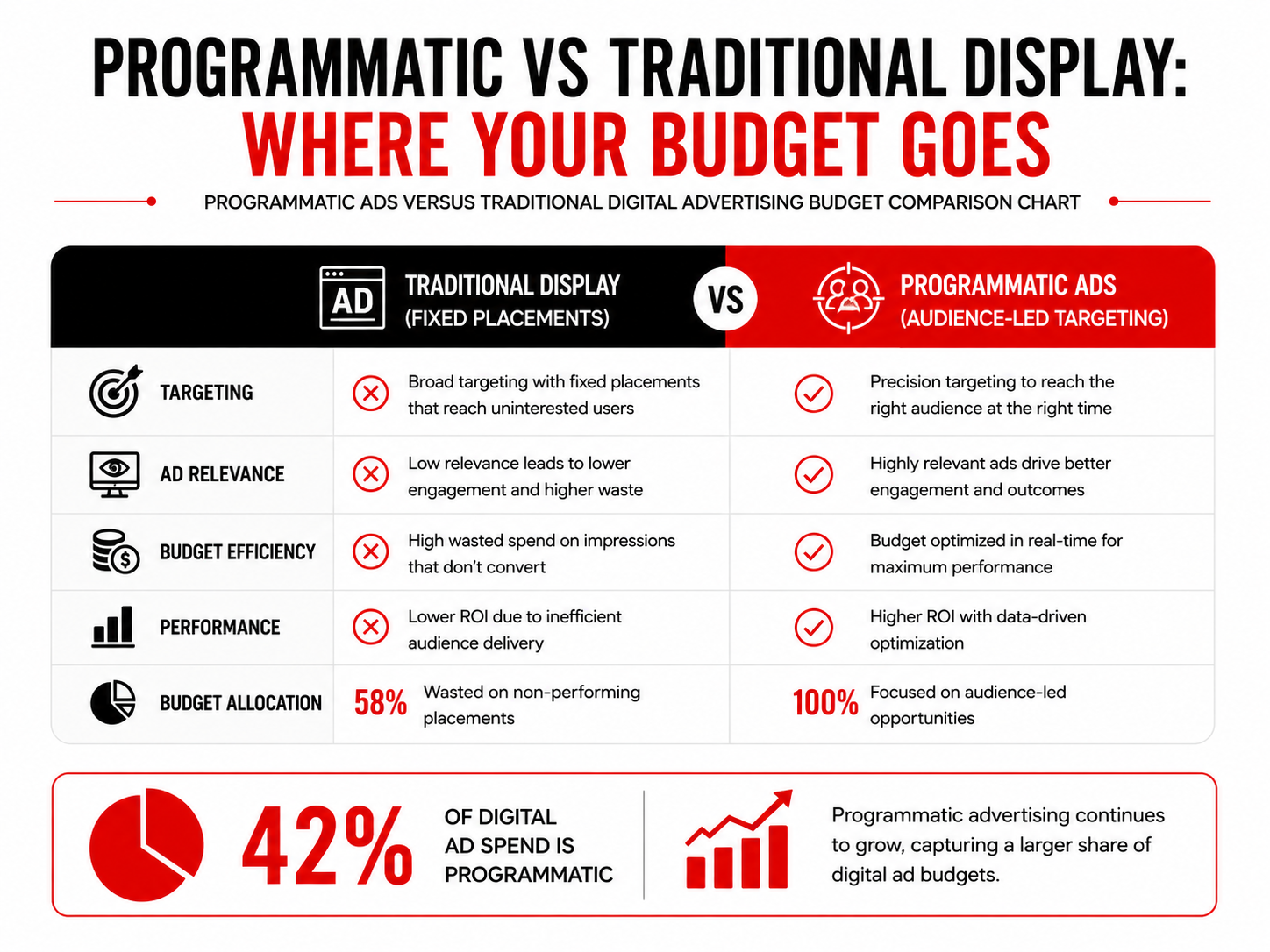
Traditional digital advertising worked like renting a billboard. You picked a site, agreed a price for a month, and hoped the right people walked past. You paid for the location, not the audience.
Manual buying, the weakness: You pay for guaranteed placement on one site, even when half the visitors are irrelevant to your product.
Programmatic buying, the fix: You pay to reach a defined audience wherever they go, so spend follows the person, not the page.
Flat monthly rates, the weakness: You lock budget into a slot regardless of whether it performs that week.
Real-time bidding, the fix: You bid per impression, so weak placements get dropped automatically and budget shifts to what works.
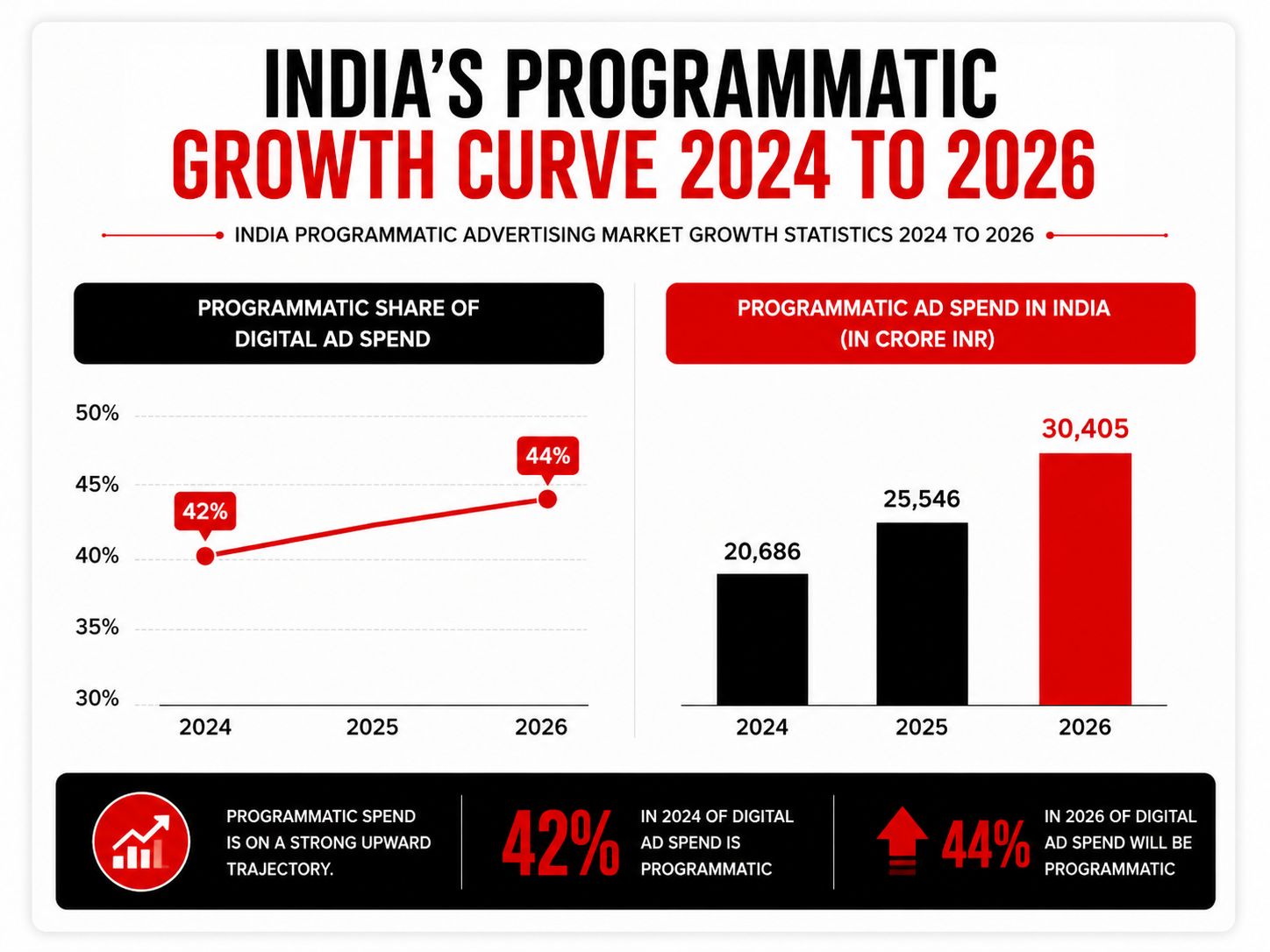
Stat: Programmatic buying contributed 42% (Rs 20,686 crore) of India’s digital media spend by the end of 2024, growing 21% over the previous year.
That is not a niche tactic anymore. That is nearly half the market.
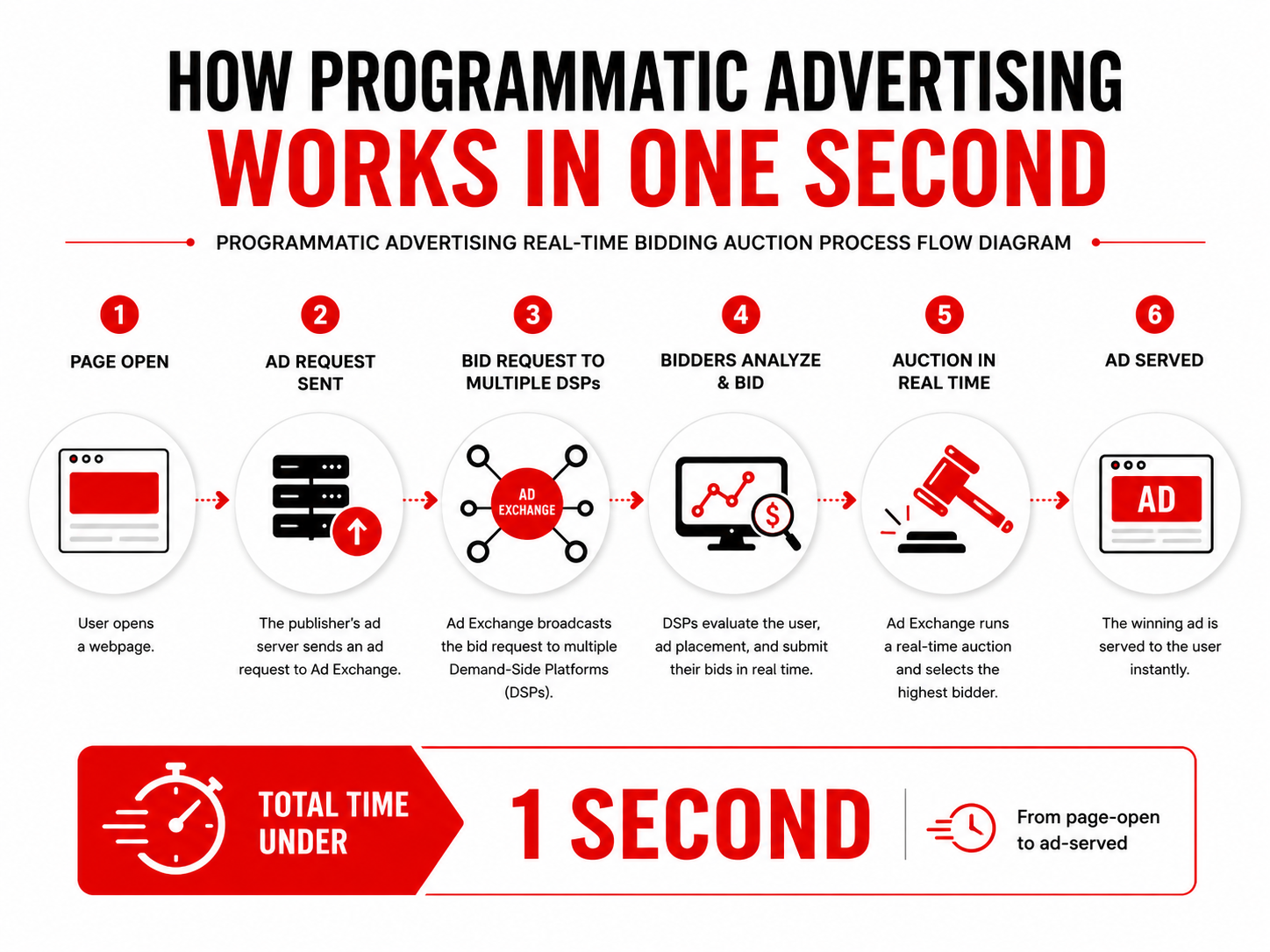
Direct answer: When someone opens an app or website, an automated auction happens in under a second. Advertisers bid to show that exact person an ad. The highest relevant bid wins, the ad loads, and the cycle repeats billions of times a day.
Think of it as a stock exchange for attention. Three parties make it run, and you only need to grasp the roles, not the labels.
On one side sits the buying platform, where you load your budget, audience, and goals. On the other sits the selling platform, where publishers list their available ad space. A real-time auction connects the two. Your programmatic ads compete for each slot based on how valuable that viewer is to you.
The auction is fast. The intelligence is in the targeting. Good campaigns use first-party data, location signals, and behaviour patterns to decide who is worth bidding on. Weak campaigns bid on everyone and burn cash. This is why a skilled programmatic agency matters more than the platform itself.
Stat: India’s programmatic market is projected to reach 44% of digital ad spend, around Rs 30,405 crore, by 2026, at a CAGR of 21.24%.
As a Google Elevator Partner, one of only 15 agencies selected from over 7,000 across India, Bright Brain builds these targeting systems daily. The platform is rented. The strategy is earned.
Direct answer: Programmatic wins when your audience is specific, scattered across many sites, and worth tracking to a real outcome. Traditional display still works for broad brand awareness on a single trusted property, but it wastes spend on precise, conversion-led goals.
Most marketing heads assume the choice is technical. It is not. It is about how clearly you can define a buyer.
If you sell premium real estate in Mumbai, a flat ad on one property portal reaches everyone, including renters and window-shoppers. Programmatic advertising lets you target households by income signals, location, and intent, then follow them across news sites, apps, and connected TV. Every rupee chases a likely buyer.
For a one-week launch where you just want maximum eyeballs on a single high-traffic site, a direct digital advertising buy can be cleaner and cheaper to manage. Not every campaign needs an auction engine. The skill is knowing which is which, and a good programmatic ads agency will tell you honestly when programmatic is overkill.
The honest test is simple. If you can name your ideal customer in one sentence and tie them to an outcome, programmatic almost always wins.
Direct answer: Strong programmatic campaigns are measured by cost per qualified lead and conversions, not impressions. The best programmatic advertising platforms are only as good as the targeting and funnel logic behind them. Software does not create results. Strategy does.
The biggest myth is that the platform decides the outcome. It does not. The same tool that wastes one brand’s budget transforms another’s, because the difference sits in the setup and in the programmatic agency running it.
A leading channel partner in Mumbai achieved over 300 conversions with a 10% click-through rate at a cost per lead of Rs 6,000 to 9,000, holding a 95% impression share. The campaign did not simply buy more ads. It restructured targeting and bidding so that spend concentrated on high-intent buyers. This kind of improvement is exactly what separates managed programmatic from set-and-forget media buying.
Stat: India’s programmatic advertising market is projected to grow at roughly 26% CAGR through 2030, among the fastest in Asia Pacific.
The same logic extends to video. An experienced OTT advertising agency applies identical precision to connected TV, where viewers watch premium content on smart screens. Done well, an OTT ad agency turns the living room into a measurable channel, not a guess. That is the promise of programmatic kept honest: every screen, accountable.
Start by defining your audience and outcome, then audit your data, then pick a partner, and only then launch. Most failures come from buying media before the foundation exists. Sequence matters as much as effort.
Doing the right things in the wrong order wastes budget. Most brands skip straight to step four, launch a campaign, watch it underperform, and blame the channel. The channel was never the problem. The missing groundwork was. Here is the sequence that works, with the thinking behind each step.
Write down exactly who you want and what action counts as success. Be specific. A real estate brand chasing site visits from buyers with a budget above one crore is a sharp target. A brand that wants more leads is not. The clearer this definition, the smarter every bid becomes. Vague inputs produce vague spend, and the auction cannot fix a brief that was never clear.
Check what first-party data you actually hold, because targeting is only as strong as your inputs. Customer lists, website visitors, past enquiries, and CRM records are the fuel that makes programmatic precise. Most brands are sitting on far more usable data than they realise, while a few overestimate what they have. Know which camp you are in before you spend, not after.
Ask any programmatic ads company how they measure success and whether they share platform access transparently. The right partner will talk about cost per qualified lead and conversions before they mention impressions. The wrong one hides behind dashboards you cannot read. Ask who owns the ad accounts, ask to see the raw numbers, and ask what happens to your data. If the answers are evasive, keep looking.
Launch one tightly targeted campaign before scaling spend. A pilot exists to test your assumptions cheaply, not to win immediately. Pick one audience, one clear offer, and a modest budget. Let it gather enough data to tell you something real. Resist the urge to change everything every two days, because the system needs room to learn before it can optimise.
Judge cost per qualified lead and conversions, not vanity impressions. A campaign with millions of views and no enquiries is a failure dressed as success. Look at what each lead costs, how many convert, and whether the quality matches what your sales team can actually close. These numbers tell you where to push and where to pull back.
Shift budget toward winning audiences and cut the rest without sentiment. Programmatic rewards brands that act on evidence quickly. When one audience or creative outperforms, feed it more. When another stalls, stop funding it. This constant reallocation, repeated week after week, is where the real efficiency compounds over time.
Most well-run campaigns show meaningful signal within 30 to 60 days. That does not mean a finished, fully optimised machine in two months. It means clear early evidence of what is working and what is not. If a partner cannot show you that progress in that window, ask why before you commit more budget. A good agency welcomes the question. A weak one deflects it.
Programmatic advertising is not the black box vendors make it out to be. At its core, it is software buying the right audience instead of a human buying the right page. Once you strip away the acronyms, the decision becomes clear. If you can name your buyer and tie them to a real outcome, programmatic ads will almost always stretch your budget further than a flat display buy.
In India, this is no longer a frontier experiment. With programmatic already near half of all digital spend and growing fast, the brands that understand it now will hold the advantage over those who keep treating it as a mystery. The platform matters far less than the strategy and the team behind it.
If you want a partner that explains every rupee rather than hides behind jargon, that is the standard worth holding any programmatic ads agency to. Learn more about how a transparent, full-funnel approach can turn programmatic from a confusing line item into your most accountable channel.
Programmatic advertising is the use of software to buy and sell digital ad space automatically. Instead of negotiating deals manually, algorithms bid for individual ad impressions in real time, placing your ad in front of a defined audience across websites, apps, and connected TV.
Traditional digital advertising buys fixed placements on chosen sites for set prices. Programmatic buys individual impressions through real-time auctions, targeting people rather than pages. This means your budget follows your audience wherever they go, reducing wasted spend on irrelevant viewers.
Yes, for most brands with a defined audience. Programmatic ads contributed 42% of India’s digital media spend in 2024, and adoption keeps rising. It works best when you can tie spend to a clear outcome like leads, bookings, or sales rather than just impressions.
Ask how they measure success, whether they give transparent platform access, and what their fee covers. A trustworthy programmatic agency reports on cost per qualified lead and conversions, not vanity metrics, and explains where every rupee of your budget actually goes.
The leading platforms include Google’s Display and Video 360, The Trade Desk, and Amazon’s ad suite. However, the platform matters less than the strategy. The best programmatic advertising platforms still depend on strong targeting, clean data, and funnel logic to deliver real results.
Yes. An OTT advertising agency uses programmatic to place ads inside streaming content on smart TVs, targeting viewers by audience signals rather than broad slots. A skilled OTT ad agency makes connected TV measurable, turning premium video into a trackable, accountable channel.