This is the pattern most D2C founders in India describe at the 18-month mark. They started with a Meta campaign that worked. They scaled the budget. CAC climbed. They tried Google. CAC climbed there too. They hired an ecommerce performance marketing agency. CAC stabilised for a quarter, then climbed again.
The problem isn’t the platform. It isn’t the agency. It’s the assumption underneath the spend: that more budget produces more revenue, and that the fix for rising CAC is a better ad.
It’s not. The fix is a better funnel.
The D2C brands in India that are reducing CAC and scaling revenue in 2026 aren’t spending more. They’re converting better, on the landing page, in the cart, and across the retargeting sequence. The ad is the last thing that needs fixing. The funnel is where the work happens. This is exactly where many generic performance marketing agencies fall short: they optimise the ad, not the system behind it. It’s also why brands increasingly shortlist a specialist ecommerce performance marketing agency rather than a generalist shop for this work.
Here’s what that looks like in practice.
Customer acquisition cost has risen across every major performance marketing platform in India over the past three years. Meta CPMs have increased. Google CPC in competitive categories has risen. The D2C boom brought more brands into the auction, which means more competition for the same attention, at higher prices.
This is structural, not temporary. And it means the playbook that worked in 2021- run a broad Meta campaign, find a winning creative, scale the budget- produces progressively worse economics in 2026.
The brands that understand this have stopped treating performance marketing as an advertising problem and started treating it as a conversion problem. They’re asking: not “how do I reach more people?” but “why aren’t the people I’m already reaching buying?” This shift in thinking is usually what separates the best performance marketing agencies from the ones still selling reach, and it’s reflected in how they scope their performance marketing services from day one.
The answer is almost always in the funnel:
Fixing these isn’t an ad problem. It’s a conversion rate optimisation (CRO) problem, and it’s the highest-ROI investment a D2C brand can make before scaling ad spend. It’s also one of the clearest signs of a genuine performance based marketing agency: one that treats conversion, not just clicks, as the product. Most brands only learn this after their first ecommerce performance marketing agency engagement fails to move CAC despite a flawless media plan.
Google Shopping is the highest-intent channel in the D2C performance marketing stack. When someone searches for a specific product, “bamboo toothbrush India,” “whey protein 5kg price,” “leather wallet men India”, they’re not browsing. They’re ready to buy. Showing up in that moment with the right product, the right price, and a compelling product image is what Google Shopping does.
For D2C brands, Google Shopping campaigns require three things to work:
Google Search Ads complement Shopping by capturing category and brand queries, “best protein powder India,” “your brand vs competitor.” These are mid-funnel buyers who are still evaluating, and ad copy that addresses their specific comparison or concern converts significantly better than generic brand ads. This is the layer of performance marketing services most retail brands underinvest in relative to Shopping and social, and it’s a gap most performance marketing agencies are happy to point out during a first audit.
Meta (Facebook and Instagram) operates at two ends of the D2C funnel simultaneously.
At the top: awareness and consideration campaigns that introduce the brand to audiences who match the profile of existing customers. Meta’s lookalike audience capability, building a targeting pool based on your existing buyer data, is one of the most powerful prospecting tools available for D2C brands when properly seeded.
At the bottom: retargeting campaigns that recover visitors who viewed a product but didn’t purchase; industry data consistently places this browse-abandonment rate between 70-80% [publisher: verify against current Baymard Institute or similar source before publishing]. A well-structured retargeting sequence moves a prospect from “I saw this product” to “I almost bought this” to “I’m getting a reason to buy now”, with different creative, different offers, and different urgency at each stage.
The D2C brands that mismanage Meta are the ones running single-phase campaigns: broad prospecting to a cold audience, direct response creative, expectation of immediate conversion. That approach worked in 2020. In 2026, it’s expensive and inconsistent. The funnel needs to be built: awareness to consideration to conversion, with Meta serving different content at each stage. A digital performance marketing agency worth the retainer will insist on this staged structure before touching budget, and a true performance based digital marketing agency will tie every stage back to a CPA or ROAS target rather than reach.
For D2C brands that sell on Amazon, and most now do, even if their own website is their primary channel, Amazon Ads are the highest-intent placement in existence. Someone browsing protein supplements on Amazon is not in the awareness phase. They’re in the purchase phase.
Amazon Sponsored Products, Sponsored Brands, and Display placements within Amazon’s ecosystem capture this buyer at the closest possible moment to purchase. For brands in competitive categories where Amazon accounts for a significant share of category discovery, ignoring Amazon Ads is leaving revenue on the table. Managing this well is exactly the kind of specialised retail performance marketing agency work that a generalist digital shop often can’t replicate, and it’s one reason many D2C brands eventually hire a dedicated retail performance marketing agency just for their marketplace presence.
Amazon DSP extends this capability beyond Amazon’s ecosystem, retargeting Amazon’s audience data on third-party websites and apps, reaching high-intent buyers who’ve shown purchase signals on Amazon but are browsing elsewhere.
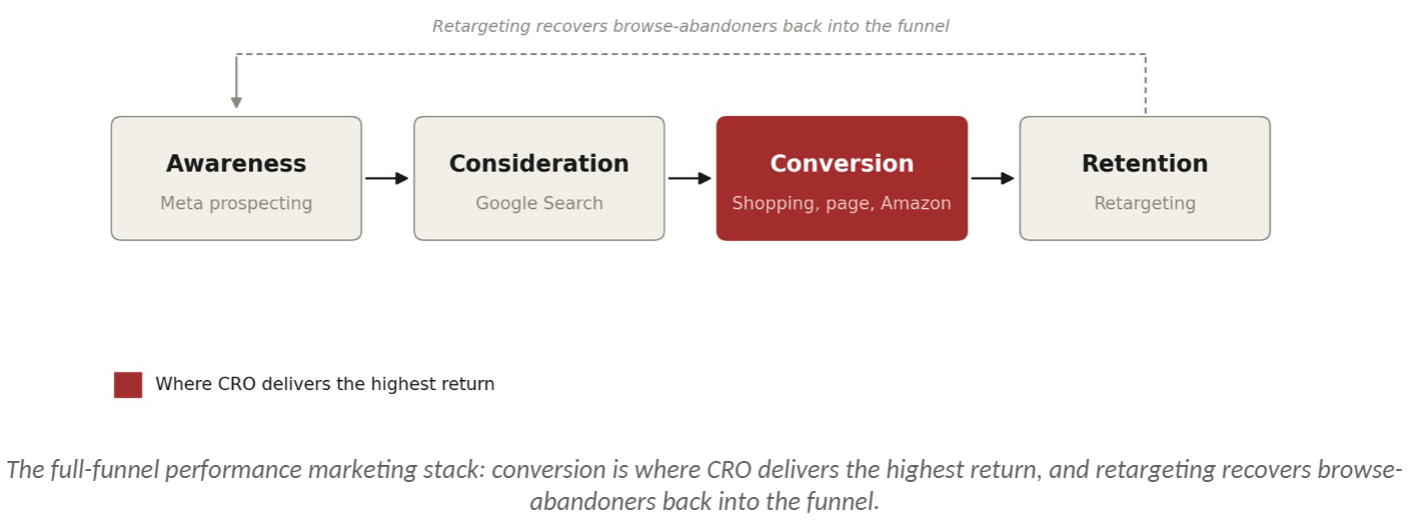
This is the lever most performance marketing agencies don’t help D2C brands with, and it’s the one with the highest return.
A landing page converting at 2% produces 200 sales from 10,000 visitors. The same traffic to a landing page converting at 4% produces 400 sales. The ad spend is identical. The revenue doubles.
Conversion rate optimisation for D2C landing pages covers:
The brands that treat landing page CRO as part of performance marketing, not a separate website project, consistently outperform the ones that hand the agency the landing page and say “do your best.” This is the single clearest differentiator between an ecommerce performance marketing agency that understands D2C and one that’s simply running media buys. Bundling CRO into the retainer, rather than billing it as a separate project, is quickly becoming standard across serious performance marketing services providers.
Performance marketing for D2C becomes a feedback loop when attribution is set up correctly. The signal from what converts- which creative, which audience, which offer, which page- tells you where to scale and where to stop.
Most D2C brands in India are running attribution on last-click, which means Meta gets credit for every sale where a Meta ad was the last touch before purchase, regardless of what else influenced the buyer. This systematically undervalues Google and SEO’s contribution and overvalues Meta’s direct-response campaigns.
A full-funnel attribution model, even a simple first-touch plus last-touch blended view, gives a clearer picture of where the customer journey actually starts and where it converts. That picture determines where budget goes next, and it’s one of the core performance marketing agency services worth paying for over a self-managed dashboard. Building and maintaining this kind of model is precisely what separates a real performance based marketing agency from one that simply resells platform reports.
Society Tea was a growing premium tea brand with strong product-market fit but a performance marketing programme that wasn’t producing the economics the brand needed to scale.
The brief to Bright Brain: reduce CAC, improve return on ad spend, and build a performance marketing system that supports revenue growth.
The approach: a full-funnel rebuild across Meta and Google, anchored in conversion rate optimisation on the product and cart pages, with a structured retargeting sequence recovering abandoned browsers and buyers.
The results: 3x orders. 2.8x digital revenue. 2x reduction in CPA. Not from a larger budget, but from a better-built funnel with more efficient ad spend behind it. Results like these are the standard any credible ecommerce performance marketing agency should be measured against, not impressions or reach, and they’re the kind of proof point that separates the best performance marketing agencies from the ones only offering media buying.
Bioclean Septic, a different category, same principle. Bright Brain’s performance marketing work delivered 60% revenue growth without additional ad spend. The improvement came entirely from conversion optimisation and campaign restructuring, not from increasing the budget.
These results share a common structure: fix the conversion rate first, then scale the spend. The brands that invert this, scale the spend, then wonder why CAC keeps rising, are the ones on the wrong side of the pattern.
Mistake 1: Scaling spend before fixing conversion. The single most expensive mistake in D2C performance marketing. A campaign converting at 1.5% that gets 3x the budget now converts at 1.5% with 3x the cost. CAC stays exactly where it was, or rises slightly as the broader audience targeting dilutes quality. Fix the conversion rate first. Then scale. It’s the first thing any experienced ecommerce performance marketing agency will check before recommending a single rupee of extra spend, and it’s a check most performance marketing agencies build into month one of any new engagement.
Mistake 2: Running the same creative across the full funnel. A prospecting creative needs to do a different job than a retargeting creative. The cold audience hasn’t heard of the brand; the creative needs to introduce, build intrigue, and move them to the product page. The retargeting audience has seen the product; the creative needs to address the specific objection that stopped them from buying. The same video or static used across both audiences is half as effective in both placements.
Mistake 3: Treating platforms as separate channels instead of a coordinated system. Meta and Google are not alternatives. They’re complements. A buyer who sees a brand on Meta, searches for it on Google, clicks a Shopping result, and buys- that’s a multi-touch journey that both platforms influenced. Optimising Meta and Google independently, with separate teams, separate budgets, and separate attribution models, produces a version of performance marketing that’s less than the sum of its parts. It’s exactly the mistake a genuine performance based digital marketing agency is built to prevent by managing both channels under one attribution view, and it’s why so many brands eventually consolidate every channel under one ecommerce performance marketing agency instead of running separate vendors.
The right ecommerce performance marketing agency for a D2C brand needs to demonstrate the following, since most performance marketing agencies fall short on at least one of these:
Not every generalist digital shop can offer this. A dedicated digital performance marketing agency, or one of the genuinely best performance marketing agencies working in the D2C space specifically, will already have this checklist built into their onboarding process rather than figuring it out mid-engagement. Whether you call it performance marketing agency services, performance marketing services, or simply performance marketing, the checklist above doesn’t change: it’s still Google, Meta, Amazon, and CRO working as one system.
Bright Brain is a Google Elevator Partner and Amazon Ads Partner with performance marketing case studies across D2C and e-commerce brands: Society Tea (3x orders, 2.8x revenue), Bioclean Septic (60% revenue growth), Nasher Miles (46.66% organic traffic improvement in 6 months), and Richfeel Naturals (70% CVR increase, 50% revenue boost without additional spend). This is the track record we bring to every engagement as a full-scope ecommerce performance marketing agency, whether the client sells primarily on Amazon, on Shopify, or across both. It’s also the reason many brands specifically call us a retail performance marketing agency rather than a general digital agency, since so much of that track record sits inside marketplace and retail ecosystems.
In practice, the label matters far less than the system behind it. Whether a brand is comparing a performance based digital marketing agency against an in-house team, or simply asking whether their current performance based marketing agency is earning its retainer, the same test applies: does spend go up only after conversion is fixed, or before?
Q1: What is the ideal ROAS for D2C performance marketing in India?
Target ROAS varies by category, margin, and growth stage. Brands with 50-60% margins typically target a blended ROAS of 3-5x; lower-margin categories can sustain 2-3x if LTV justifies it. Any competent ecommerce performance marketing agency, ideally one of the best performance marketing agencies, will set this number from your margins, not an industry benchmark.
Q2: How much should a D2C brand spend on performance marketing in India?
There’s no fixed percentage. Early-stage brands should spend the minimum needed to gather conversion data, not scale. Growth-stage brands typically allocate 20-40% of revenue to paid acquisition, scaling once CPA is profitable- a check any performance based marketing agency should run before proposing a budget.
Q3: Is Meta or Google better for D2C performance marketing?
Neither alone, both together. Google captures high-intent buyers already searching; Meta builds audience and retargets. The best performance marketing agencies run both as one system; hiring a single digital performance marketing agency, ideally a genuine performance based digital marketing agency, beats splitting work between a retail performance marketing agency and a separate performance based marketing agency.
Q4: How long does it take to optimise a D2C performance marketing campaign?
A new campaign typically needs 4-8 weeks of data before meaningful optimisation decisions can be made: audience testing, creative performance, landing page conversion signal. Avoid structural changes (audience, budget, creative) in the first 2 weeks while algorithms are still learning; a timeline any experienced ecommerce performance marketing agency will set expectations around upfront.
Q5: What is a good CAC for a D2C brand in India?
CAC only means something relative to lifetime value (LTV). A ₹500 CAC looks different against a ₹3,000 order value with 20% repeat purchase than against a ₹1,200 product with 60% repeat. Aim for an LTV: CAC ratio of 3:1 or higher; below 2:1, acquisition is unsustainable, regardless of how good the performance marketing agency services on paper look.
Q6: How important is creative quality in D2C performance marketing?
Creative is the highest-leverage variable in Meta performance marketing. A sharper, authentic creative aligned to the real objection can double or triple results from the same budget. Test 3-5 variants, separating a genuine performance-based digital marketing agency and solid performance marketing agency services from a digital performance marketing agency running the same static ad for months.
Q7: What should a retail or D2C brand look for specifically in a marketplace-focused partner?
Look for a dedicated retail performance marketing agency with direct Amazon Ads Partner status, not just Google and Meta credentials. A generalist digital performance marketing agency without marketplace experience typically underdelivers on bidding logic and DSP retargeting. Strong partners pair performance marketing agency services with benchmarked performance marketing services, ranking among the best performance marketing agencies in retail specifically.