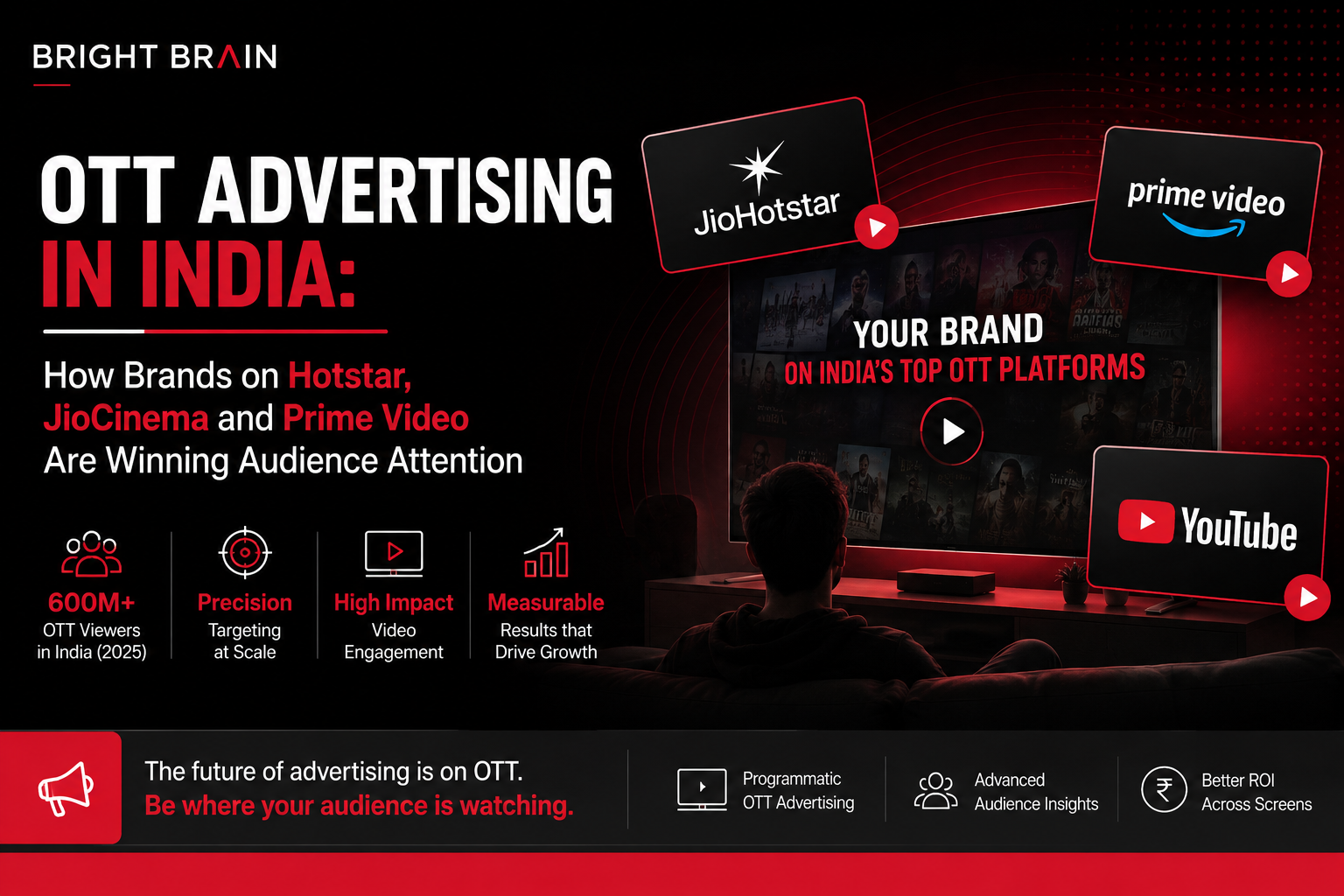
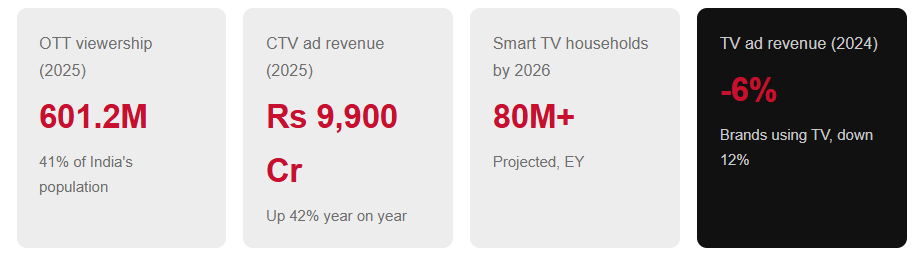
Television advertising revenue in India fell 6% in 2024, according to the FICCI-EY Media and Entertainment Report 2025. The number of brands actively using television as an advertising medium declined by 12% in the same year. These are not rounding errors. They are a structural signal.
The audience did not disappear. It moved.
India’s OTT viewership reached 601.2 million in 2025, representing 41% of the total population, according to Media Partners Asia. Connected TV advertising revenues surged 42% to an estimated Rs 9,900 crore in 2025, per the EY Media and Entertainment Report 2026. More than 80 million Indian households are expected to own a Smart TV by 2026.
For any brand that wants reach, this is where reach lives now.
The difference from broadcast television is not just scale. It is targeting precision. OTT advertising gives brands demographic filters, content-genre alignment, geographic precision down to the city or postal cluster, and device-level targeting, all in one campaign. Traditional television gave you a time slot and a hope. OTT advertising gives you an audience segment and a measurement framework. For any brand serious about reaching this audience efficiently, working with a qualified OTT ads agency is where the planning conversation starts.
The brands winning attention in India’s streaming market today are not winning because they have the largest budgets. They are winning because they have the right agency architecture: the right platform mix, the right creative format for each context, and a programmatic advertising layer that optimises spend in real time.
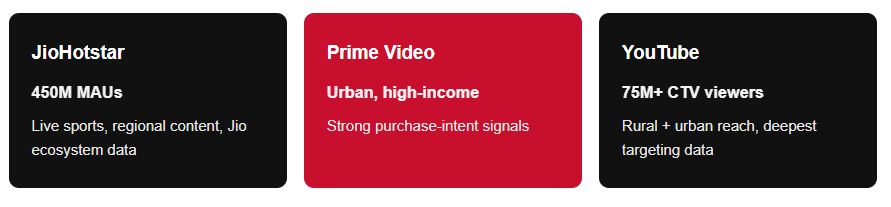
India’s OTT landscape is dominated by three platforms that together account for the majority of premium streaming attention. Each serves a different audience profile and demands a different planning approach.
JioHotstar is the result of the February 2025 merger between Reliance’s Viacom18 (which owned JioCinema) and Walt Disney’s Star India (which owned Disney+ Hotstar). The merged platform serves 450 million monthly active users, has crossed 100 million paid subscribers (the first Indian OTT to do so), and holds approximately 50% of SVOD subscriber volume in India. Its content library spans IPL, ICC cricket, Disney originals, Marvel, HBO, and over three lakh hours of programming across 19 languages.
For advertisers, JioHotstar’s advantage is breadth combined with Jio ecosystem data. Location signals, device usage, mobile network data, and consumption patterns from across the Jio ecosystem allow audience segmentation that goes beyond what a platform-only data set can produce. The platform also opened a self-serve advertising manager in 2026, similar in structure to Google Ads, which allows brands to plan, launch, and manage campaigns directly.
Amazon Prime Video reaches India’s urban, digitally mature households. Prime subscribers skew toward higher-income brackets and have demonstrated transactional intent (they already pay for a subscription and shop on Amazon). For brands in D2C, BFSI, and premium consumer goods, Prime Video audiences carry inherently stronger purchase-intent signals than an open-access ad-supported platform would. Choosing the right mix of these platforms is one of the core decisions an OTT advertising agency makes before a campaign brief is written.
YouTube is the most underestimated platform in OTT planning conversations. It generates Rs 14,300 crore in advertising and subscription revenue in FY 2024-25, capturing 37.7% of total digital media revenue in India, per the FICCI-EY 2025 report. Its connected TV audience now exceeds 75 million viewers in India. It operates across rural and urban geographies, in 20+ Indian languages, with targeting depth that no other streaming platform matches. Brands that treat video ads on YouTube as a separate “social media” budget and OTT as a distinct TV-replacement budget are running two strategies where one integrated approach would perform better.
A competent OTT ads agency plans across all three platforms, allocates by audience fit, and uses unified attribution to read performance.
The format choice is not aesthetic. It is strategic. Each format serves a different moment in the viewer’s attention arc, and matching format to objective is where campaigns gain or lose efficiency.
Pre-roll ads run before content begins, when the viewer has the highest intent to watch and is not yet in passive consumption mode. They are best suited to brand awareness and product launches where the message needs full attention in the first five seconds. Completion rates are highest for pre-roll when creative is tightly written and under 20 seconds.
Mid-roll ads interrupt content at natural pauses, typically during live sports or episodic programming. This is the premium placement for live events: IPL, cricket series, premium web series, where contextual relevance is high. Brands running mid-roll during IPL on JioHotstar are placing video ads on YouTube and connected TV simultaneously for many of those viewers, who multi-screen through peak moments.
Pause ads and interactive ads appear when a viewer pauses content. They carry no audio and rely entirely on visual impact. They have low annoyance scores and high recall for visually sharp creative. Shoppable carousel formats on JioHotstar allow brands to present product options directly in the viewing experience, shortening the path from awareness to consideration.
Connected TV (CTV) masthead placements give brands the big-screen impact of television with the audience precision of digital advertising. CTV ad completion rates exceed 90%, significantly above any desktop or mobile equivalent, making them the highest-quality impression in a brand’s media plan.
The format layer connects directly to the creative brief. A brand running a 6-second bumper during live cricket is writing a different brief from a brand running a 30-second interactive pre-roll during a premium drama series. An experienced OTT ads agency briefs creative by format and platform, not by generic “video ad” specifications.
Programmatic advertising is the automated buying and selling of ad inventory in real time, using data signals to match the right message to the right viewer at the right moment. In the OTT context, it is what separates a media plan from a performance system.
Traditional OTT media buying worked on reservations: a brand negotiated a fixed number of impressions on a given platform, paid a rate, and received a post-campaign report. Automated programmatic buying inverts that model. The ad buy happens in milliseconds, in an automated auction, at the moment a specific viewer is about to see a placement. The brand’s bid reflects the value of that specific viewer to that specific campaign, not the average value of a platform’s audience.
The business impact for advertisers is measurable. A programmatic ads agency operating on demand-side platforms (DSPs) like The Trade Desk can target by content genre, viewer demographics, geographic granularity, device type, time of day, and first-party audience data overlays simultaneously. They can set frequency caps so the same viewer does not see the same ad six times in a day. They can run A/B tests on creative variants and reallocate budget in real time toward the better performer. This capability is what separates a programmatic ads agency from a traditional media buyer: the campaign optimises itself between report cycles, not just at the end of the flight.
For brands in high-frequency purchase categories (FMCG, D2C, EdTech), programmatic advertising allows retargeting: a viewer who has visited the brand’s website can be served a contextually relevant message while watching a drama on JioHotstar that evening. The attribution loop closes in a way broadcast television cannot replicate.
Programmatic ads agency expertise is not optional for OTT campaigns at meaningful scale. The platform interfaces exist. The self-serve tools exist. But the difference between an account that burns budget and an account that generates measurable ROI is the strategic layer: audience architecture, bid strategy, creative sequencing, and attribution modelling. That layer is what a specialist OTT ads agency provides. Brands that skip this layer consistently report the same outcome: strong impression delivery, weak business results.
A section on OTT advertising in India that treats YouTube as a footnote is incomplete. It is the largest digital advertising platform in India by revenue share, the dominant connected TV service by audience volume, and the only platform that reaches rural India at scale.
Video ads on YouTube span a format range no other OTT platform matches: 6-second non-skippable bumpers, 15-second skippable TrueView in-stream, 30-second non-skippable pre-roll, YouTube Shorts ads (vertical, under 60 seconds), masthead placements on the YouTube homepage, and connected TV inventory across Smart TVs. Each format has distinct CPM profiles, creative requirements, and performance characteristics.
YouTube ad campaigns benefit from Google’s first-party audience data, which is the deepest and most current data set available to advertisers in India. Custom intent audiences built on search behaviour, demographic overlays from Gmail and Maps, and in-market segments based on product category interest are all available within YouTube ad campaigns on the Google Ads platform. These signals are not available through any independent OTT platform.
YouTube channel promotion deserves its own mention. For brands building long-form content assets (product demonstrations, testimonials, educational content), YouTube channel promotion through paid seeding builds an organic audience alongside paid reach. A well-structured YouTube channel promotion strategy compounds: paid campaigns seed initial viewership, which drives subscriptions, which generate free reach for every subsequent piece of content. Brands in EdTech, Real Estate, and B2B services find YouTube channel promotion particularly effective for building trust with audiences who research extensively before purchasing. Paired with YouTube ad campaigns, a channel-building programme turns paid reach into an owned asset over time. Running YouTube ad campaigns without a channel strategy is like running search ads without a landing page: the traffic arrives, but there is nowhere meaningful for it to go.
For an OTT advertising agency managing integrated digital advertising across platforms, YouTube connects the performance layer (search intent, retargeting) to the upper funnel (CTV awareness, reach campaigns) in a single account structure. That connectivity is a planning advantage no other platform currently offers at India’s scale.
The mistake most brands make is treating OTT as a single channel. It is a collection of channels with overlapping but distinct audiences, distinct creative requirements, and distinct performance characteristics.
A multi-platform strategy starts with audience mapping, not platform selection. The question is not “should we be on JioHotstar or Prime Video?” The question is “where does my target audience spend time, and in what content context?” Platform selection follows that answer. A qualified programmatic ads agency runs this audience analysis before touching the buying platform. It is the difference between a media plan and a media guess.
Once platforms are selected, the creative brief must be platform-specific. A 30-second brand film that runs on Prime Video’s drama inventory should not be the same cut that runs as a 6-second bumper during IPL on JioHotstar. Attention context, screen size, and viewer state differ significantly. An OTT ads agency that accepts a single master creative and deploys it across all platforms is optimising for convenience, not performance.
Budget allocation needs a weighting model. For a brand building awareness in a new geography, CTV masthead placements and high-reach programmatic buys during live sports make sense as a starting allocation. For a D2C brand with a strong first-party customer list, retargeting through programmatic advertising on YouTube and mid-roll placements on JioHotstar are higher-efficiency moves.
Measurement architecture must be agreed before the campaign launches, not after. What counts as a completion? What is the attribution window? How does the brand connect an OTT impression to an eventual purchase, sign-up, or store visit? A programmatic ads agency with cross-platform attribution experience builds this into the media plan from day one. Without it, OTT budget gets measured on last-touch and consistently underperforms expectations: not because the channel failed, but because the measurement model did.
The right OTT ads agency partner does not just buy inventory. It builds the measurement architecture that makes the investment legible. And a specialist OTT advertising agency brings the creative production guidance, trafficking setup, and real-time optimisation that turns a structured media plan into a performing campaign. Every brand running meaningful advertising services investment across OTT should have a structured attribution conversation before the first creative is trafficked.
Advertising services for OTT do not end at media buying. They include creative production guidance, audience data strategy, campaign setup and trafficking, ongoing optimisation, and performance reporting. The brands that treat OTT as a buy-and-report exercise consistently underperform those that treat it as a managed performance channel.
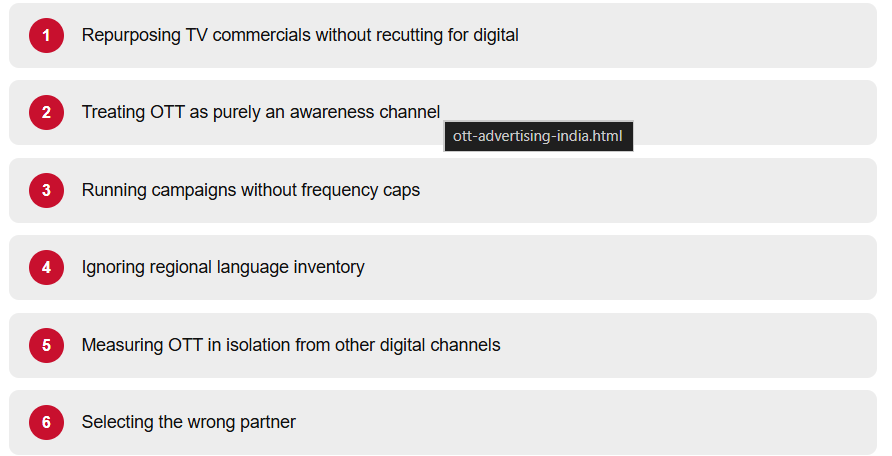
Repurposing television commercials without recutting for digital. A 30-second TV spot built for passive lean-back viewing behaves differently on a 6-inch screen in a mid-roll placement. Viewers skip, mute, or mentally disengage. The first three seconds of any OTT ad carry the entire creative weight. If those seconds do not establish a reason to watch, the rest of the budget is wasted. Digital advertising requires a different creative discipline from broadcast.
Treating OTT as purely an awareness channel. The best OTT advertising agency deployments integrate awareness and performance. A viewer who sees a brand on CTV, clicks a QR overlay during a pause ad, and lands on a product page is showing mid-funnel purchase intent. That signal can be fed into programmatic advertising retargeting sequences that carry the conversion path through to purchase.
Running campaigns without frequency caps. Without caps, high-value inventory can serve the same viewer twelve times in a week. This generates strong impression counts and weak brand sentiment. A managed OTT ads agency sets frequency floors and ceilings per platform and per creative variant.
Ignoring regional language inventory. India’s Tier 2 and Tier 3 cities are the growth market for most consumer categories over the next decade. OTT platforms serve this audience in 19+ Indian languages. Advertising services that deploy only Hindi and English creative leave a significant portion of the reachable audience unmoved. Brands whose advertising services budget includes regional language variants consistently see lower CPMs and stronger completion rates in Tier 2 and 3 markets.
Measuring OTT in isolation from other digital advertising channels. An OTT impression that does not convert in the same session is not wasted. It is the first touch in a multi-touch attribution journey. Brands that measure OTT on last-touch conversions will always undervalue it and underfund it. A full-funnel measurement model is the corrective.
Selecting the wrong partner. Self-serve access to JioHotstar Ads Manager or Google Ads does not constitute an OTT strategy. The tools exist; the expertise does not come included. A specialist OTT ads agency brings audience architecture, creative guidance, bid strategy, and attribution experience that the tools alone do not provide. When evaluating an OTT ads agency, the right question is not “do you buy on JioHotstar?” but “how do you connect my OTT spend to the business metric I actually care about?”
Bright Brain is a Google Elevator Partner (one of 15 agencies selected from 8,000+ across India in 2019). We run programmatic advertising, video ads on YouTube, connected TV campaigns, and integrated digital advertising across OTT platforms as part of full-funnel performance systems, not as isolated media buys.
Our advertising services for OTT cover the full campaign lifecycle: audience strategy and data architecture, platform selection and budget weighting, creative brief development by format, campaign setup and trafficking, real-time bid management, frequency management, cross-platform attribution, and performance reporting that connects OTT impressions to business outcomes.
We work with brands across Real Estate, EdTech, D2C, BFSI, and B2B — verticals where the OTT audience profile and the brand’s target customer overlap significantly. For brands with existing digital performance campaigns, we integrate OTT into the same attribution model, so upper-funnel OTT impressions receive proper credit in the conversion path. Our advertising services are built to connect streaming reach to bottom-funnel outcomes, not to deliver impression counts as a proxy for results.
The brands winning attention on JioHotstar, Prime Video, and YouTube today are not outspending competitors. They are out-targeting and out-structuring them.
OTT advertising refers to video advertising delivered on streaming platforms like JioHotstar, Amazon Prime Video, and YouTube that bypass traditional cable or satellite television. It matters because India’s OTT viewership crossed 600 million in 2025, meaning the majority of the urban middle class and a significant portion of Tier 2 and 3 audiences now spend more time on streaming platforms than on broadcast television.
Traditional TV advertising buys time slots against assumed audiences. OTT advertising buys specific audiences in real time through automated, data-driven buying, with targeting by demographics, location, content interest, device, and time of day. It delivers measurable outcomes (completion rates, view-through rates, post-view conversions) that broadcast television cannot.
The answer depends on your target audience, not platform preference. JioHotstar reaches the broadest audience (450 million MAUs), with strength in live sports, regional content, and Jio-ecosystem data. Amazon Prime Video reaches higher-income urban households with demonstrated purchase intent. YouTube reaches all segments including rural India, with the deepest targeting data available through Google’s first-party signals. Most effective strategies run across two or three platforms with differentiated creative and budget weighting by objective.
Programmatic advertising is automated, data-driven ad buying in real time, where available ad slots go to an automated auction at the moment a viewer is about to see a placement. The brand’s DSP bids based on how closely the viewer matches the campaign’s target profile. The winning bid’s creative is served in milliseconds. This allows brands to pay for audience fit rather than generic impressions, and to optimise in real time based on performance signals.
Pre-roll ads work best for brand awareness at close attention moments. Mid-roll ads during live sports deliver strong contextual relevance. Pause ads and interactive shoppable formats work for product consideration phases. Connected TV masthead placements deliver large-screen brand impact with completion rates above 90%. Video ads on YouTube span the full format range and connect to Google’s retargeting infrastructure. Format selection should follow campaign objective, not convenience.
OTT advertising costs vary significantly by platform, format, inventory type, and audience specificity. CPMs on JioHotstar for live sports inventory are higher than for general entertainment. Video ads on YouTube pricing varies by format, with skippable TrueView ads typically priced lower than non-skippable pre-roll. Most serious OTT campaigns require a minimum budget that supports meaningful reach and optimisation cycles. An OTT ads agency can provide a realistic budget architecture based on brand objective and target audience.
Results depend on campaign structure, creative quality, audience targeting, and whether the campaign is optimised actively during its run. Brands running well-structured CTV campaigns report ad completion rates exceeding 90% and recall improvements compared to linear TV. Connected TV campaigns in India have demonstrated 23% better ROI versus linear TV in comparable setups, according to industry benchmarks. An OTT advertising agency provides realistic outcome benchmarks before campaign launch, not projections built post-sale.
Self-serve tools exist on JioHotstar Ads Manager, Google Ads, and Amazon Ads. The tools are accessible; the expertise is not embedded in them. A specialist OTT ads agency provides audience architecture, cross-platform attribution modelling, creative guidance by format, bid strategy, and ongoing optimisation: the layer that separates a budget-burning campaign from a performing one. For brands without a dedicated programmatic team, an OTT advertising agency is the difference between spending on OTT and generating return on it.