Most Indian businesses that try to expand abroad make the same costly assumption. They believe a good product and a translated homepage are enough to win search visibility in a new country. They are not. Google treats every country and language as a separate audience with separate intent, separate competitors, and separate trust signals to earn. Without a structured plan, a brand can spend lakhs on paid media chasing visibility that organic search could have delivered for a fraction of the cost.
This is exactly where international seo services earn their keep. Rather than running the same domain, the same content, and the same backlink profile across every geography, a properly built global programme treats each target market as its own campaign, connected under one technical framework. The businesses that get this right are not always the ones with the biggest budgets. They are the ones who sequence their work correctly from day one.
“Most founders ask us to make their website rank in five countries at once. We usually tell them to prove the model in one country first.” Bright Brain team observation, client discovery calls
Founders often discover this the hard way, after months of running country-specific ad campaigns with no organic traffic to show for it. The fix is not more spend. It is a different foundation, one built around technical structure, localisation, and authority, in that order, the same foundation every serious seo agency should be laying before touching a single ad account.
Direct answer: Indian businesses struggle abroad mainly because they treat expansion as a translation project instead of a search strategy, skipping the technical signalling Google needs to show the right page to the right country.
The most common mistake is launching a subdirectory or subdomain for a new country, filling it with translated copy, and expecting Google to figure out the rest. Google does not guess. Without the correct technical markup, search engines often show the wrong country version to the wrong audience, or worse, treat both versions as duplicate content and suppress one entirely.
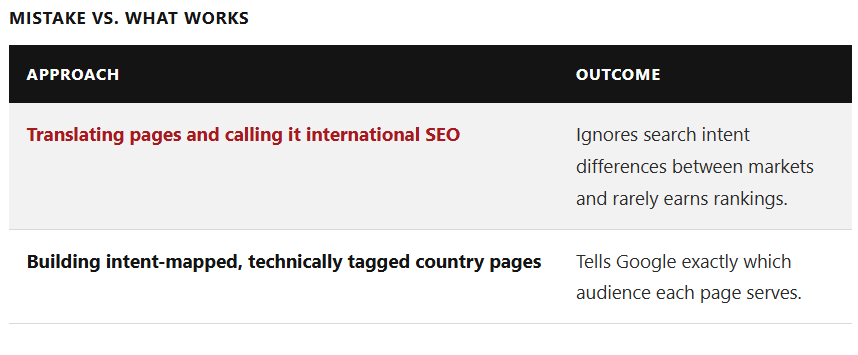
Mistake: Translating pages and calling it international seo. This ignores search intent differences between markets and rarely earns rankings. What works: Building intent-mapped, technically tagged country pages. This tells Google exactly which audience each page serves.
An Ahrefs study spanning more than 374,000 domains found that 67 percent of hreflang implementations contain errors, precisely the kind of technical mistake that causes search engines to serve the wrong country page or ignore localisation signals altogether. (Source: Ahrefs)
Next, it helps to understand what a properly scoped global programme actually includes, before assuming the fix is simply more content, or a bigger retainer with an seo services provider that has never run a multi-country account.
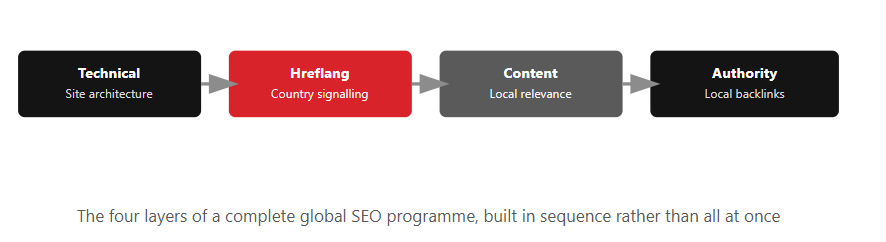
Many businesses hire an seo agency expecting a single deliverable, usually more keywords or more blog posts. A genuine international seo services programme is broader. It starts with deciding the site architecture, whether that means country-code domains, subdomains, or subdirectories, based on resources and long-term intent. It then layers in the technical tagging that tells search engines which page belongs to which country and language combination.
This is also where seo services for global expansion differ sharply from domestic SEO work. Keyword research has to be redone per market, since search phrasing, seasonality, and even the platforms people use to search vary by country. A term that drives strong volume in India may carry entirely different intent in the UK or the Gulf.
Bright Brain’s work with Wright Research shows what this layered approach can achieve. The firm gained more than 600 organic users arriving directly from AI answer engines like ChatGPT, Perplexity, and Gemini, alongside an 18 percent lift in signups, after their content and technical structure were rebuilt around genuine search intent rather than assumptions.
The next layer to get right is the technical one, and it is where most international campaigns quietly fail.
Direct answer: Hreflang SEO tags tell search engines which language and country version of a page to serve to a given searcher, preventing duplicate content penalties and misdirected traffic across markets.
Every page targeting a specific country and language pair needs a corresponding hreflang annotation, either in the HTML head, the HTTP header, or the sitemap. Get the syntax wrong, even by a missing return tag pointing back to the original page, and search engines may ignore the entire set of annotations.
The most frequent failure is inconsistent tagging between the sitemap and the page itself. The second is forgetting a default “x-default” tag for visitors whose language does not match any listed variant, which often sends valuable traffic to the wrong page entirely.
Data point: Google’s own developer documentation confirms that localised pages are only treated as duplicate content when the main content stays untranslated or hreflang signalling is missing, which is exactly why unmarked country pages so often get filtered out of search results. (Source: Google Search Central)
Bright Brain, as a Google International Growth Agency Partner since 2022, builds hreflang seo architecture as the first deliverable in any global engagement, precisely because every other layer of any international seo services programme depends on it working correctly.
Once the technical foundation holds, the next question is what actually goes on those pages.
A page translated word for word rarely matches how a native searcher actually phrases their query. It also misses local context, currency, regulations, and cultural references that build trust with an unfamiliar visitor. Google’s own systems are increasingly good at detecting content that reads as machine-translated rather than natively written.
Businesses that invest in locally briefed content, even when written by the same core team, consistently see stronger engagement and lower bounce rates than those relying on straight translation tools. This is the difference between genuine multilingual seo and a homepage run through a translation plugin.
The content layer builds trust with visitors. The next layer builds trust with search engines themselves.
Search engines weigh the relevance and geography of linking domains heavily when assessing trust for a country-targeted page. A backlink from a respected Indian publication carries little weight for a page trying to rank in Germany. This means link building services for international campaigns need country-specific outreach, local press relationships, and market-relevant partnerships, not a single global backlink campaign reused everywhere.
Piaggio’s regional campaign work with Bright Brain illustrates this principle in a related context. Restructuring targeting and creative by region, rather than running one blanket campaign, delivered 17.49 percent more leads at 27 percent less spend, proof that market-specific execution consistently outperforms one-size-fits-all approaches. The same logic applies to link building services: a backlink strategy built market by market outperforms one campaign stretched across every geography at once.
With authority building in place, the remaining question is sequencing, since doing all four layers at once usually means doing none of them well.
Budgets get burned when businesses try to launch five country pages, five content calendars, and five link campaigns in the same quarter. A more efficient global seo strategy picks the single highest-intent market first, gets the hreflang and content right there, and only expands once that market shows measurable organic movement.
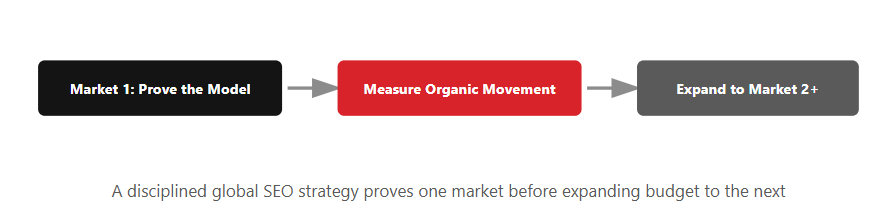
This sequencing also protects internal resources. A small in-house team, or a lean partner engagement, can execute one market properly far more effectively than five markets poorly. The proof shows up in organic sessions and qualified enquiries, not just published pages. It is also the clearest sign that a global seo strategy is working before the second or third market gets added to the roadmap.
The final consideration for most founders is who actually executes this work.
Direct answer: The right international seo agency brings proof of technical execution, country-specific results, and AI answer engine visibility, not just a list of markets they claim to serve.
Ask any prospective seo agency for evidence of hreflang implementation on a live client site, not just a description of the process. Ask for organic traffic data broken down by country, not a single blended number that hides underperforming markets. A credible international seo agency should also be able to show visibility inside AI-generated answers, since global buyers increasingly research through tools like ChatGPT and Perplexity before ever reaching a traditional search results page.
Bright Brain’s Google Elevator Partner status, one of only 15 agencies selected from more than 7,000 across India, reflects exactly this kind of verified technical execution rather than self-reported claims. Not every seo agency invests in this depth of proof, which is exactly why the distinction matters before signing a retainer with any provider of international seo services.
Not every business needs the same starting point when evaluating international seo services.
Expanding into new markets does not have to mean multiplying your marketing spend by the number of countries you enter. The businesses that scale internationally without burning through budget are the ones that treat international seo services as a structured, sequenced discipline rather than a translation exercise. Get the technical foundation right, write content that genuinely speaks to each market, and build authority where it actually counts, and organic growth compounds in every country you add.
If you are weighing where to start, Learn More about how a properly sequenced programme of international seo services could work for your business. The right foundation now saves considerably more than it costs.
This work covers the technical, content, and link-building layers required to make a website rank in multiple countries and languages. It includes hreflang tagging, localised content, and country-specific authority building, all coordinated under one site architecture rather than run as separate campaigns. Most providers structure international seo services around exactly these three layers.
Regular seo services target one country and language. International seo adds technical signalling like hreflang tags, plus separate keyword research and content for each target market, since search intent and phrasing change from country to country.
Hreflang seo tells search engines which country and language version of a page to show a given visitor. Done correctly, it prevents duplicate content issues and stops the wrong page from appearing to the wrong audience.
No. Multilingual seo means writing original, locally researched content for each language and market. Direct translation often misses local search phrasing, context, and trust signals that native content naturally includes.
Yes, generally. These campaigns need to be country-specific, since backlinks from domains relevant to one market carry limited authority for a completely different country audience. Link building services built for one geography rarely transfer cleanly to another.
Look for a partner that can show live hreflang implementation, country-by-country organic traffic data, and visibility inside AI answer engines, rather than one that simply lists the markets it claims to cover. A genuine international seo agency will have this proof ready before you ask.
Pick the single highest-intent country, get the hreflang and content right there, and prove organic movement before expanding. This is the core of a disciplined global seo strategy, and it applies whether you’re hiring an seo agency or building the capability in-house.