By Suhail Bajaj ·
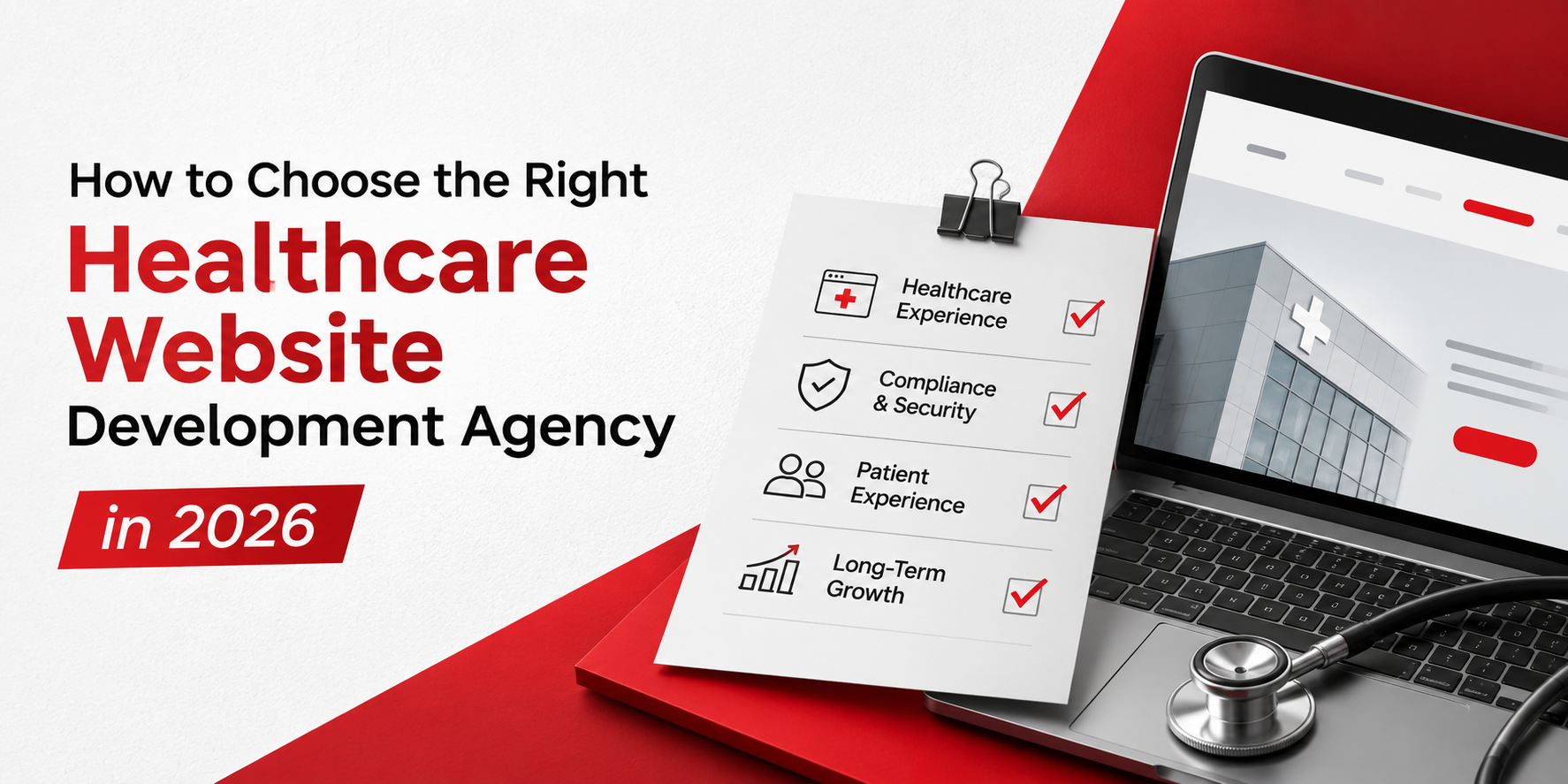
Choosing a healthcare website development agency means finding a partner who understands patient trust, data privacy, accessibility, and local search, not just design. The right agency builds a secure, fast, compliant website that answers patient questions clearly and turns visits into booked appointments. This guide explains exactly what to look for and what to ask.
Think about the last time you looked for a doctor. You probably searched online, scanned a few websites, and quietly judged each one within seconds. Your patients do the same thing.
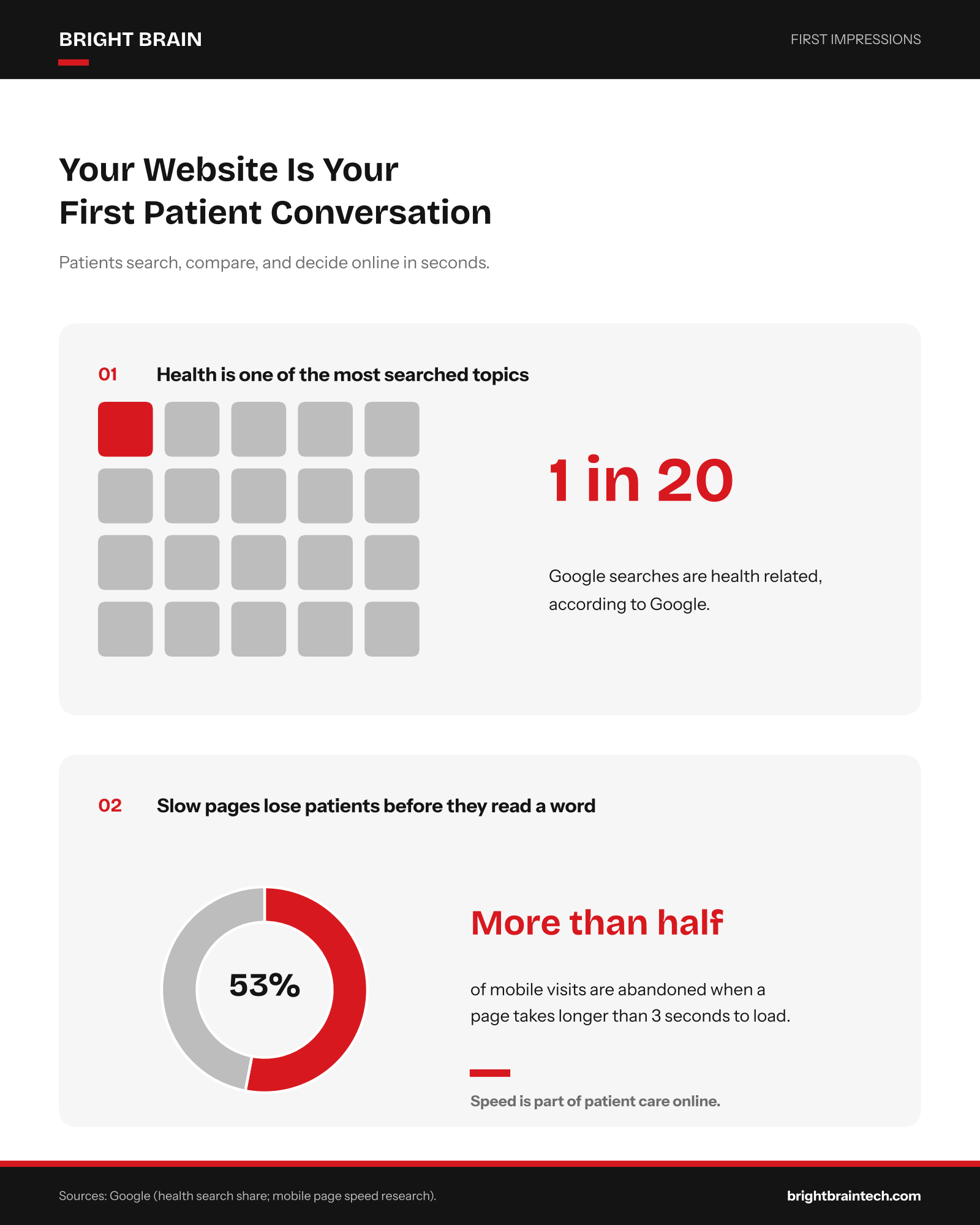
Google has shared that roughly one in every twenty searches is health-related. That is an enormous volume of people looking for answers, reassurance, and care. Many of them are anxious, in pain, or searching on behalf of someone they love.
Your website is often the first conversation you have with these people. If it loads slowly, feels outdated, or hides basic information like timings and fees, they leave. Google’s own research found that more than half of mobile visitors abandon a page that takes longer than three seconds to load.
This is why choosing the right digital partner is not a cosmetic decision. It shapes how many patients find you, how many trust you, and how many actually book.
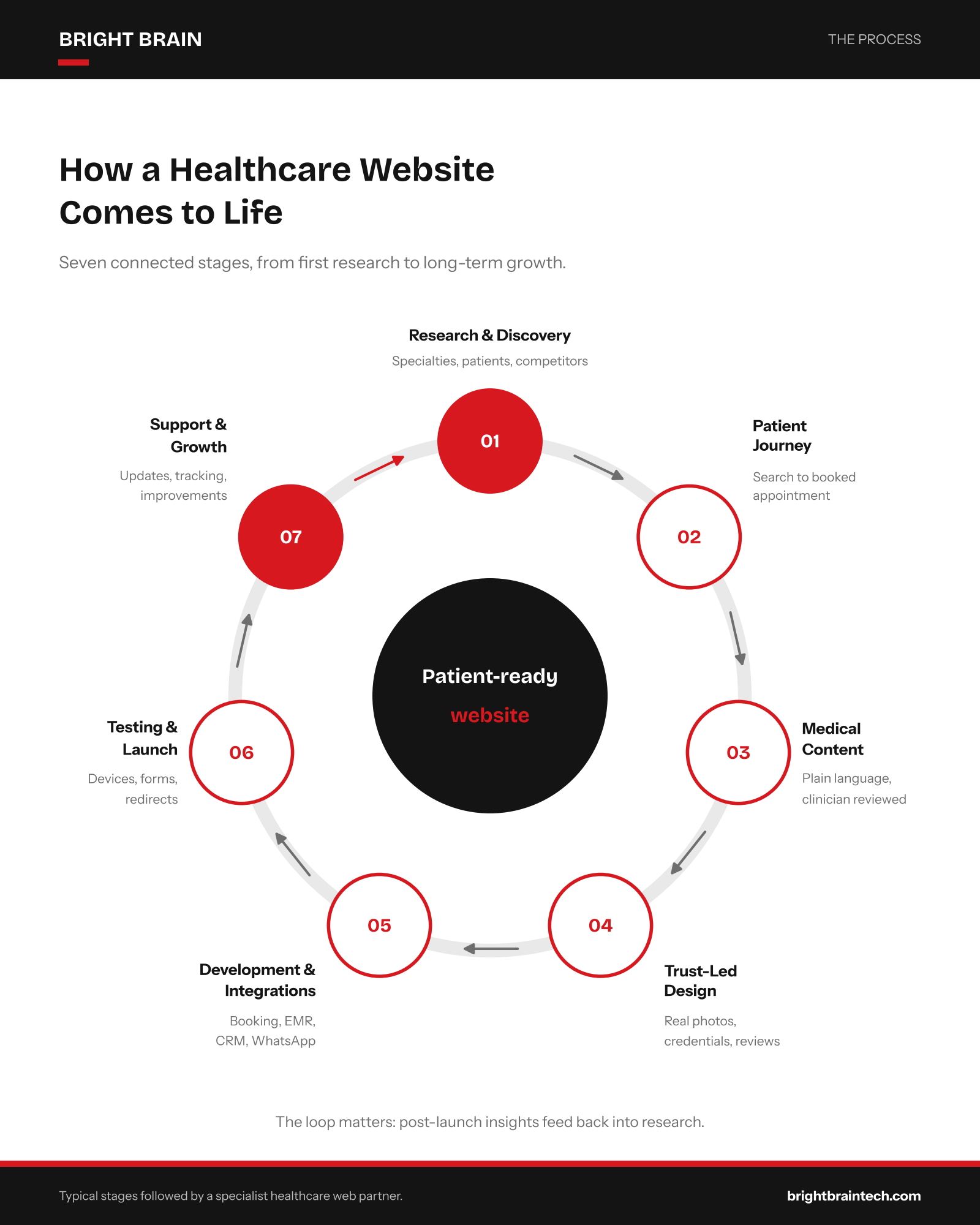
A capable specialist partner handles far more than visuals. Its work covers several connected stages, and each one shapes how patients experience your practice online.
Good healthcare web design services usually begin with research. The team studies your specialties, patient demographics, competitors, and the questions people ask before choosing a provider. It also speaks with your doctors and front desk staff, since they hear patient concerns every day. Only then does design begin.
Next, the team maps how patients move from first search to booked appointment. It considers different visitors, such as a new patient comparing clinics, an existing patient looking for reports, or a family member searching on someone’s behalf. Each journey should feel short, clear, and reassuring.
Patients judge your expertise through your words. A specialist partner writes or structures condition pages, treatment explanations, doctor profiles, and FAQs in plain language. Ideally, a clinician reviews every page for accuracy before it goes live, which protects both patients and your reputation.
Design then brings the plan to life. This includes calm colour palettes, real photographs of your team and facilities, visible credentials, and patient reviews placed where they matter most. Every page should guide visitors gently toward one clear action, such as booking a visit or calling the clinic.
Development focuses on speed, mobile performance, security, and search visibility. The team also connects your site with tools like practice management software, telehealth platforms, payment gateways, WhatsApp, and CRM systems. These integrations reduce manual work for your staff and make booking easier for patients.
Before launch, the site is tested across devices, browsers, and screen readers. Forms, booking flows, and integrations are checked carefully so that no enquiry goes missing. Redirects are also planned when an old website is replaced, so existing search rankings are not lost.
After launch, the best partners stay involved. They monitor uptime, apply security updates, track enquiries, and test improvements over time. They also keep the site aligned with changing regulations and search behaviour.
In short, a healthcare web development company should act like a long-term growth partner, not a vendor who disappears after go-live.
Many clinics start with a general web studio because it seems simpler or cheaper. The problem appears later.
A general studio may build a beautiful site, but it often misses healthcare-specific needs. It may not understand consent requirements, sensitive data handling, medical content review, or how patients actually make healthcare decisions.
A specialised healthcare web design agency brings that context from day one. It knows that a cardiology patient and a cosmetic dentistry patient think differently. It knows that doctor profiles, credentials, and reviews carry enormous weight. It understands that a confusing booking form can cost you a patient who needed care that week.
When you compare healthcare web design companies, look for this kind of industry fluency. Ask to see live healthcare projects, not just a general portfolio. The difference usually shows within the first ten minutes of conversation.
Healthcare data is among the most sensitive information a person can share. Your website must protect it with care.
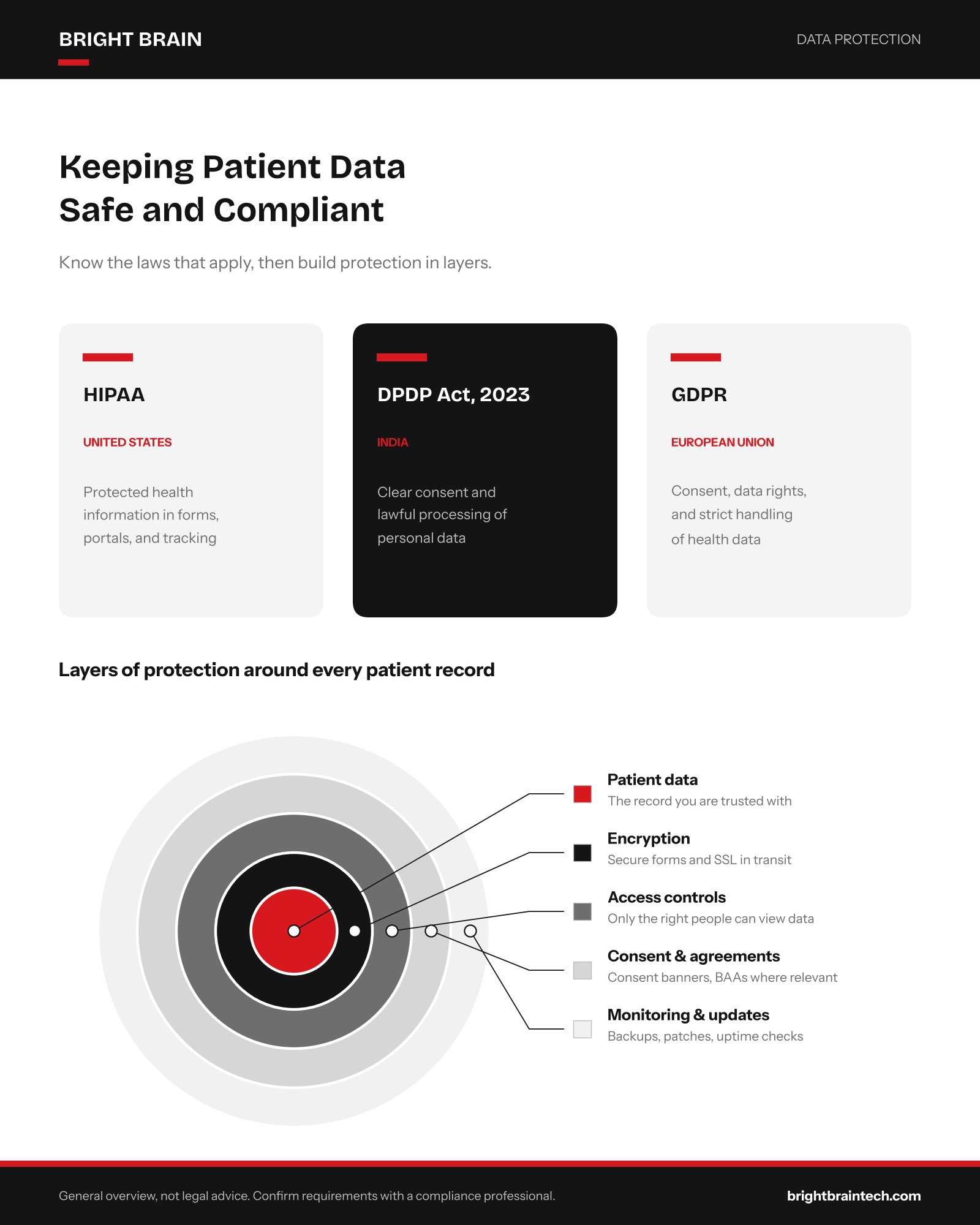
If you serve patients in the United States, your website must align with HIPAA wherever it collects, stores, or transmits protected health information. That includes contact forms, appointment requests, patient portals, and even some analytics or tracking setups. In India, the Digital Personal Data Protection Act, 2023 sets clear expectations around consent and how personal data is processed. Practices serving patients in Europe must also consider GDPR.
A trustworthy agency will discuss these frameworks openly. It should explain how it handles encrypted forms, secure hosting, access controls, consent banners, and vendor agreements such as Business Associate Agreements where relevant.
Be cautious of any medical web design agency that treats compliance as an afterthought or simply says, “Don’t worry, it’s covered.” You deserve specifics. Ask where data goes, who can see it, and how it is protected at every step.
Any medical web design company worth hiring will document this in writing. Security also extends beyond regulations. Regular updates, backups, uptime monitoring, and SSL certificates are basic hygiene. A reliable healthcare web development company will include these in its maintenance plan rather than charging for each fix.
Patients come to your website with very different abilities, devices, and comfort levels with technology. An elderly patient on a small phone needs the same clarity as a young professional on a laptop.
Experienced healthcare web design services focus on simple navigation, readable fonts, clear calls to action, and booking paths that take a few taps rather than a few minutes. They also follow accessibility standards such as WCAG, which help people with visual, hearing, motor, or cognitive challenges use your site comfortably.
A capable medical web design agency also tests key pages with real users before launch. Emotional design matters too. Calm colours, real photographs of your team, honest language, and visible credentials make a nervous patient feel safer. A thoughtful medical web design company understands that reassurance converts better than pressure.
A beautiful website that nobody finds cannot help patients. Search visibility should be built into the foundation, not added later.
A strong healthcare-focused agency plans site architecture around how patients search. That includes condition pages, treatment pages, doctor profiles, and location pages. It also uses structured content, fast load times, and clean technical setup so search engines can understand your practice.
Search is also changing. Patients increasingly ask questions in Google’s AI Overviews, ChatGPT, Gemini, and Perplexity. This is where Answer Engine Optimisation, or AEO, comes in. Clear, well-organised, medically accurate answers are more likely to be cited by these tools.
Local SEO deserves special attention. Most patients want care close to home, whether that is a clinic in Mumbai or a hospital in a smaller city. Accurate Google Business Profiles, consistent addresses, local reviews, and location-specific pages all help. A seasoned medical web design company will set these up as part of the build.
The best healthcare web design companies treat search as part of patient access. After all, being found is the first step in being trusted.
Not all healthcare websites have the same goals. A dental clinic, a diagnostic lab, and a multi-specialty hospital each need a different approach, which is why healthcare web design services should never be one-size-fits-all.
A dental web design company should understand treatment-focused journeys. Patients researching implants, aligners, or smile makeovers want before-and-after galleries, transparent pricing guidance, financing information, and easy consultation booking. A good dental web design company will also know how to present cosmetic results responsibly and ethically.
A medical web design agency working with hospitals or specialist clinics faces different challenges. It must organise dozens of departments, hundreds of doctors, and complex patient pathways without overwhelming visitors. Search filters, doctor finders, and clear department pages become essential.
Multi-location groups need consistent branding along with distinct local pages. Each location should have its own address, doctors, timings, and reviews so that both patients and search engines can find the right branch.
When reviewing a medical web design company, ask which specialties it has worked with. Relevant experience shortens timelines and avoids costly trial and error.
The right questions reveal a lot about a potential partner. These five will help you separate genuine specialists from generalists, and the answers will tell you how the team thinks, not just what it sells.
Start by asking how many healthcare websites the team has built and whether you can speak with a past client. A confident agency will happily connect you. Look closely at live projects rather than screenshots. Visit the sites on your phone, try the booking flow, and notice how easily you can find doctor details, timings, and contact information. Experience with practices similar to yours, whether a single clinic or a multi-specialty hospital, is a strong signal.
If you are evaluating a medical web design company, ask how they approach compliance, including HIPAA, DPDP, or GDPR depending on where your patients are. Ask where form data is stored, who can access it, and how consent is captured. Then ask who writes and reviews medical content and whether a clinician checks it before it goes live. Clear, specific answers here show that the team takes patient safety seriously.
Ask what platforms they recommend and why. A good partner explains the trade-offs in simple terms, such as ease of editing, security, speed, and long-term costs. Ask how your site will connect with your booking system, EMR, or CRM, and whether those connections will need regular maintenance. Also ask how easily your own team can update timings, add doctors, or publish new content without calling the agency every time.
Ask how they measure success after launch. Enquiries, booked appointments, and cost per patient tell you far more than page views. Request a sample report so you can see what you will receive each month and how clearly it is explained. Be cautious if a medical web design agency promises guaranteed first-page rankings within weeks, because no honest healthcare web development company can promise that. Realistic goals and transparent reporting are far better signs of a reliable partner.
Finally, ask who owns the website, the domain, and the content when the project ends. You should always own your digital assets, including design files, login credentials, and hosting access. Also ask what happens if you decide to move to another provider in future. A dependable healthcare web design agency will put this in writing without hesitation.
Pricing varies widely depending on scope. A small clinic website with a few service pages costs far less than a hospital platform with patient portals, integrations, and multilingual content. Comparing quotes from two or three healthcare web design companies helps you understand what is fair for your scope.
Rather than focusing only on the upfront price, think about value. A website that brings in ten extra patients a month often pays for itself quickly.
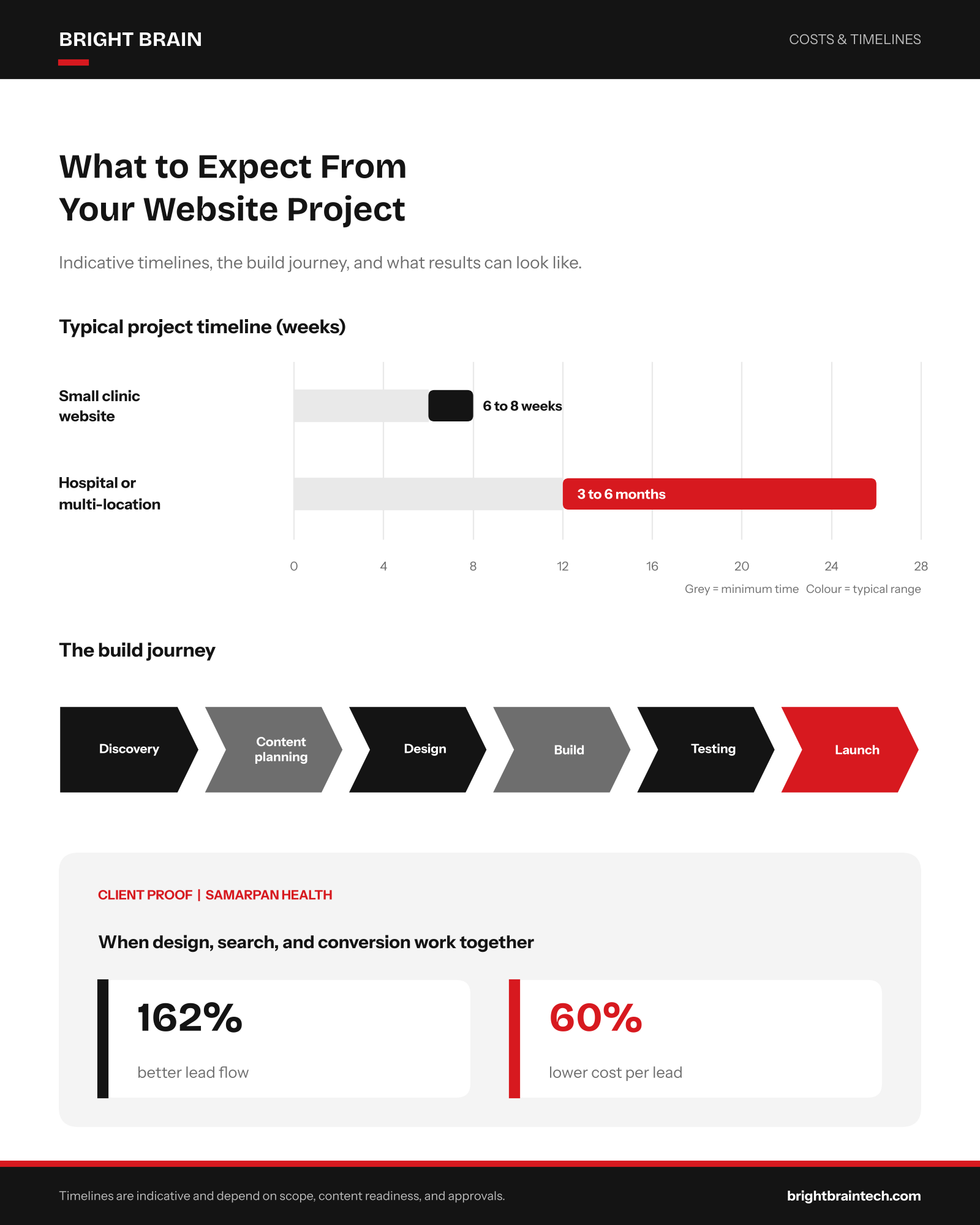
Typical projects move through discovery, content planning, design, development, testing, and launch. Simple builds may take six to eight weeks. Larger platforms can take several months. Your agency should give you a clear timeline, defined milestones, and a single point of contact. When you request quotes for healthcare web design services, ask for an itemised scope, and expect any healthcare web development company to state maintenance costs upfront.
At Bright Brain, a Mumbai-based Google Elevator Partner, we have seen how healthcare growth depends on the full journey from search to booking. For Samarpan Health, our work delivered 162% better lead flow and a 60% lower cost per lead. Strong healthcare web design services work best when design, search, and conversion thinking come together.
Choosing a healthcare website development agency can feel like a big decision, and it is. Your website speaks for your practice every hour of every day, often to people at vulnerable moments.
The right partner will listen before designing, explain compliance clearly, respect your patients’ needs, and stay accountable for results. Whether you need a dental web design company, a medical web design agency, or a full-service healthcare web development company, look for experience, transparency, and genuine care for the patient experience.
You do not need to have every answer before you start. You simply need a partner who asks the right questions and helps you build something patients will trust. If you are ready to explore what a better website could do for your practice, we would be glad to talk. Learn More about how Bright Brain helps healthcare brands grow with confidence.
A specialist healthcare web agency designs, builds, and maintains websites for clinics, hospitals, and health brands. It handles patient-focused design, secure forms, compliance, accessibility, appointment booking, integrations, and search visibility. The goal is a trustworthy website that helps patients find information quickly and book care with confidence.
A specialised healthcare web design agency understands patient behaviour, medical content standards, data privacy laws, and trust signals that general designers often overlook. This experience reduces compliance risks, shortens timelines, and usually produces a website that converts more visitors into booked appointments.
A HIPAA-ready website encrypts any protected health information, uses secure hosting, limits data access, and works with vendors who sign Business Associate Agreements. Ask your agency to explain exactly how forms, storage, and analytics handle patient data before you approve the build.
A good dental web design company includes treatment pages, dentist profiles, before-and-after galleries, patient reviews, pricing or financing guidance, clear location details, and simple online booking. The site should load quickly on mobile and reassure anxious patients with friendly, honest language and real photographs.
A small clinic website typically takes six to eight weeks from discovery to launch. Larger hospital or multi-location websites with portals and integrations can take three to six months. Timelines depend on content readiness, approvals, compliance reviews, and the number of systems that need to connect.
Compare healthcare web design companies by their healthcare portfolio, compliance knowledge, SEO and AEO capability, client references, and post-launch support. Ask for measurable results such as enquiry growth or booked appointments. Also confirm that you will fully own your website, domain, and content after the project ends.