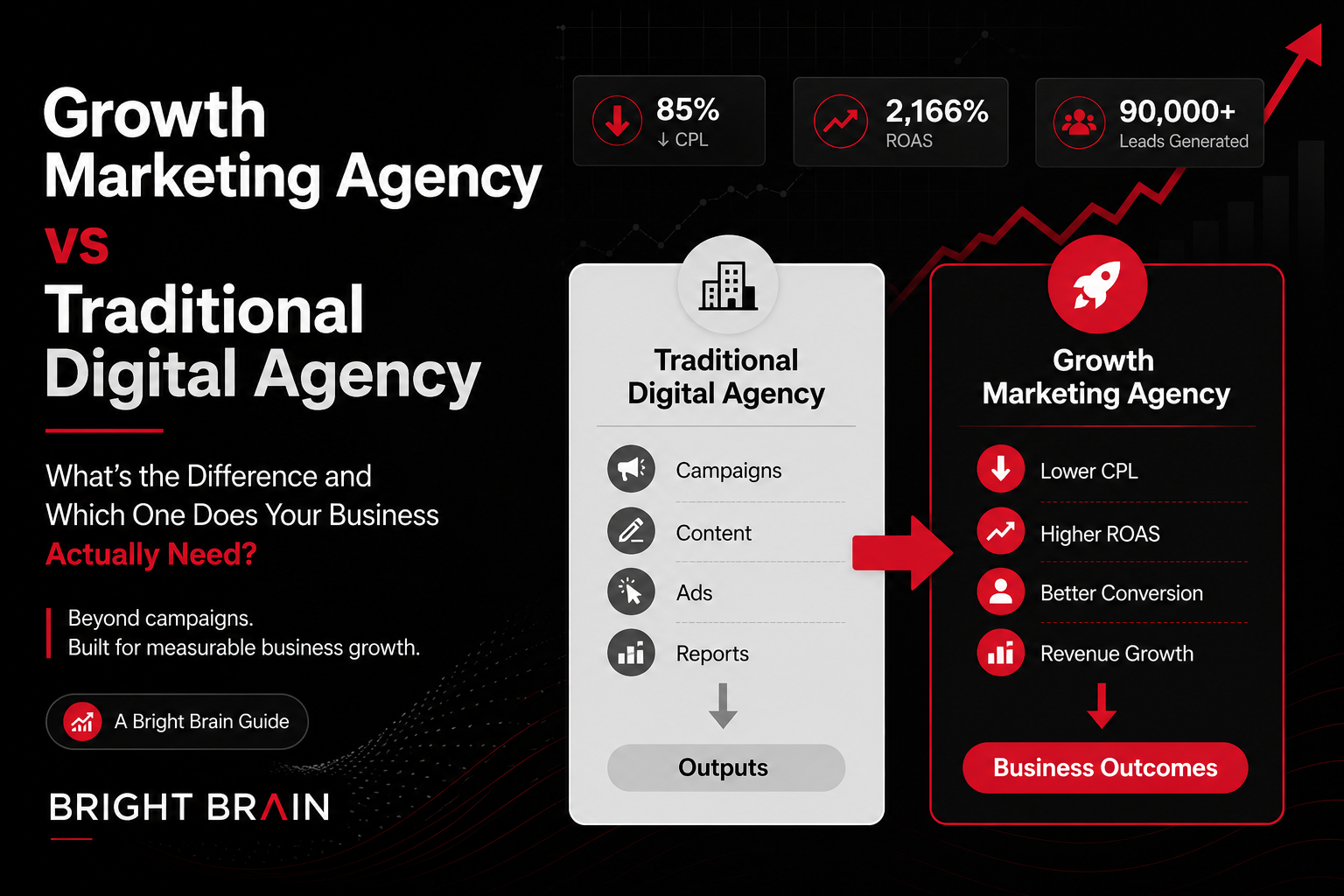
You have a marketing budget. You need more leads, better conversions, lower acquisition costs. So you start shortlisting agencies.
Two types keep showing up in your search results: the traditional digital agency that promises visibility, and the growth marketing agency that promises outcomes. Both sound credible. Both have decent case studies. Both will take your retainer.
The difference between them is not cosmetic. One charges you for work done. The other is accountable for results produced. Get this wrong, and you spend six months and a significant budget discovering which one you hired.
This guide breaks down the actual distinction, maps each model to the business stage it fits, and gives you a decision framework to pick the right partner before you sign a contract.
A traditional digital agency is built around service delivery. You brief them on what you need, they execute it, and they report back on what was done.
Their deliverables are channels: SEO, social media, Google Ads, content, email campaigns, website builds. Their billing model reflects this. You pay for the work, not the outcome. If the campaign goes live on time, the deliverable is complete. Whether that campaign generated qualified leads, reduced your cost per acquisition, or moved your revenue needle is a separate conversation, and often one the agency is not on the hook for.
This model made sense when digital marketing was simpler. Run an ad. Get clicks. Count impressions. Report reach. But as marketing firms evolved and buyers became more sophisticated, the gap between activity metrics and business outcomes became harder to ignore.
Traditional agencies work well for specific scenarios:
If you are a ₹500 Cr FMCG brand running a Diwali awareness campaign, a traditional marketing agency may be exactly what you need. The objective is reach, the metric is impressions, and the agency’s job is to execute creative at scale.
But if you are a ₹100 to 400 Cr growth-stage company and your primary objective is qualified leads, lower CPL, and scalable customer acquisition, the traditional agency model has a structural problem: it is not designed to own that outcome.
A growth marketing agency is structured differently at a foundational level. The engagement starts with a business problem, not a channel brief.
Where a traditional digital agency asks, “What do you want us to run?” a growth marketing agency asks, “What number are we trying to move, and what is stopping it right now?”
The operating model covers the entire funnel:
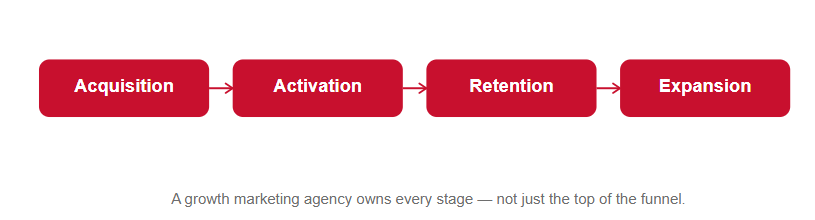
A growth marketing agency runs structured experiments across these layers. It does not just execute campaigns. It tests hypotheses, reads data, kills what is not working, and doubles down on what is. The accountability is to the business outcome, not the campaign delivery.
This is what separates a genuine digital performance agency from one that has simply added “growth” to its name. The test is simple: what is the agency on the hook for? If the answer is deliverables (ads live, content published, SEO work submitted), it is a traditional agency with a modern label. If the answer is outcomes (CPL reduced, leads generated, ROAS improved), it is operating as a growth marketing agency.
India’s digital advertising market is projected to hit ₹69,856 crore by 2026, with performance marketing already capturing over 50% of spends as brands demand measurable ROI over vanity metrics. The shift is not directional. It has already happened.
Understanding the model is useful. Understanding how it shows up in practice is more useful.
Difference 1: What they are accountable for
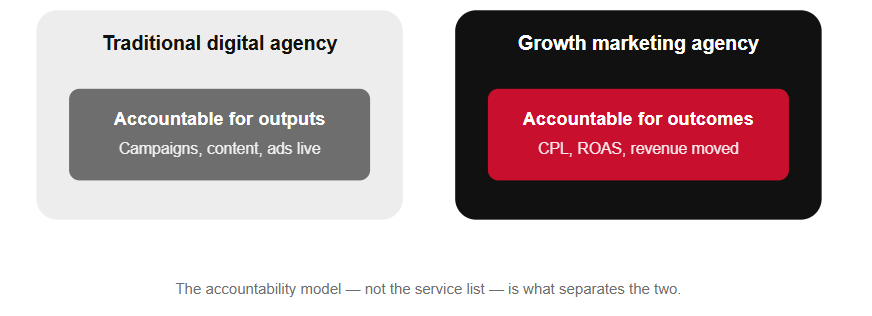
A traditional digital agency is accountable for outputs: campaigns launched, content published, ads live. A growth marketing agency is accountable for outcomes: leads generated, CPL reduced, ROAS improved, revenue moved.
This single distinction shapes everything downstream: how the agency is staffed, how it reports, how it charges, and whether it stays invested in your results once the month’s deliverables are shipped.
Difference 2: Funnel depth
Traditional marketing firms typically operate at the top of the funnel. They drive awareness and traffic and hand the baton to your sales team. A growth marketing agency owns the full funnel. It optimises the landing page, the follow-up sequence, the offer structure, the retargeting logic. It does not stop at the click.
Difference 3: Testing culture
A growth marketing agency treats every campaign as a hypothesis. Headlines are A/B tested. Audiences are split. Landing pages are iterated. A traditional digital agency delivers a campaign and moves to the next brief. The speed of learning is fundamentally different.
Difference 4: Reporting language
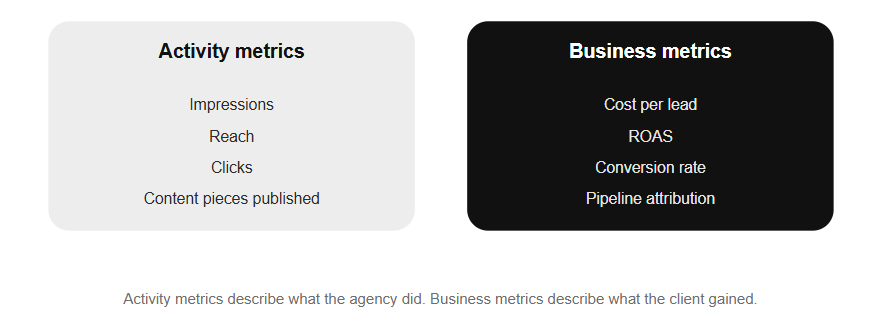
Traditional agencies report in activity metrics: impressions, reach, clicks, content pieces published. A digital performance agency reports in business metrics: CPL, ROAS, conversion rate, cost per acquisition, pipeline attributed to paid channels.
The difference is not just cosmetic. It reflects whose frame the agency is operating in. Activity metrics describe what the agency did. Business metrics describe what the client gained.
Difference 5: Strategic involvement
A growth marketing agency participates in strategy, not just execution. It brings a point of view on where your funnel is leaking, which segments to prioritise, and which channels are oversaturated for your vertical. A traditional marketing agency executes the strategy you already have.
Difference 6: Commercial model alignment
Because a growth marketing agency is accountable to outcomes, its incentives align with yours. When your CPL drops, the relationship gets stronger. When a channel stops performing, the agency flags it before you do. Traditional agencies are paid for time and deliverables. Their incentive is to keep the scope running. A growth marketing agency‘s incentive is to make the work work.
The honest answer is: both models have a place. The question is not which is objectively better. The question is which fits where your business is right now.
Early-stage company (₹10 to 50 Cr revenue, pre-product-market fit):
Avoid both until you have clarity on your ICP and value proposition. A growth marketing agency cannot accelerate a funnel that has not been validated. A traditional digital agency will burn budget on execution you cannot use yet. Build the brief first.
Growth-stage company (₹50 to 400 Cr revenue, scaling a proven model):
This is where a growth marketing agency creates the most leverage. You know who your customer is. You have a product that converts. Your problem is acquisition cost and funnel efficiency at scale. A genuine online performance marketing agency with vertical depth in your category will compress your CPL, improve your ROAS, and find the funnel leaks you cannot see from inside.
This is also the stage where hiring the wrong model hurts most. A traditional marketing agency will run beautiful campaigns and report strong awareness numbers while your CAC climbs and your sales team waits for qualified leads.
Established brand (₹400 Cr+ revenue, category leader):
You may need both. A top performance marketing agency for conversion-focused channels (paid search, retargeting, lead gen) and a brand-led agency for awareness, creative, and above-the-funnel positioning. The mistake at this stage is running all of it through a single digital agency that is not calibrated for either objective.
India’s top performance marketing agencies operate across a wide quality spectrum. The label means little without the substance behind it. Here is what actually separates strong marketing firms from those that borrow the language without delivering the model.
Vertical proof, not generic case studies
The best growth marketing agency relationships work when the agency has operated in your vertical before. It already knows the CPL benchmarks, the audience behaviour patterns, the seasonality curves. Generic case studies with no vertical relevance are a red flag. Ask for results in your exact category.
In Real Estate, a well-run digital performance agency should be able to demonstrate CPL reductions comparable to the 85% reduction Bright Brain delivered for Kalpataru Realty through intent-based search targeting and landing page optimisation. In Education, look for evidence of brand search growth and lead flow improvement, like the 95% rise in brand search queries and 17.78% lead flow increase Bright Brain delivered for Atlas University. These are not aspirational claims. They are the output of a structured, test-and-iterate methodology applied by a genuine growth marketing agency.
Reporting language tells you everything
Before signing, ask the agency to show you a sample report. If the report is full of impressions, reach, and engagement rate, you are looking at a traditional marketing agency. If it leads with CPL, ROAS, conversion rate by traffic source, and pipeline attribution, you are looking at a digital performance agency that operates the way you need it to.
Credentials that are independently verifiable
In a market with hundreds of agencies competing for the same clients, credentials are a meaningful filter. Google Elevator Partner status, for example, is awarded to fewer than 15 agencies from a pool of 8,000 across India. That is not a badge any agency can buy. It reflects a verified track record across spend, strategy quality, and client outcomes. When you are evaluating top performance marketing agencies, ask which credentials are independently verified, not self-reported.
Strategic involvement from day one
The right growth marketing agency will push back on your brief before it executes it. It will tell you that your CPL problem is not media-buying; it is a landing page problem. It will tell you that the audience you want to target is not where your best customers actually come from. That kind of strategic investment in your business, before the campaign goes live, is the clearest signal that you are dealing with a genuine growth partner.
Bright Brain is a Mumbai-based growth marketing agency and one of only 15 Google Elevator Partners selected from 8,000+ agencies across India. That 0.3% selection rate is not a marketing claim. It is a verified credential from Google based on performance standards, strategic quality, and client outcomes.
The agency operates as a digital performance agency across Real Estate, Education, BFSI, FinTech, D2C, FMCG, Automotive, B2B Manufacturing, and Healthcare. Every engagement begins with a diagnostic, not a channel brief. The question is always: what number are we moving, and what is the fastest path to moving it?

The results come from that framing:
As a Google International Growth Agency Partner (2022), Meta Business Partner, and Amazon Ads Partner, Bright Brain brings the full-funnel capability of a growth marketing agency with the channel depth of a top performance marketing agency. The combination is what delivers outcomes, not just activity.
A traditional digital agency is accountable for outputs: campaigns delivered, ads live, content published. A growth marketing agency is accountable for outcomes: CPL reduced, leads generated, ROAS improved, revenue moved. The accountability model is the fundamental distinction, not the services offered.
Choose a growth marketing agency when your primary objective is measurable acquisition growth, not brand awareness. If you need CPL reduction, ROAS improvement, or full-funnel conversion optimisation, a digital performance agency is the right fit. If you need brand-building campaigns with reach and awareness as the goal, a traditional marketing agency may suffice.
Ask one question: what will you be on the hook for? A genuine growth marketing agency answers with business metrics: CPL targets, ROAS benchmarks, lead volume, pipeline attribution. A traditional digital agency using the label answers with deliverables: campaign launches, content pieces, channel reports.
Look for independently verified credentials: Google Elevator Partner status, Google International Growth Agency Partner designation, Meta Business Partner, and industry awards tied to specific campaign results. These are not self-reported claims. Top performance marketing agencies in India earn these through verified performance data, not applications.
Initial performance signals typically appear within 4 to 6 weeks. Meaningful optimisation and scaling, where the growth marketing agency has enough data to compress CPL and improve ROAS systematically, usually requires 3 to 4 months of consistent testing. Any online performance marketing agency that promises transformative results in 2 weeks is selling a claim it cannot support.
No. A growth marketing agency is most effective as a strategic and execution partner layered over an in-house team. Your internal team owns the brand, the product knowledge, and the customer relationships. The digital performance agency brings channel expertise, testing infrastructure, and the outside-in diagnostic that your internal team cannot provide.
Performance marketing captures over 50% of digital ad spend in India, as brands shift away from vanity metrics toward measurable ROI. India’s digital advertising market is projected to reach ₹69,856 crore by 2026. The shift to outcome-accountability is structural, not cyclical.
Ask: What metrics will you be accountable for? Show me a case study in my vertical with verified numbers. What is your credential stack, and is it independently verified? How do you report, and in which metrics? What do you do when a channel stops performing? The answers tell you whether you are hiring a growth marketing agency or a traditional digital agency with a modern label.