A GEO agency helps your brand get cited inside AI-generated answers from ChatGPT, Google AI Overviews, Perplexity, and Gemini. Unlike traditional SEO, which wins you a ranked link, generative engine optimization services win you the answer itself. If your business is not cited by AI systems today, it is invisible where a growing share of buying decisions begin. These geo services increasingly decide which brands even enter the conversation.
When someone types a question into ChatGPT, Perplexity, or Google’s AI Overviews, they do not get ten blue links. They get a synthesised answer, and that answer cites a small number of trusted sources. A geo agency exists to make your brand one of those sources.
Generative engine optimization is the practice of structuring your content, building your authority, and configuring your technical infrastructure so that AI language models retrieve, trust, and cite your brand when generating responses relevant to your business. A geo agency specialises in exactly this work.
The term was formally introduced in a 2023 research paper from Princeton, Georgia Tech, and IIT Delhi, later published at ACM KDD 2024. Since then, the discipline has moved fast. By 2026, ai seo agency services that once lived on the fringe of digital marketing have become a core growth channel for brands that need to stay visible as AI reshapes how people find information.
A geo agency is not the same as a traditional SEO firm that added “AI” to its pitch deck. The technical foundations are different, the measurement frameworks are different, and the content strategy is different. Understanding that gap is the starting point for any decision about whether your business needs one, and about which geo services are worth paying for.
The three terms are related but not interchangeable.
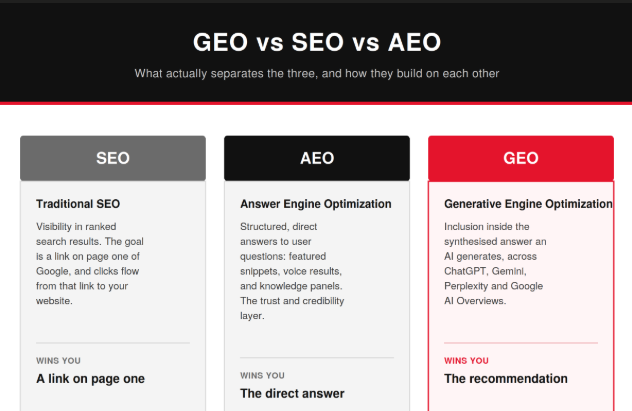
Traditional SEO focuses on visibility in ranked search results. The goal is a link on page one of Google. Clicks flow from that link to your website.
AEO, or Answer Engine Optimization, focuses on structured, direct answers to user questions. Featured snippets, voice search responses, and knowledge panels are AEO territory. AEO is the trust and credibility layer: it signals to search systems that your content is reliable enough to surface above the fold.
Generative engine optimization services operate at a broader level. The goal is not a link or a snippet. It is inclusion inside the synthesised answer an AI generates. A geo seo agency works to ensure that when a user asks ChatGPT which accounting software to use, or asks Perplexity which pump manufacturer in India has the best service track record, your brand is named in the response.
In practice, the three disciplines build on each other. Strong traditional SEO authority supports generative engine optimization performance. GEO-optimised content often improves traditional rankings. A credible llm seo agency treats the three as a stack, not three separate silos. The short version: SEO wins you a link. AEO wins you a direct answer. GEO wins you the recommendation.
Generative engine optimization services combine several disciplines that most traditional agencies handle separately or not at all, which is exactly the gap an ai seo agency is built to close.
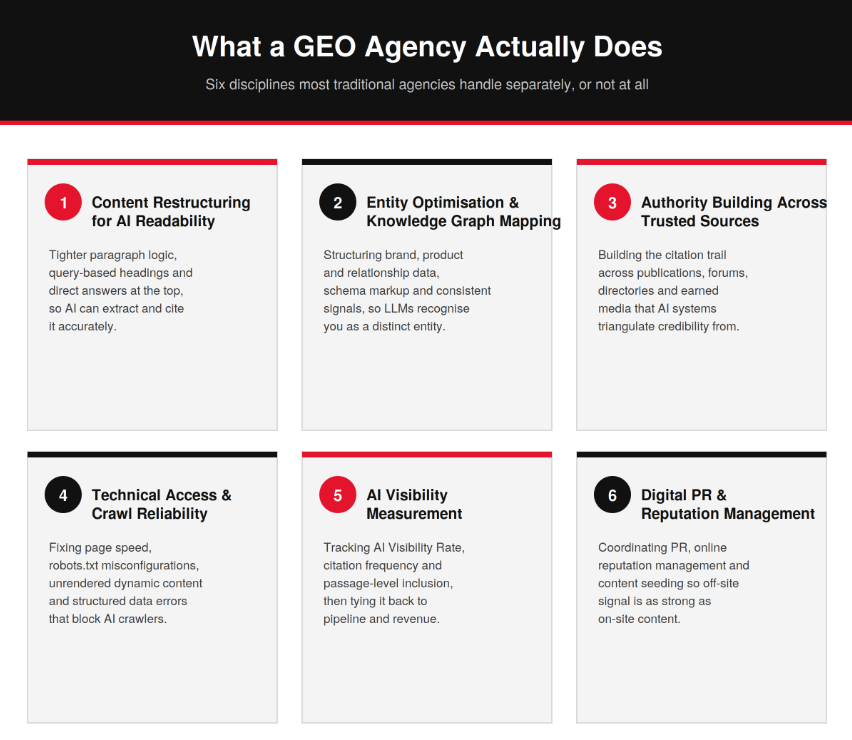
AI systems reward clarity and structure. A geo marketing agency rewrites or reorganises existing content so language models can extract, summarise, and cite it accurately. This means tighter paragraph logic, query-based headings, well-scoped sections, and direct answers at the top of each page, not buried three scrolls down.
AI models understand the world through entities: brands, products, people, locations, and the relationships between them. A geo agency maps your brand’s entity relationships and structures them in formats that LLMs can read. This includes schema markup, structured data, and consistent brand signals across the open web, the same groundwork a llm seo agency relies on to get a brand recognised as a distinct entity.
Generative engines do not just read your website. They triangulate your credibility across the broader web: publications, forums, third-party directories, review platforms, and earned media. A geo seo agency builds the citation trail that signals to AI systems that your brand is a reliable source worth recommending.
An AI system cannot cite content it cannot read. A llm seo agency audits and fixes the technical gaps that block AI crawlers: page load speeds, robots.txt misconfigurations, dynamic content that does not render for bots, and structured data errors that prevent correct extraction.
Ranking reports mean nothing in a GEO context. A geo marketing agency tracks AI Visibility Rate, citation frequency across platforms, and passage-level inclusion, then ties those numbers back to pipeline and revenue, not just impressions.
What other sources say about you shapes what AI says about you. A generative engine optimization agency coordinates digital PR, online reputation management, and content seeding to ensure the off-site signal is as strong as the on-site signal.
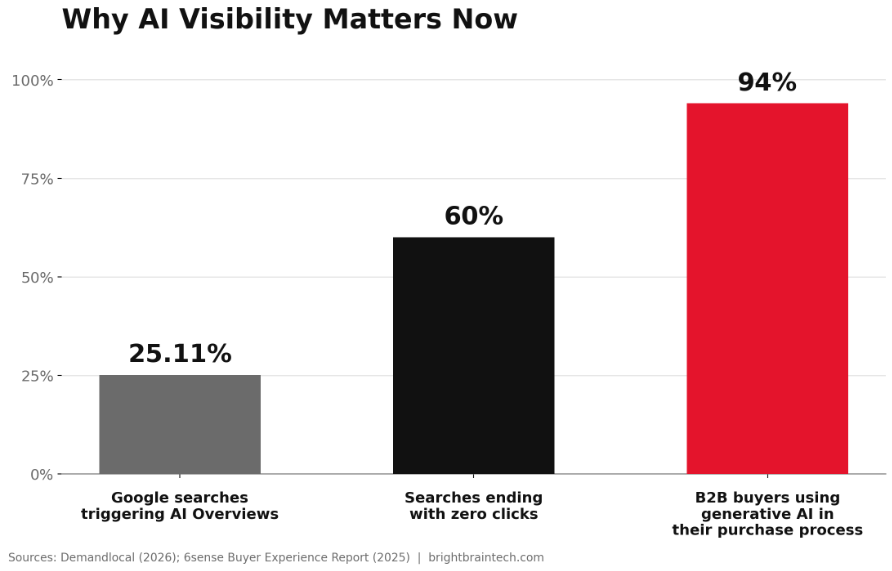
The shift is not gradual. Data from DemandLocal (2026) indicates that 25.11% of Google searches now trigger AI Overviews and 60% of searches end without a click to any website. Separately, a 6sense Buyer Experience Report (2025) found that 94% of B2B buyers now use generative AI tools during their purchase process.
The implication is direct. Your customers are asking AI systems for vendor recommendations before they run a Google search. If your brand is not named in those AI responses, you do not exist in that part of the buyer journey.
Ai seo agency services matter here because the economics of AI traffic are materially different from traditional search traffic. AI-referred visitors convert at higher rates than traditional search traffic (Demandlocal, 2026) because they arrive with a specific recommendation in hand, not an open query. A generative engine optimization agency that builds your AI citation presence is not just boosting visibility, it is building a qualified-lead channel that operates before the user ever types a search.
For Indian B2B brands in particular, the window to establish AI citation presence is still open. Most competitors have not moved yet. A geo agency engaged today builds a compounding authority position that becomes harder to displace over time, and early movers on geo services tend to keep that lead.
Not every business does, but the criteria are clearer than most assume.
The discipline is new enough that “GEO agency” has become a label applied loosely, and that includes agencies calling themselves an ai seo agency without the technical depth to back it up. Here is how to tell the real ones from the pitch-deck rebrands.
A GEO agency is a specialised marketing agency that optimises your brand’s content, authority, and technical infrastructure so that AI systems like ChatGPT, Gemini, Perplexity, and Google AI Overviews cite, reference, and recommend your brand in their generated responses. Unlike traditional SEO, which targets ranked links, a geo agency targets inclusion inside the synthesised answers AI returns.
GEO stands for Generative Engine Optimization. It refers to the practice of optimising digital content and brand signals so that large language models (LLMs) retrieve and cite a brand when generating answers. Generative engine optimization services sit at the intersection of content strategy, technical SEO, entity optimisation, and authority building, work that a dedicated GEO marketing agency is typically structured to handle end-to-end.
A traditional SEO agency optimises for ranked links in search results. A geo seo agency optimises for brand inclusion inside AI-generated answers. The technical methods differ: GEO involves entity mapping, schema for AI extraction, retrieval-augmented generation compatibility, and off-site citation building, and the measurement frameworks differ too. A GEO agency tracks citation frequency and AI visibility rate; a traditional SEO agency tracks rankings and organic traffic.
AEO (Answer Engine Optimization) focuses on traditional answer features: featured snippets, voice search, and knowledge panels in conventional search engines. Generative engine optimization extends this to AI-generated platforms like ChatGPT, Perplexity, and Gemini. Both disciplines overlap significantly, and a strong ai seo agency builds them together as a complementary stack rather than choosing between them.
A generative engine optimization agency restructures your content for AI readability, builds your brand’s entity presence, deploys structured data and schema markup, earns off-site citations across trusted sources, monitors your AI citation performance across platforms, and ties all of those activities back to pipeline and revenue. The goal is consistent, accurate brand representation inside AI-generated answers relevant to your business.
Strong traditional SEO is the foundation, not a substitute. Geo services build on top of SEO authority. AI systems rely on the same crawling infrastructure and content quality signals as traditional search, but add layers of entity recognition, passage-level extraction, and off-site credibility triangulation that SEO alone does not address. If 60% of searches now end without a click, and AI Overviews are absorbing traffic your site used to receive, traditional SEO alone is an incomplete strategy.
Some quick wins, like restructuring high-traffic existing content for AI citation readiness, can show results within weeks. Building new topical authority and off-site citation trails takes three to six months for measurable movement in citation frequency. A credible geo marketing agency will set realistic timelines and show you baseline measurement so you can track progress from day one.
High-consideration B2B categories benefit most: manufacturing, professional services, BFSI, EdTech, healthcare, and technology. These are the categories where buyers conduct extensive AI-assisted research before making a decision, and where being cited as the recommended source translates directly to qualified leads. That said, llm seo agency support is increasingly relevant across any category where buyers research online before transacting.