Every pharmaceutical marketing head in India has faced the same tension at some point. The product works, the clinical data is solid, doctors trust the brand, yet the marketing playbook that works for consumer goods, or even most other B2B categories, cannot simply be lifted and dropped into pharma. Digital marketing for pharmaceutical companies in India sits inside one of the most tightly regulated communication environments in the country, shaped by the Drugs and Magic Remedies Act, the Drugs and Cosmetics Rules, and the ethical code laid down by the Organisation of Pharmaceutical Producers of India.
Add platform-level restrictions from Google and Meta on health claims, and it becomes clear why so many pharma brands either play it too safe online or unintentionally step over a compliance line. This is exactly where a well-built approach to pharmaceutical digital marketing earns its value. Done right, it builds trust with healthcare professionals, educates patients responsibly, and grows brand equity, all without inviting a legal notice. This piece walks through the regulatory guardrails, the channels that genuinely work in the Indian pharma context, and the strategic choices that separate pharma brands with real digital traction from the ones still treating their website as a digital brochure.
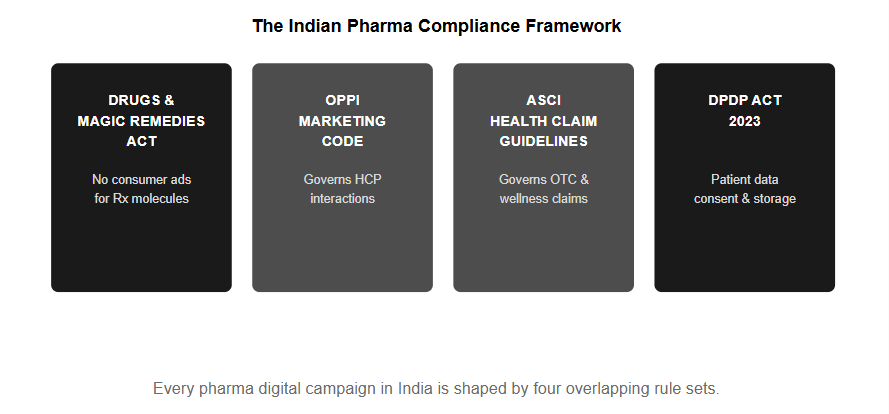
Before any campaign brief gets written, every pharma marketer needs to internalise one fact. Digital marketing in pharma industry contexts is not primarily a creativity problem; it is a compliance and trust problem first, and a creativity problem second. The Drugs and Magic Remedies (Objectionable Advertisements) Act, 1954, restricts advertising for a defined list of diseases and prohibits misleading or exaggerated claims about a drug’s ability to cure them.
Schedule H, H1, and X drugs, which require a prescription, cannot be advertised to the general public at all. Only over-the-counter medicines and general wellness products can be marketed directly to consumers, and even then within careful limits.
Sitting alongside this is the OPPI Code of Pharmaceutical Marketing Practices, which governs how companies interact with healthcare professionals, covering everything from gifting and hospitality to sponsorships and sample distribution. The National Medical Commission’s code of ethics further restricts what a registered doctor can endorse publicly, which is why brand ambassador-style campaigns simply do not exist in this category the way they do in FMCG.
The Advertising Standards Council of India applies its own guidelines to health and wellness claims, adding another layer of scrutiny for OTC and nutraceutical brands. On top of the regulatory framework, Google Ads and Meta Ads carry their own healthcare content policies that restrict personalised targeting for medical conditions and, in some cases, require certification before health-related ads can even run.
Layer in the Digital Personal Data Protection Act, 2023, which governs how patient data collected through forms, chatbots, or adherence apps must be stored, consented to, and protected, and the picture becomes clear. Any credible pharma digital marketing strategy in India has to be built around these constraints from day one, not retrofitted after a campaign gets flagged.
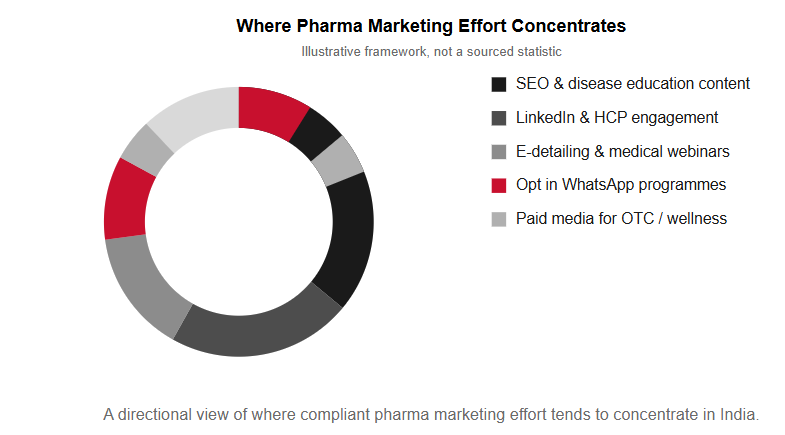
Once the regulatory boundaries are clear, the channel conversation becomes far more practical. Digital marketing pharma teams in India tend to see the strongest, most sustainable results from a specific mix of channels, each suited to a particular audience and purpose. In practice, this is where digital marketing in pharma industry teams either build a durable presence or waste a budget chasing tactics that were never designed for this category in the first place.
Search engine optimisation remains the backbone. Disease awareness content, symptom explainers, and condition-specific microsites answer the questions patients are already typing into Google, without promoting a specific molecule. This kind of content is low risk from a regulatory standpoint and compounds in value over time, unlike a paid campaign that stops the moment the budget does.
Most successful digital marketing for pharmaceutical companies programmes in India are built around this channel logic rather than around a single flagship campaign.
LinkedIn is, without question, the strongest channel for reaching healthcare professionals. Medical affairs updates, key opinion leader collaborations, clinical trial milestones, and corporate announcements all land well with a professional, credentialed audience that trusts the platform’s context. Medical education platforms and e-detailing apps have also become central to how field teams reach doctors, replacing or supplementing in-person visits with virtual conferences, webinars, and continuing medical education content.
WhatsApp Business has quietly become one of the most effective tools for patient-facing programmes, provided every interaction is opt-in. Appointment reminders, adherence nudges for approved OTC products, and caregiver support messages all work well here because the channel feels personal without crossing into unsolicited promotion.
For over-the-counter and wellness brands specifically, programmatic and native advertising can run in a more conventional sense, since these products are not bound by the same prescription drug restrictions. Video content, particularly doctor-led explainers and CSR storytelling on platforms like YouTube, rounds out a channel mix built for digital pharma marketing that respects both the law and the audience’s intelligence.
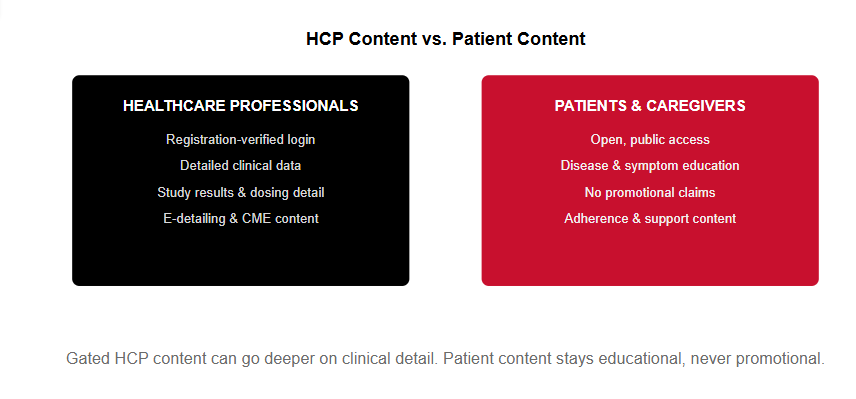
Channels alone do not make a strategy. The pharma companies seeing genuine digital traction in India share a few strategic habits that others tend to skip. The first is audience segmentation that goes beyond demographics. Healthcare professionals, patients, and caregivers each need distinct content built for their specific decision, and blending these audiences into one generic content stream is one of the most common reasons pharma websites underperform.
The second habit is gated, verified content for healthcare professionals. Login walls that verify a medical registration number allow companies to legally share more detailed clinical data, dosing information, and study results than public-facing content ever could, since that information is intended for a qualified audience rather than the general public. The third is an SEO approach that targets disease and symptom queries rather than brand or molecule names for prescription products, since the latter simply cannot be promoted to consumers in the first place.
Measurement also needs to shift. Instead of judging every campaign purely on conversions, the more useful metrics for this category include HCP content engagement rates, e-detail completion rates, and patient adherence app retention over time. None of this works, however, without a medical, legal, and regulatory review workflow built directly into the content calendar. A pharmaceutical digital marketing strategy that treats MLR review as an afterthought will always stall at the last mile, no matter how strong the creative or the targeting is. This is also where a broader digital marketing for pharmaceutical companies view helps, since it forces teams to plan for review timelines before a campaign is built, rather than after it gets stuck in approvals.
Because paid promotion of prescription drugs to consumers is essentially off the table, the content marketing pharmaceutical industry teams rely on tends to carry far more weight than it does in almost any other category. Disease awareness articles, patient support programme pages, caregiver resources, and doctor-authored condition guides build long-term organic authority in a way that paid media simply cannot replicate here.
There is also a newer advantage worth noting. The exact kind of clear, credible, well-structured health information that Google’s featured snippets and AI Overviews reward is precisely what a strong content marketing programme produces. Pharma brands investing early in structured, genuinely useful health content are increasingly the ones being cited by AI-powered search experiences, giving them visibility that a purely paid approach could never buy in this category.
This is also where digital marketing for pharmaceutical companies’ budgets tends to be spent most efficiently, since a single well-researched piece of disease education content keeps working long after a paid campaign has ended. The strongest content marketing pharmaceutical industry programmes treat this as an ongoing editorial function, not a one-time project, updating existing content as guidelines, treatment protocols, and search behaviour evolve.
None of this happens without the right execution partner. A team working on digital marketing for pharmaceutical companies in India needs to understand MLR review timelines from the inside, know the practical difference between OTC and prescription marketing rules, and be capable of building SEO and content engines rather than running one-off campaigns that disappear once the budget ends.
Bright Brain brings this to the table as a Google Elevator Partner, one of only 15 agencies selected from over 7,000 across India, alongside Google International Growth Agency Partner status and Meta Business Partner recognition. That credential stack, combined with genuine AEO and GEO expertise, means the same discipline that has driven measurable results across fintech, real estate, and e-commerce clients can be applied to the specific constraints of the pharma category, built around compliance rather than around it.
For a marketing head evaluating partners, the real question is simple. Does this team understand digital marketing pharma work well enough to plan an entire pharmaceutical digital marketing strategy around MLR timelines, or will compliance be treated as a last-minute obstacle? Agencies that have only ever worked on unregulated categories tend to struggle with this shift, however talented their creative output may be for a typical content marketing pharmaceutical industry brief.
Pharma marketing in India will likely never look like marketing in any other category, and that is not a limitation to work around; it is simply the terrain. The brands doing this well are not the ones chasing shortcuts around the Drugs and Magic Remedies Act or the OPPI Code; they are the ones building genuinely useful, well-governed digital programmes that healthcare professionals and patients actually trust.
If your team is ready to build a compliant, growth-focused digital presence, Book a Consultation Call with Bright Brain, or View Case Studies to see how a credential-backed, results-first approach has worked across other regulated and high-consideration categories.
No. Schedule H, H1, and X drugs cannot be advertised to the general public under Indian law. Digital marketing for pharmaceutical companies can promote only over-the-counter medicines and general wellness products directly to consumers, and even these campaigns must avoid misleading or exaggerated health claims under the Drugs and Magic Remedies Act.
The OPPI Code is a self-regulatory framework from the Organisation of Pharmaceutical Producers of India that governs how companies interact with healthcare professionals. Digital marketing for pharmaceutical companies must follow these ethical guidelines on gifting, hospitality, sponsorships, and sample distribution to ensure transparent and compliant promotional practices.
For digital marketing for pharmaceutical companies, SEO-driven disease education content, LinkedIn for healthcare professional engagement, e-detailing, medical webinars, and opt-in WhatsApp programmes for patients deliver the most sustainable results. Paid advertising is generally limited to OTC medicines and wellness products.
Yes. Digital marketing for pharmaceutical companies benefits significantly from SEO focused on disease and symptom education rather than branded or molecule-specific promotion. This approach carries lower regulatory risk while building long-term organic visibility and trust.
The Digital Personal Data Protection Act, 2023 requires clear consent before collecting patient data through forms, chatbots, or adherence apps, along with secure storage and defined usage limits. For digital marketing for pharmaceutical companies, privacy compliance is now a fundamental part of every digital programme.
An effective digital marketing strategy for pharmaceutical companies segments healthcare professionals, patients, and caregivers separately, incorporates MLR review into the content workflow from the start, prioritises education over promotion, and measures engagement and adherence alongside business outcomes rather than relying only on conversion volume.