
The enrollment season lasts eight weeks.
For most schools, colleges, and EdTech brands in India, those eight weeks decide the entire year. Admission targets, fee revenue, batch sizes, faculty ratios: every downstream number traces back to how many of the right students enrolled during that window.
And the decision about which institution to choose? That’s being made on a phone. By a student on Instagram at 11 pm. By a parent on Google on a Sunday morning. By both of them watching a college’s YouTube channel to see whether the campus looks like what they imagined.
The institutions that fill their seats during that window aren’t necessarily the ones with the best programmes. They’re the ones that are visible, credible, and specific when the decision is being made. They’ve built an admissions pipeline, not just a marketing campaign, usually with the help of a specialised digital marketing agency for education industry experience.
Here’s how Indian schools, colleges, and EdTech brands are doing it, using a mix of paid, organic, and content-led approaches that make up modern digital marketing for education sector work.
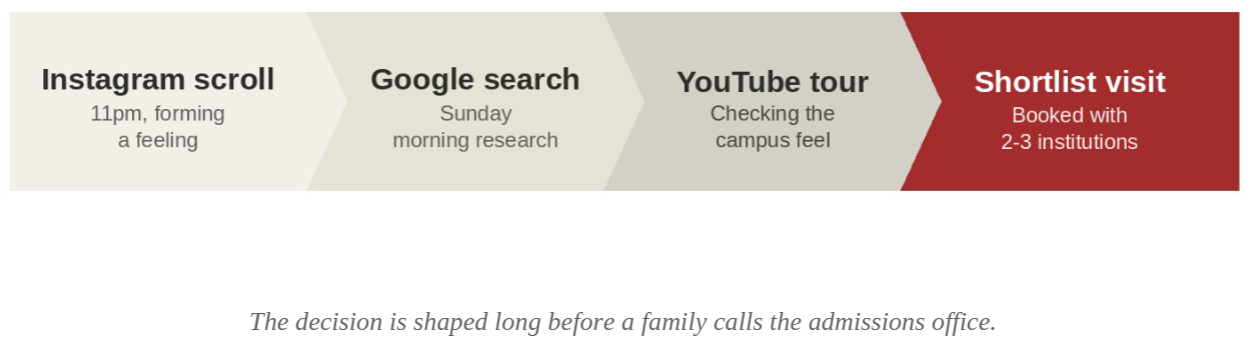
A decade ago, a school’s reputation was built through principal networks, board exam results posted on gates, and newspaper inserts. A college’s reputation was built through the batch before, word-of-mouth from alumni families in the same housing society.
Both of those channels still carry weight. But neither of them is where the shortlist gets built now.
Today, a parent evaluating two schools starts on Google, reads reviews, scrolls both schools’ Instagram pages, watches a virtual tour video on YouTube, and makes a shortlist, all before booking a school visit. A student choosing between degree colleges reads Reddit threads, checks LinkedIn for alumni placement data, and evaluates the institution’s credibility based on the quality of its online presence.
If your institution isn’t present and credible across those touchpoints, you’re not being considered. You’re being skipped in favour of a competitor who understood that the admissions office is no longer the first impression. That’s exactly the gap a specialised digital marketing agency for education industry is built to close, through online marketing for educational institutions that meets families at every stage of the search. This is the core promise of well-executed digital marketing for educational institutions: showing up, credibly, before the competitor does. A dependable digital marketing agency for education treats this as the starting point of every strategy, not an afterthought.
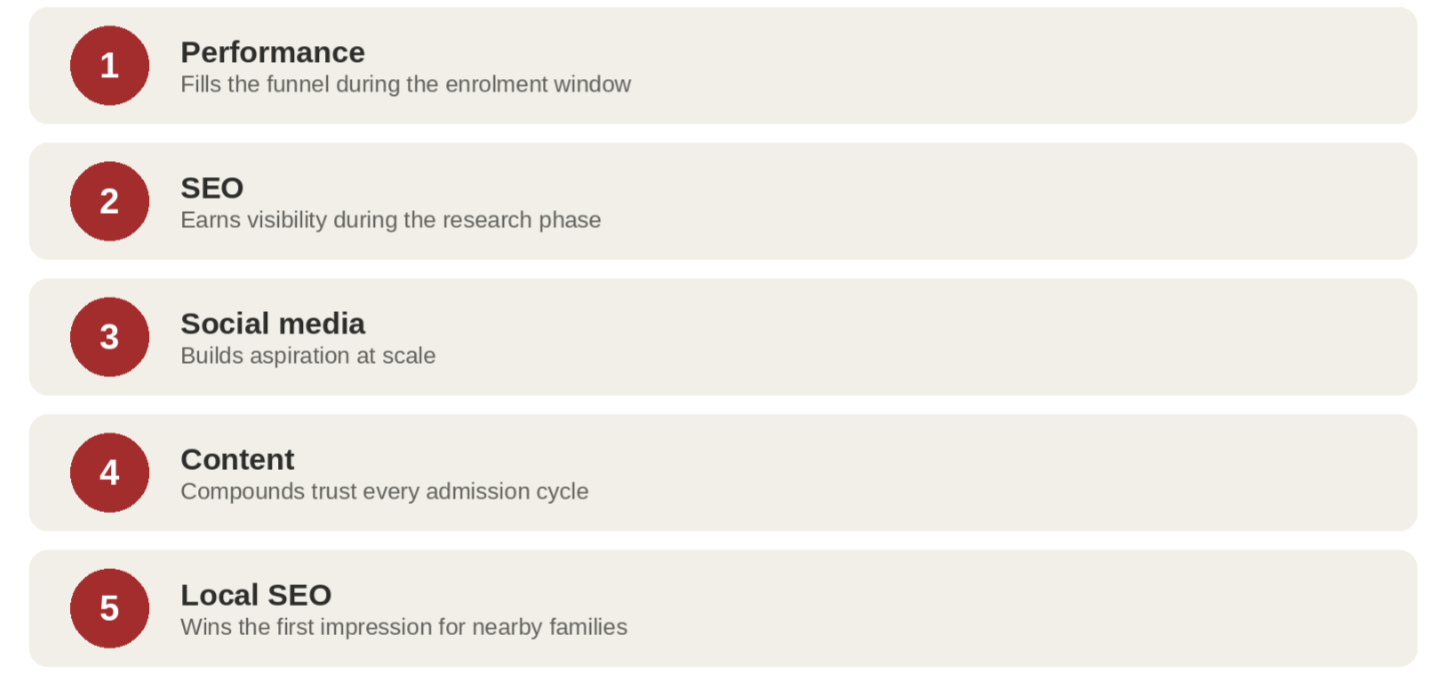
These are the five channels a capable digital marketing agency for education industry background should manage as one coordinated system, not five separate line items.
For schools, colleges, and EdTech brands, performance marketing (Google Search Ads and Meta Ads) is the highest-leverage channel during the admission season. The reason is precision: you can reach students and parents who are actively searching for institutions in your category, your geography, and your fee range, exactly when they’re looking.
Google Search Ads work for capturing high-intent queries: “CBSE school admission in Andheri,” “BBA college Mumbai admission 2026,” “online MBA programmes India.” These buyers have already decided they want to act. Your ad gets them to you before they find a competitor.
Meta Ads (Facebook and Instagram) work for the awareness-to-consideration phase, reaching parents in specific demographics, interests, and geographies with content that builds familiarity and trust before the search begins.
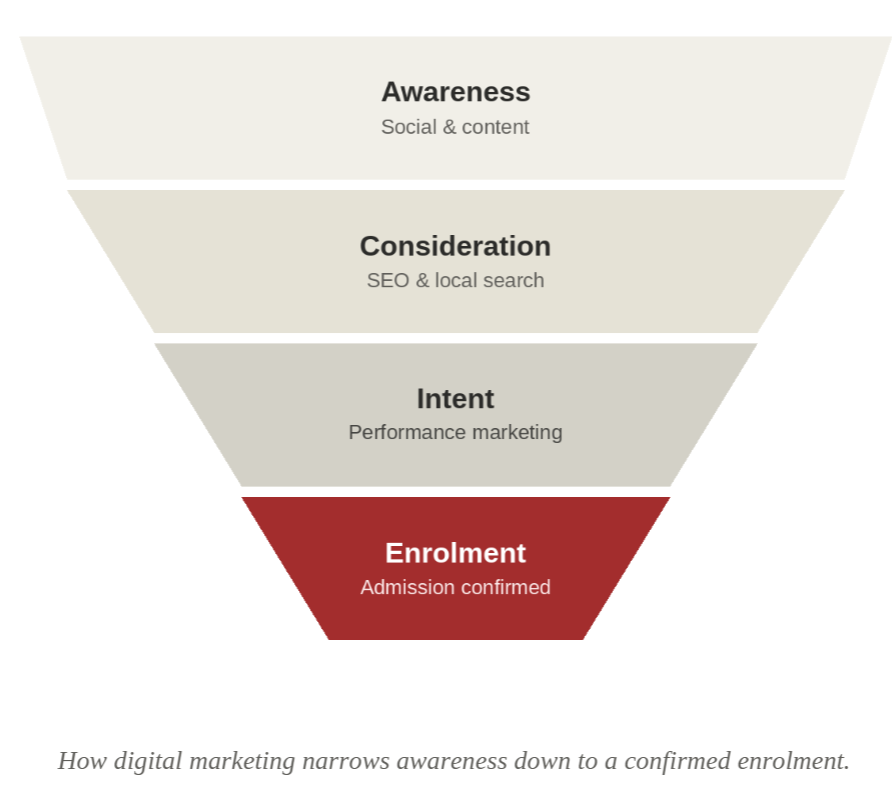
The combination of both, Search for active buyers, Meta for building the consideration pool, is what creates a full-funnel admissions system rather than a last-minute sprint.
Atlas University ran this full-funnel approach with Bright Brain. The result: a 95% rise in brand search queries, a 9% reduction in cost per lead, and a 17.78% increase in lead flow, while winning Bright Brain the e4m Digital Partner of the Year award in 2025. Results like these are what a genuine digital marketing agency for education industry track record should be able to show, not just promise.
Before the enrollment window opens, families are researching. They’re comparing institutions, reading about programmes, and looking for signals that tell them whether an institution is credible. SEO for educational institutions is about being found during that research phase, not just during peak admission season.
An effective SEO strategy for schools and colleges in India targets:
The institutions that show up organically for these searches build a credibility advantage that paid ads alone cannot replicate. A parent who finds an institution through organic search has already been through a filtering process; they’re more qualified, more informed, and more likely to convert into an enrolled student. This is the kind of organic visibility a specialist seo agency for universities and schools alike is built to deliver. A well-briefed digital marketing agency for schools builds exactly this kind of long-term organic asset alongside any paid activity.
For schools and colleges, Instagram and YouTube aren’t optional extras. They are where prospective students form their emotional impression of your institution.
A student choosing between two colleges with similar programmes and similar fees will choose the one that feels like where they belong. That feeling is built through consistent, authentic social media marketing for educational institutions, campus life, faculty thought leadership, student testimonials, placement stories, and behind-the-scenes access.
Social media marketing for educational institutions works best when it shows, not tells. Not “we have a state-of-the-art campus”, but a reel of students in the library at 9 pm, or a faculty member explaining a concept that isn’t in any textbook. That’s the content that converts a consideration into a visit request. A skilled digital marketing agency for education industry clients rely on builds this kind of content system deliberately, rather than posting on instinct.
Done well, social media marketing for educational institutions is what turns a passive scroller into someone who books a campus visit. For EdTech brands, social media performs a different function: demonstrating that learning is happening. Course completion stories, skill application testimonials, and learner community content build the proof that the online format delivers what it promises. It’s one of the clearest examples of how online marketing for educational institutions shifts depending on whether the audience can visit a physical campus.
Content marketing for education compounds in a way that paid campaigns don’t. A well-written guide to “how to choose the right college in India” or a resource on “CBSE vs ICSE: what parents need to know” attracts families in the research phase, builds trust, and generates inquiries, year after year, without additional spend.
The best educational content addresses the actual questions families are asking during the decision process:
Institutions that build this content library don’t just get traffic. They become the reference point for families navigating a complex, high-stakes decision. That’s a trust advantage that outlasts any single admission campaign, and it’s why content marketing for education is rarely optional for institutions serious about enrolment growth. Alongside SEO, it’s one of the two channels that make digital marketing for educational institutions a compounding asset rather than a recurring cost.
For schools and colleges with a physical campus, local SEO is the highest-ROI channel in the mix. When a parent searches “CBSE school near me” or “degree college in Thane,” the Google Maps result is the first thing they see, before organic results, before ads.
A well-maintained Google My Business profile with accurate information, recent photos, active reviews, and a high star rating is often the difference between a school visit inquiry and a scroll-past. Yet most schools in India treat their GMB listing as an afterthought. This is one of the simplest wins a digital marketing agency for schools can deliver in the first 90 days of an engagement.
The institutions that take local SEO seriously, maintaining an accurate profile, actively soliciting parent reviews, and responding to questions, show up first in the local pack and get first-mover advantage with the highest-intent, lowest-funnel searchers. For universities and larger colleges managing multiple campuses, this local-search discipline is usually run alongside a dedicated seo agency for universities, since the technical requirements scale with every additional location.
The challenge with most content about digital marketing for education sector is that it stays at the level of advice, “run Google Ads,” “post on Instagram”, without showing what the numbers look like when the strategy is built correctly.
Here’s what it looks like.
Atlas University needed to grow brand recognition alongside direct admission inquiries. The challenge: a crowded EdTech and university landscape where every competitor was running similar campaigns with similar messaging. The brief to Bright Brain was to cut through, not by spending more, but by being sharper.
The approach: a full-funnel campaign integrating Google Search, Meta, and brand search investment, timed precisely to the admissions cycle and optimised for lead quality, not lead volume.
The results: 95% rise in brand search queries. 9% reduction in cost per lead. 17.78% increase in lead flow. The campaign won the e4m Digital Partner of the Year 2025.
For another education client, ISME, a focused Google Search Ads campaign delivered a 2,166% campaign ROAS, not through a higher budget, but through tighter audience definition and sharper creative aligned to the specific anxieties of the target applicant. This is the standard of proof to expect from any digital marketing agency for education industry you’re evaluating.
These aren’t outliers. They’re the consistent pattern when educational institutions stop running generic awareness campaigns and start building intent-based admissions pipelines with a proven digital marketing agency for education. Numbers like these are what separate genuine digital marketing for education sector expertise from generic agency work borrowed from consumer categories, and they’re the standard any serious online marketing for educational institutions partner should be held to.
Most schools, colleges, and EdTech brands that invest in digital marketing for education sector work and see poor results are making one of three consistent mistakes. Interestingly, many of these mistakes trace back to skipping content marketing for education entirely and relying only on paid media, or to hiring a generalist digital marketing agency for schools without sector experience.
Mistake 1: Running admission campaigns only during peak season The decision to enrol in an institution is rarely made in the three weeks before the deadline. It’s shaped over months, a school visit in November that was prompted by an Instagram reel seen in August. Institutions that only run campaigns during the admission window are competing with everyone else in a very crowded space, without the brand equity that familiarity builds over time.
Mistake 2: Measuring leads instead of enrolments A digital marketing campaign for a school or college is only successful if it contributes to enrolments, not just inquiries. Many institutions optimise their campaigns for inquiry volume and end up with large numbers of low-quality leads that don’t convert. The right metric is cost per enrolment, not cost per lead. Getting there requires tracking the full funnel, from first ad click to admission form to enrolment, and optimising accordingly.
Mistake 3: Separating brand and performance budgets Institutions that treat brand campaigns and performance campaigns as separate, unrelated budget lines consistently underperform. Brand investment, awareness content, social media presence, and organic search visibility reduce the cost per lead in performance campaigns by warming up the audience before the ad appears. The two work together. Managing them separately produces suboptimal results from both, and it’s a mistake a capable digital marketing agency for education will flag early in any audit.
Not every agency understands the admission cycle, the parent-student dual-audience dynamic, or the compliance requirements that govern education marketing in India. Choosing the right digital marketing agency for education industry partner is one of the highest-leverage decisions an institution’s leadership will make all year. Whether you’re looking for a broad digital marketing agency for education or a specialist digital marketing agency for schools, or even a focused seo agency for universities for a single campaign, the right partner needs to demonstrate:
Bright Brain has delivered proven results across the education sector: 95% brand search growth and 17.78% lead flow increase for Atlas University, and 2,166% campaign ROAS for ISME. As one of only 15 Google Elevator Partners selected from 8,000+ agencies in India, we bring both the credentials and the case studies expected of a serious digital marketing agency for education industry partner, as well as the range to work as a dedicated digital marketing agency for schools, universities, and EdTech brands alike.
Q1: What is the best time to run digital marketing campaigns for school and college admissions?
Run intensive campaigns from November to February, aligned with admission season, but start building awareness from June so families already recognise you when the window opens. Launching cold in October and expecting January results is the costliest mistake, one a competent digital marketing agency for education helps you avoid by planning early.
Q2: How much does digital marketing cost for a school or college in India?
Programmes typically start at ₹2–5 lakh per month in peak admission season, scaling to ₹1–2 lakh in off-season for brand and content work. Measure returns against cost per enrolment, not cost per lead. Most institutions get better ROI partnering with an established digital marketing agency for education industry clients trust than going in-house.
Q3: Which social media platform works best for educational institution marketing?
Instagram reaches students aged 15–25; Facebook and LinkedIn reach parents and professionals; YouTube suits campus tours and faculty features. The right social media marketing for educational institutions strategy depends on your audience. Universities running multi-programme campaigns often pair this with a dedicated seo agency for universities for reinforcement.
Q4: How does SEO help educational institutions drive enrolments?
SEO builds visibility for research-phase searches: programme names, comparisons, “best college in [city].” Organic rankings are trusted more than ads and keep working without ongoing spend. A specialist seo agency for universities and schools captures researching families that paid campaigns never reach.
Q5: How should EdTech brands approach digital marketing differently from traditional institutions?
EdTech brands can’t offer campus visits, so trust must come from elsewhere. Digital marketing for educational institutions operating online leans harder on social proof (completion stories, learner outcomes, instructor credentials, and community content) to build the confidence a campus visit normally provides.
Q6: What metrics should educational institutions track for digital marketing?
Track enrolments first, then cost per qualified inquiry and inquiry-to-enrolment conversion. Impressions and clicks are vanity metrics. A good digital marketing agency for education industry partner ties every campaign to enrolment, the discipline that defines mature digital marketing for education sector work, whether it’s called online marketing for educational institutions or something else.
Q7: Is it worth hiring an external digital marketing agency for education industry, or should institutions build an in-house team?
Yes, usually. Agencies bring cross-institution pattern recognition, sharper creative testing, and dedicated media-buying expertise most in-house teams lack. A hybrid model, an in-house counsellor supported by an external online marketing for educational institutions partner, works best for larger institutions with year-round admissions activity.