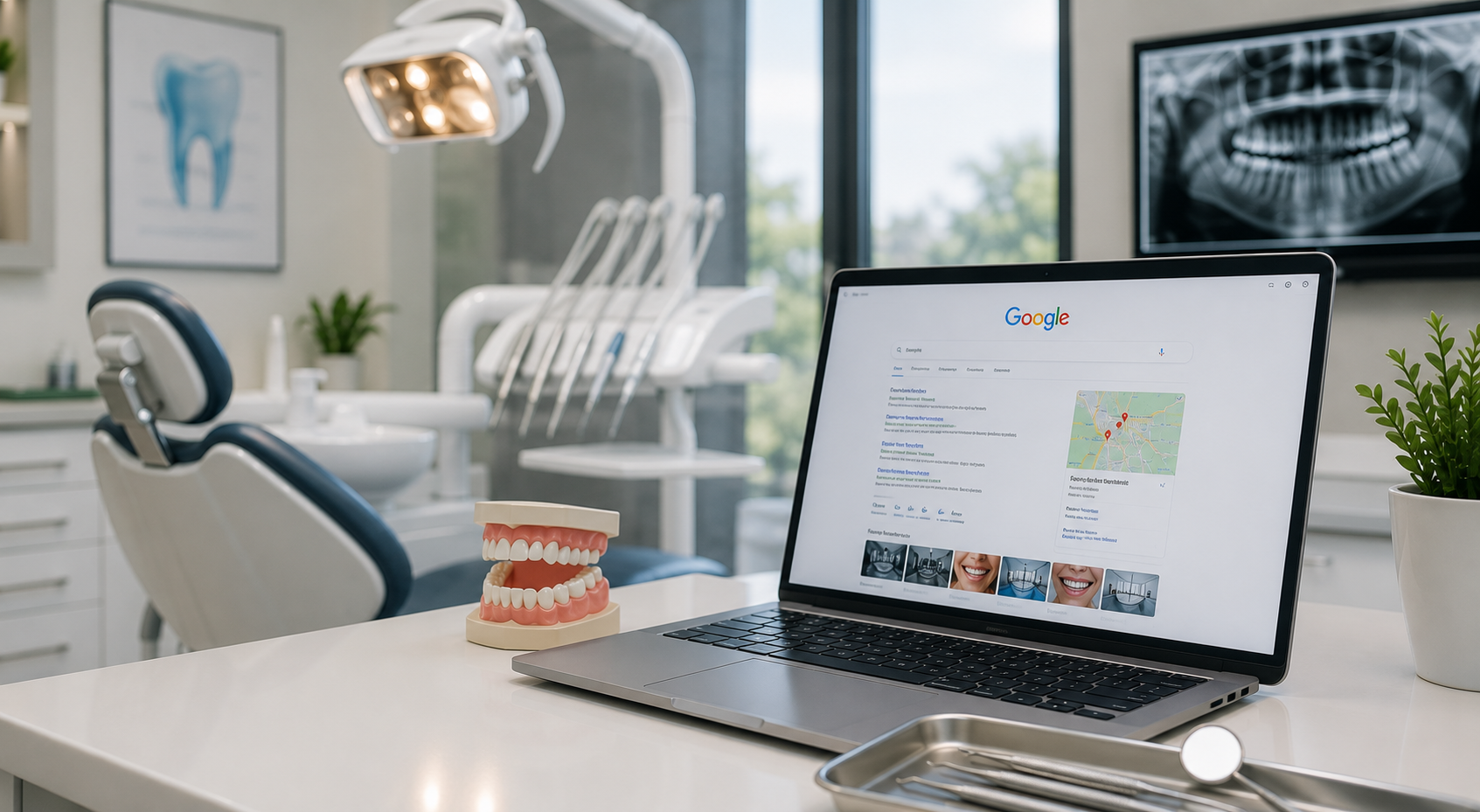
The new patient’s journey starts before they call.
They wake up on a Tuesday morning with tooth pain. They pick up their phone. They search “dentist near me” or “emergency dentist [neighbourhood name].” Google returns a local pack, the three clinics shown in the map result at the top of the page. They click on the first one, check the reviews, read a few lines about the clinic, and book an appointment through the website.
Your phone didn’t ring. But the decision was already made.
This is how new patients find dentists in 2026. Not through a referral (though referrals still matter). Not through a newspaper insert (long gone). Not through the address on the building. Through a 90-second phone search that returns three options and ends with an appointment at whichever clinic appeared first and looked most trustworthy.
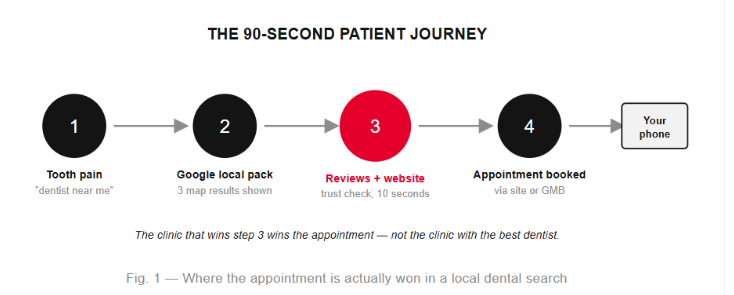
The dental practice that wins that search moment doesn’t necessarily have the best dentist. It has the best dental seo, a Google My Business profile that’s complete and actively maintained, reviews that build trust at a glance, and a website that answers the patient’s specific question before they can think to ask it. Building all of this in-house is rare; most practices eventually bring in a dental seo company to run it as a system rather than a side project.
Here’s how clinics and dentists in India build that presence.
Most dental practices in India market through word-of-mouth, referrals from existing patients, and occasional print or social media advertising. All of these matter. But none of them capture the patient who is ready to book an appointment right now, which is exactly who search marketing reaches.
Dental SEO is high-ROI for three specific reasons:
This same logic extends beyond dentistry. A physiotherapist, a counsellor, or a clinic offering seo for therapists is chasing the same local, high-intent search behaviour, just in a different specialty. The mechanics a dental seo company uses to win the local pack for a dental clinic translate almost directly to seo for therapists and other appointment-based healthcare practices.
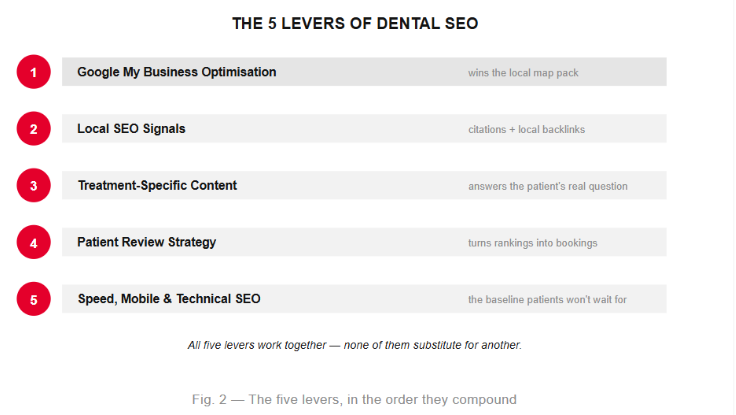
For most dental clinics in India, Google My Business optimization is the single highest-impact SEO asset, because it’s what determines whether the clinic appears in the local pack (the three-result map block at the top of a local search result). The same is true for a physiotherapy clinic running seo for therapists, or any other appointment-based practice: the map pack, not the website, is usually the first real impression.
Appearing in the local pack for “dentist in [your area]” generates more new patient inquiries than ranking at position one in the organic results below it. The local pack is the first thing the patient sees; it shows reviews and ratings at a glance, and it enables direct appointment booking through the GMB listing.
A fully optimised GMB profile for a dental clinic includes:
Most dental clinics in India have a GMB profile. Very few have an actively optimised one. That gap is where the competitive advantage lives, and it’s usually the first thing a dental seo company fixes in the first 30 days of an engagement.
Google determines local search rankings based on three factors: relevance (how well does this business match the search?), distance (how close is the business to the searcher?), and prominence (how well-established and credible is the business online?).
Of these three, prominence is the one most directly shaped by a dental seo company:
For dental clinics in multi-location cities like Mumbai, Bengaluru, or Delhi, working with a dedicated local seo agency is usually the deciding factor between appearing in the local pack for “dentist in Bandra” vs appearing in it for “dentist in Mumbai”, a much larger and more competitive pool.
Most dental clinic websites list their services. Very few answer the specific questions patients are asking when they search for those services.
A patient considering dental implants isn’t searching “we offer dental implants.” They’re searching “dental implant cost in Mumbai” or “how long do dental implants last” or “dental implant vs bridge India.” The clinic that has specific, detailed content answering those questions, on a dedicated implant page, in a FAQ section, or in a blog post, appears when that patient is in research mode.
This is treatment-specific content: pages and posts built around the actual search queries of patients who are considering a specific procedure. It’s the SEO equivalent of being present in the patient’s conversation with themselves before they book. Producing this well is as much a dental web design company function as it is a writing function, since the page structure and load speed matter as much as the words on it.
The highest-traffic treatment content for dental clinics in India covers:
Clinics that build specific, accurate content around each of these treatment categories rank for the informational searches that precede booking, and they convert that ranking into appointments.
A clinic that ranks third in the local pack with 200 reviews at 4.8 stars will frequently out-convert a clinic that ranks first with 15 reviews at 4.2 stars.
Reviews are not an afterthought to dental SEO. They’re the trust signal that converts a search ranking into an appointment booked. A patient browsing three options in a local pack is looking at star rating, review count, and the quality of the most recent reviews, all before they click through to the website.
An effective dental practice review strategy has three components:
In 2026, 80%+ of dental search queries in India come from mobile devices. A dental clinic website that loads slowly on mobile, displays incorrectly on a small screen, or makes it difficult to find the phone number or appointment booking form loses patients before they’ve read a word about the practice. This is precisely the layer where a specialist healthcare web design agency earns its retainer: a site that’s fast and clear on mobile, not just attractive on a desktop mockup. A dental web design company and a healthcare web design agency solve the same underlying problem, just for slightly different patient journeys.
Technical dental SEO covers:
These are baseline requirements, not competitive advantages. A clinic website that doesn’t meet these standards is leaving ranking potential on the table before the SEO work even begins, and it’s often the first gap a dental web design company flags during an initial audit.
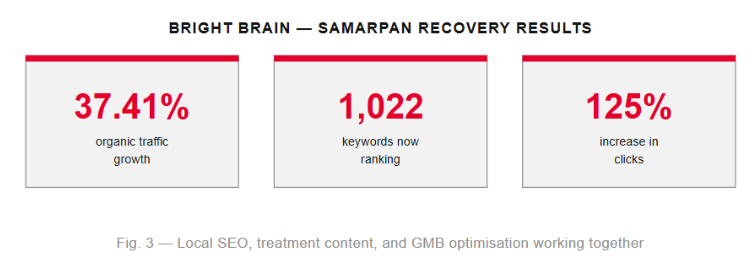
Bright Brain has executed SEO programmes for healthcare-adjacent clients that follow the same local intent model as dental SEO. The Samarpan Recovery case demonstrates the pattern: 37.41% organic traffic growth, 1,022 keywords now ranking, and a 125% increase in clicks, from a combination of local SEO, treatment-specific content, and Google My Business optimization.
The Ziba Beauty case (US market) illustrates a cross-vertical principle: 70% of target keywords on the first page and a 39.77% increase in organic traffic from a similar structure, local signals, specific service content, and review velocity working in combination.
The pattern is consistent across healthcare-adjacent services: specific content, active GMB, and review discipline compound into a search presence that generates appointments without ongoing ad spend. It’s the same pattern any credible dental seo company should be able to point to, regardless of the specific clinic or specialty involved.
Mistake 1: Treating the website as a brochure, not a patient-acquisition tool. A website that lists “General Dentistry, Cosmetic Dentistry, Orthodontics” without explaining what each treatment involves, what it costs, how long it takes, and what a patient should expect fails the patient at the search moment. The clinic that answers those questions in detail ranks for the research queries and converts the researcher into a patient. The clinic with the brochure website hopes the patient calls.
Mistake 2: Neglecting GMB after the initial setup. A GMB profile created once and left untouched signals neglect to Google and to patients. Active GMB profiles with recent photos, recent reviews, and recent posts consistently outrank dormant ones in local pack results, even when the dormant profile belongs to a more established practice. Google My Business optimization is not a one-time setup. It’s an ongoing maintenance task that directly impacts local pack visibility, and it’s one that a serious healthcare web design agency or local seo services provider should build into the retainer as recurring work, not a one-off deliverable.
Mistake 3: Chasing high-volume, non-local keywords. “Best dentist in India” is a search term. It’s not a patient acquisition opportunity for a clinic in Pune. The patients a dental clinic actually serves are searching within their commutable distance, and the SEO strategy should target those local, specific queries rather than high-volume terms with no geographic relevance. A clinic ranking for “dental implants in Kothrud” gets appointments. A clinic trying to rank for “best dental implants India” competes with national brands and aggregators and wins no patients. This is exactly the mistake a competent local seo agency is paid to prevent.
The right dental seo company for a clinic needs to demonstrate:
Not every generalist digital shop can deliver this. Whether a clinic is comparing individual local seo services providers or looking for the best local seo company India has to offer in the healthcare category specifically, the checklist above doesn’t change. A dedicated local seo agency with healthcare experience will already have this checklist built into onboarding, rather than discovering it mid-engagement, and the best local seo company India clinics work with almost always leads with GMB and review strategy, not just backlinks.
Bright Brain’s SEO work spans healthcare-adjacent clients across India and the US, with a track record in local and organic search across professional service businesses. This is the same discipline we bring to every dental seo company engagement, whether the client is a single clinic or a multi-location practice.
Q1: How long does dental SEO take to show results?
Local SEO results for dental clinics typically begin within 2-4 months for Google My Business optimization and local pack visibility. Content rankings take 4-8 months. The full compounding effect materialises around the 9-12 month mark, the timeline any honest dental seo company should set upfront.
Q2: How much does dental SEO cost in India?
A credible dental seo company in India typically charges ₹25,000-75,000 per month, depending on market competitiveness, treatment specialities targeted, and whether content creation is included. Modest local seo services can work at the lower end, though the best local seo company India clinics use prices this in clearly upfront.
Q3: Is Google My Business optimisation the same as dental SEO?
Google my business optimization is the most impactful single component of dental local SEO, since it drives local pack visibility. Full dental SEO also needs technical optimisation, content, citations, and reviews, which is why a local seo agency treats GMB as one input, not the whole programme.
Q4: How important are Google reviews for dental clinic SEO?
Reviews are one of three ranking factors Google uses, alongside relevance and distance. A clinic with 200 recent reviews will outrank one with 30. Reviews also convert rankings into bookings; patients judge review count and recency before clicking through to a site built by a good dental web design company or healthcare web design agency.
Q5: Can a new dental clinic compete with established clinics on Google?
Yes, especially in specific neighbourhoods or treatment niches. A new clinic with a complete GMB profile, early reviews, and content around a niche treatment can outrank older, neglected clinics. This is where a focused local seo agency, or the best local seo company India has to offer, beats a bigger but inactive competitor.
Q6: What is the difference between local SEO and general SEO for dentists?
General SEO targets broad, high-volume keywords nationally. Local seo services target geography-specific queries within a practice’s catchment area. For dental clinics, local is the primary discipline since patients and searches are local, and the same applies to seo for therapists and other appointment-led healthcare practices.
Q7: Does a dental clinic need a separate web design partner, or can the SEO company handle the website too?
Many clinics do better with one partner handling both. A dental web design company that also runs SEO avoids handoff friction, and a broader healthcare web design agency brings outside pattern recognition. Ask any agency whether design and SEO sit under one roof, since a best local seo company India candidate should offer both or a tested handoff.