
The conversation usually starts the same way. A marketing head at a logistics or SaaS company has been running Google Ads in-house; the results look decent on paper, and leadership wants to scale. They brief three agencies, sit through three presentations about audience targeting and creative testing, and sign the one with the most confident pitch.
Six months later, the CPL looks acceptable. But the sales team is closing nothing.
This is the most common failure pattern in b2b performance marketing agency retainers in India today. The agency is optimising for what it can measure easily: form fills, click-through rates, cost per lead. The client is optimising for what actually matters: pipeline, revenue, and qualified conversations. These two objectives rarely align automatically.
The distinction between a generic agency and a genuinely capable b2b performance marketing agency comes down to one question: do they understand that a B2B lead and a B2C lead are fundamentally different animals? B2B buyers have longer decision cycles, multiple stakeholders, and high intent barriers. A form fill from a junior executive exploring options carries zero commercial value. A demo booked by a procurement head who has already read your case studies is worth something.
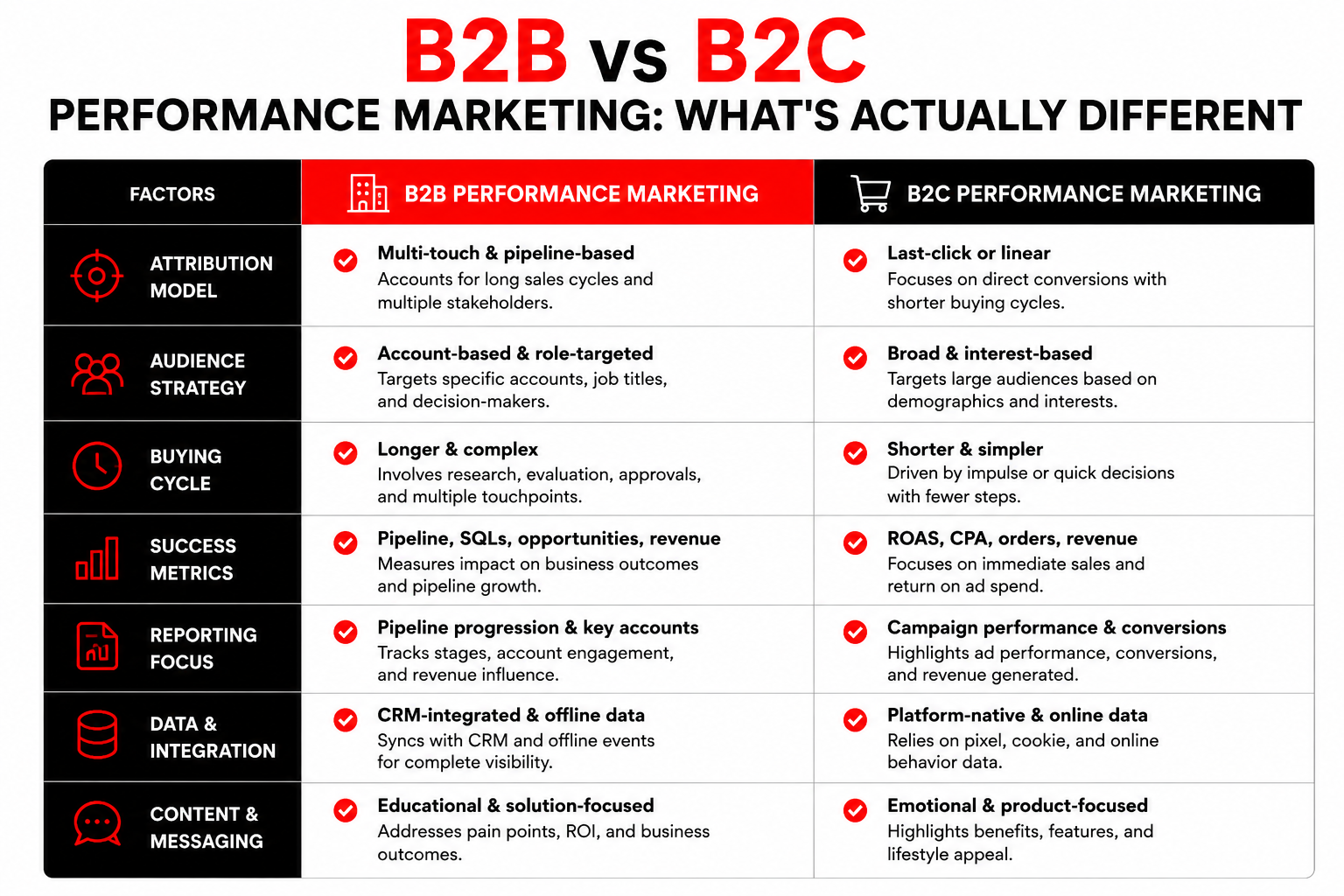
Most performance marketing agencies never build the frameworks to distinguish between the two.
The retainer decisions that go wrong are almost always the ones where the client evaluated agencies on reach, tools, and testimonials, not on how precisely the agency can define, track, and improve lead quality in a complex B2B sales environment.
Before you sign anything, you need to run through a specific set of checks. Most buyers skip them. That is exactly why they end up locked into six-month retainers delivering CPL reports that bear no relationship to actual revenue.
Direct answer: Before engaging any performance marketing agency for B2B, ask them to explain exactly how they attribute a closed deal back to the first ad interaction. If they cannot answer this clearly, or if their answer stops at “we track form fills,” do not proceed.
Attribution is the first real test of an agency’s B2B sophistication. It separates agencies that understand the B2B buying cycle from those that have repurposed their B2C playbook and changed the logo.
In a B2B context, the buyer’s journey typically spans 30 to 180 days. A decision-maker might see your LinkedIn ad in November, read a thought leadership piece in December, search your brand name in January, and book a demo in February. A last-click attribution model, which most agencies default to, will credit that demo entirely to the Google search in January, ignoring the paid social and content touchpoints that built trust across three months.
This creates a compounding problem. The agency cuts LinkedIn spend because “it’s not converting.” LinkedIn was the thing priming the entire funnel. Six months later, your Google Ads efficiency starts dropping too, because the awareness layer is gone.
According to LinkedIn’s B2B Institute, B2B purchase decisions involve an average of 6.8 stakeholders. No last-click model captures that complexity accurately.
The strongest performance marketing agencies in India today build attribution workflows that connect paid media data to CRM records within the first 30 days of a retainer. They define what a marketing-qualified lead (MQL) looks like before they run a single ad. They agree on what a sales-qualified lead (SQL) means. And they hold themselves accountable to MQL-to-SQL conversion rates, not just lead volume.
Performance marketing, by definition, is advertising where you pay for measurable outcomes. Every performance-based marketing agency will tell you this. Very few will define what “outcome” means in a B2B context, and that ambiguity is where retainer value disappears.
In B2C, “performance” is relatively clean. A user clicks an ad, lands on a product page, and buys. The conversion event is unambiguous. You can optimise toward it directly.
In B2B, performance is layered. The purchase decision involves multiple individuals across departments, a significant budget threshold requiring internal approval, and a sales cycle that runs in parallel with your marketing activity. Performance, in this environment, means different things at different funnel stages.
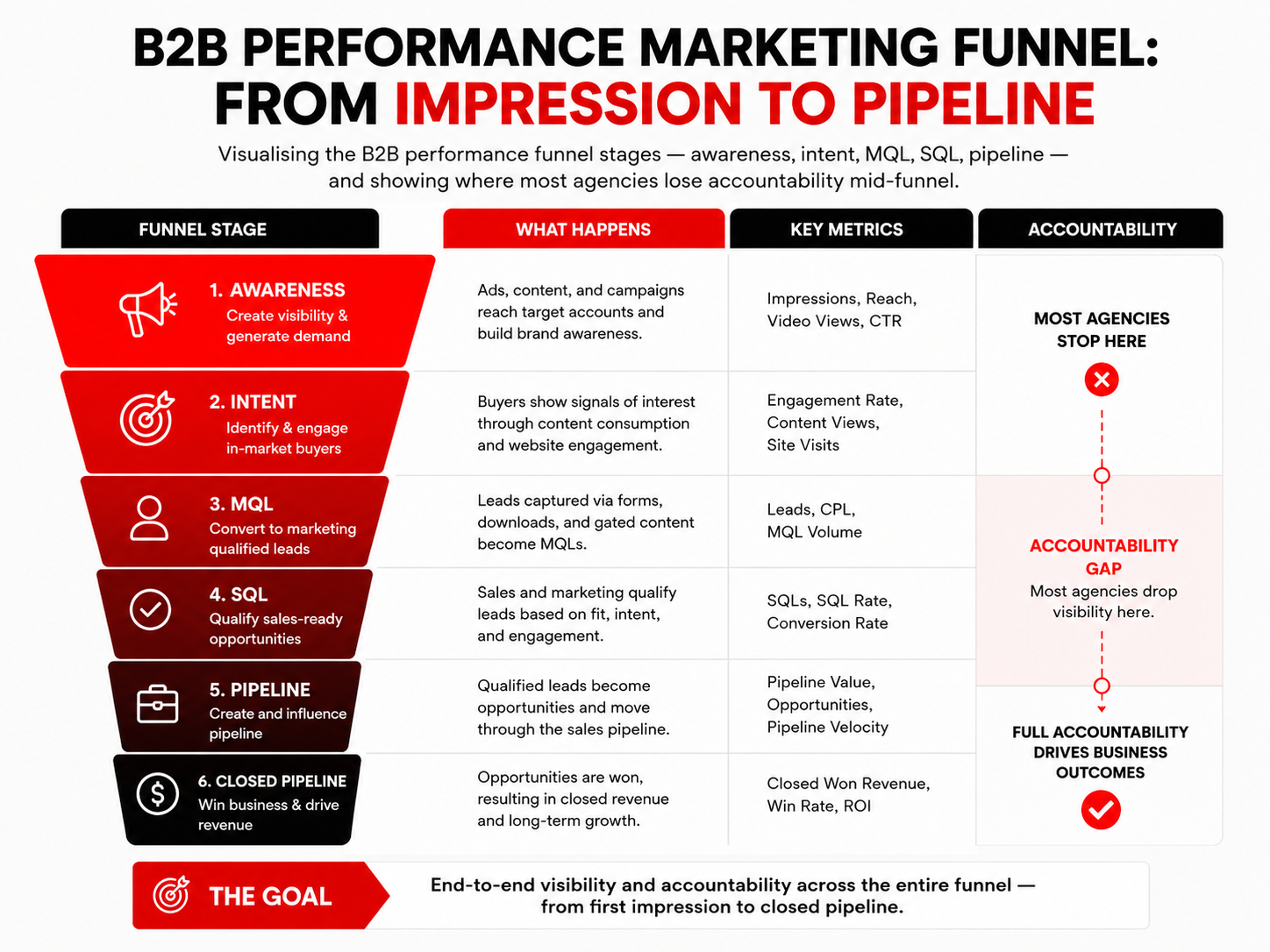
At the top of the funnel, performance means reach efficiency: are you getting your content in front of the right job titles at the right company sizes? At the middle of the funnel, performance means engagement quality: are target accounts returning to your site, consuming multiple pages, booking calls? At the bottom of the funnel, performance means pipeline contribution: what percentage of active deals in your CRM were influenced by a paid media touchpoint in the last 90 days?
A capable digital performance marketing agency builds measurement frameworks for all three layers simultaneously. It does not report on impressions and clicks as if those were outcomes. It reports on account penetration rates, MQL velocity, and revenue influenced, and it can explain the causal chain from campaign to conversion.
This distinction matters enormously when evaluating Indian agencies. The best performance marketing agencies for B2B are not necessarily the ones with the largest client logos or the most awards. They are the ones whose reporting packs tell a story that ends with a commercial outcome and can defend every step of that story.
Ask any agency you are considering to show you a sample reporting dashboard from a current B2B client. Look at what metrics are front and centre. If CPL and CTR dominate the first screen with no reference to pipeline or lead quality, you are looking at a B2C reporting model applied to a B2B account.
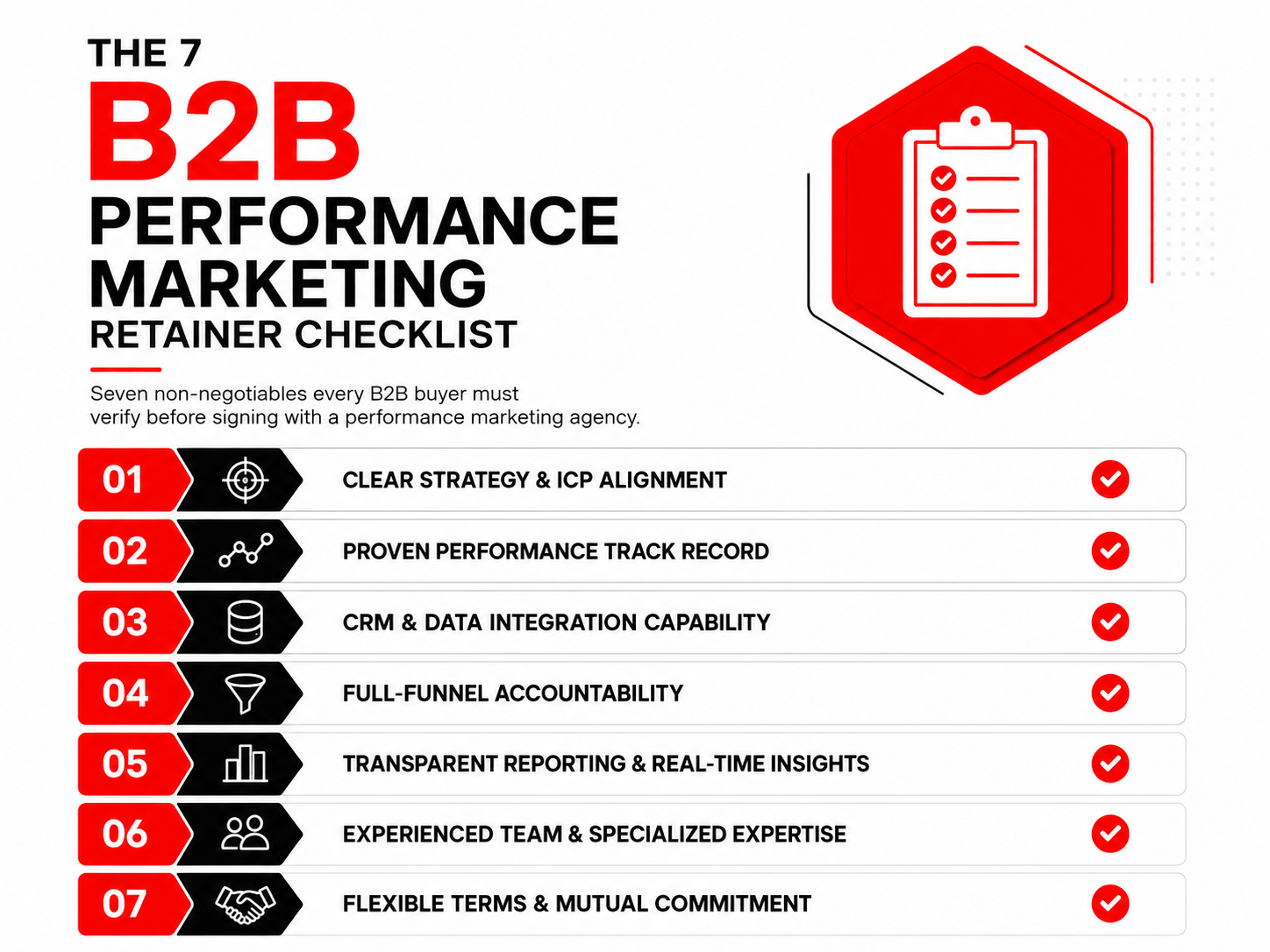
There are seven specific things every B2B marketing head must verify before committing to a b2b performance marketing agency retainer. These are not aspirational good practices. They are deal-breakers.
The agency must be able to connect your ad platforms to your CRM in the first 30 days. Without this connection, every “performance” claim is based on form fills, not revenue. Ask for proof of past integrations, not promises of future ones.
B2B audiences require company-size targeting, job-title layering, and intent signal layering, none of which exist in standard consumer ad setups. A genuine performance-based digital marketing agency has a documented playbook for building B2B audiences on Google, LinkedIn, and Meta, and will explain it to you before the contract starts.
Ask the agency how they define and score a qualified lead for your specific business. If their answer is “we’ll figure that out once campaigns go live,” walk away. A qualified b2b performance marketing agency defines lead scoring criteria in the briefing stage, not after three months of wasted spend.
The best performance marketing services include structured handoff points where the agency interacts directly with your sales team, not just your marketing manager. Monthly calls with both teams reviewing lead quality prevent the classic situation where the agency is proud of its 400 leads and sales is frustrated by 380 of them being irrelevant.
B2B campaigns bleed budget fastest through irrelevant traffic: consumers, students, wrong geographies, and competitor employees. Ask the agency to walk you through their exclusion strategy. If they cannot name five immediate exclusion categories for your industry within 60 seconds, they are not thinking in B2B terms.
Your monthly report should begin with a number that connects to your P&L. How many MQLs did this campaign produce? How many progressed to SQL? What is the estimated pipeline value of this month’s media spend? Performance-based advertising agencies that lead with impressions and clicks as headline metrics are not measuring the right things for B2B.
Generic case studies are not proof. Ask specifically: has this agency delivered results for a B2B company in your vertical or with a similar average deal size? The best performance marketing agencies for B2B have recognisable proof in at least two or three relevant verticals, not just a broad portfolio of consumer brands.
Knowing what to look for in a strong agency is important. Knowing what to walk away from is equally important. These are the red flags that experienced B2B marketing heads have learned to watch for, usually after learning them the hard way.
The first red flag is a guaranteed CPL promise before an audit. No serious b2b performance marketing agency will commit to a specific cost per lead before understanding your current account structure, offer quality, landing page conversion rate, and sales team capacity. Agencies that lead with a guaranteed CPL number are either fabricating it or planning to game it with unqualified traffic.
The second red flag is an inability to explain the creative-to-conversion chain. In B2B, the creative brief, which covers the message, the proof point, and the format, has a direct bearing on lead quality. An agency that treats ad creative as a design task rather than a sales argument does not understand how B2B buyers think.
The third red flag is no reference to content or SEO alignment. Performance marketing services in B2B cannot operate in isolation from content strategy. Buyers research before they buy. If your paid ads drive clicks to landing pages that are not supported by a content ecosystem, including case studies, thought leadership, and industry-specific proof, your CPL will be structurally higher than it needs to be. Agencies that operate in a pure paid-media silo are leaving quality and efficiency on the table.
EFL, a logistics company, came to Bright Brain with exactly this challenge: isolated paid campaigns that were generating volume without quality. By restructuring the audience strategy and aligning paid media with content touchpoints, Bright Brain delivered 75% lead growth and 40% better conversion rates while simultaneously improving lead quality by 45%.
The fourth red flag is over-dependence on one channel. A digital performance marketing agency that relies entirely on Google Search, without a LinkedIn or retargeting layer, will struggle with B2B accounts where the decision-making audience is not actively searching every day. B2B performance needs a multi-channel architecture, even if one channel dominates spend.
Bright Brain is a Mumbai-based b2b performance marketing agency and India’s only Google Elevator Partner in Mumbai, one of just 15 agencies selected from over 7,000 across India. That credential is not decorative. It reflects the performance standards, audit access, and benchmark data that come with operating at the top tier of Google’s partner ecosystem.
The difference in Bright Brain’s approach to performance marketing services for B2B clients is structural. Every B2B engagement begins with a revenue-first briefing: what does a qualified lead look like, what is the expected sales cycle, what CRM does the sales team use, and what is the current MQL-to-SQL conversion rate? These questions determine the entire campaign architecture before a single rupee of media spend is committed.
For B2B clients in logistics, the challenge is typically reaching procurement decision-makers at the right company size and triggering intent at the right stage of their evaluation cycle. For SaaS and tech clients, the challenge is often building brand search volume while also capturing bottom-of-funnel intent from buyers who are already comparing solutions. For BFSI and financial services B2B clients, the challenge is usually lead quality at scale, generating volume without sacrificing the intent signals that lead to actual conversations.
Bright Brain has delivered proven results across these categories. For Ashv Finance, a B2B financial services client, the team generated 2,460 qualified leads at a cost per lead of just Rs 25, within a single month, while improving landing page conversion rates by 25% and reducing CPM by 24%. For Skillgigs, a B2B recruitment technology platform, Bright Brain achieved a 1,300% improvement in lead quality alongside over 4,000 leads in six months, with a 30% growth in branded search volume.
These results did not come from running standard campaigns with higher budgets. They came from solving the right problem: not “how do we get more leads?” but “how do we get leads that the sales team can actually close?”
For B2B companies in Mumbai and across India evaluating performance marketing agencies, Bright Brain’s starting point is always the same. You do not need more leads. You need the right leads, tracked to revenue, with a clear line from media spend to closed business.
As a Stanford Seed Transformation Program Alumni (2024) and Meta Business Partner and Amazon Ads Partner, Bright Brain brings both the strategic framework and the technical execution depth to make that outcome real, whether for ecommerce performance marketing agency mandates, B2B lead generation, or complex full-funnel campaigns.
What is a B2B performance marketing agency?
A b2b performance marketing agency is a firm that runs paid media campaigns specifically for business-to-business companies, with accountability tied to commercial outcomes such as qualified leads, pipeline contribution, or revenue, rather than impressions or clicks alone. It structures campaigns, attribution models, and reporting around the B2B buying cycle, which typically involves multiple stakeholders and a longer decision timeline than consumer purchases.
How is B2B performance marketing different from B2C performance marketing?
B2B performance marketing targets professional decision-makers by company size, job title, and buying intent, not broad consumer demographics. Success is measured at the MQL and SQL level, not just form fills. Campaigns must account for longer sales cycles, multi-stakeholder journeys, and offline deal closure, all of which require CRM integration and multi-touch attribution rather than standard last-click models.
What should I look for in the best performance marketing agencies for B2B?
The best performance marketing agencies for B2B demonstrate CRM integration experience, a documented lead scoring framework, B2B-specific audience strategy across Google and LinkedIn, and reporting that connects media spend to pipeline value. Verified case studies in your vertical are a stronger signal than awards or client logos.
How do performance marketing services differ for B2B versus ecommerce?
For ecommerce, performance marketing services optimise toward direct purchase events: ROAS, cart completions, and repeat order rates. For B2B, the same services must optimise toward pipeline stages: MQL volume, SQL conversion rate, and average deal value. An ecommerce performance marketing agency and a B2B-focused agency require fundamentally different measurement architectures, even if they use the same ad platforms.
What is a realistic timeline to see results from a B2B performance marketing retainer?
Most B2B campaigns require 60 to 90 days to produce reliable performance data, given the learning phase of ad platforms, the time required to build exclusion lists and audience layers, and the natural length of the B2B sales cycle. Agencies that promise meaningful results within the first 30 days are typically measuring form fills, not pipeline progression. Months three onward is when performance-based marketing agency retainers should begin showing measurable MQL-to-SQL improvement.
What are the biggest red flags when evaluating a performance-based digital marketing agency for B2B?
The most significant red flags are: guaranteed CPL promises before an audit, attribution models that stop at form fills, no CRM integration plan, reporting packs that lead with impressions and clicks rather than pipeline data, and case studies from consumer verticals being used as proof for B2B mandates. A credible performance-based advertising agency for B2B will ask about your sales process before discussing your ad platforms.