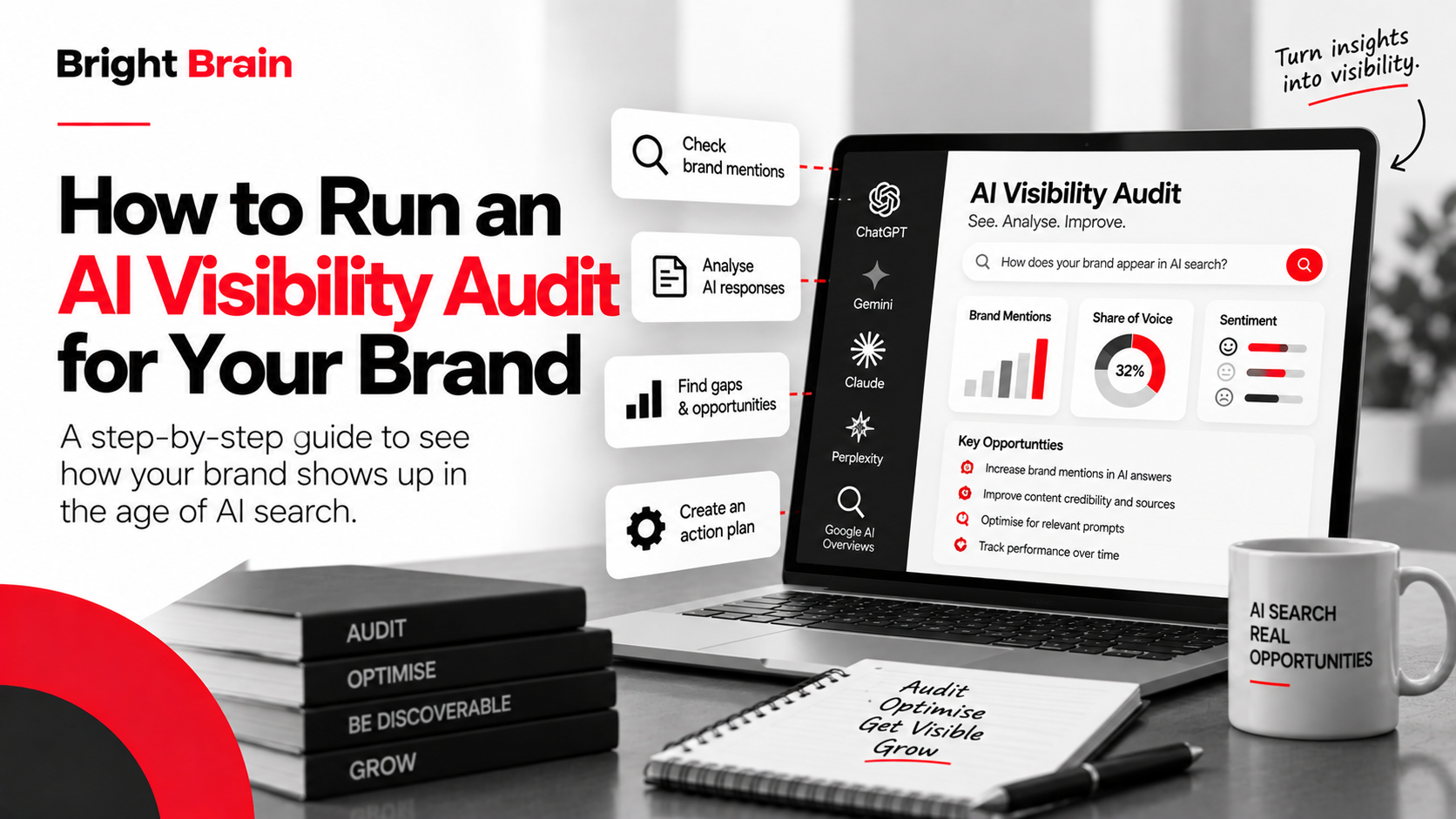
An AI visibility audit is a structured review of how often, and how accurately, your brand appears when people ask ChatGPT, Gemini, Perplexity, or Google’s AI Overviews about your industry. It checks brand mentions in AI search, citation sources, and competitor comparisons, then gives you an action plan for fixing every gap AI systems currently ignore.
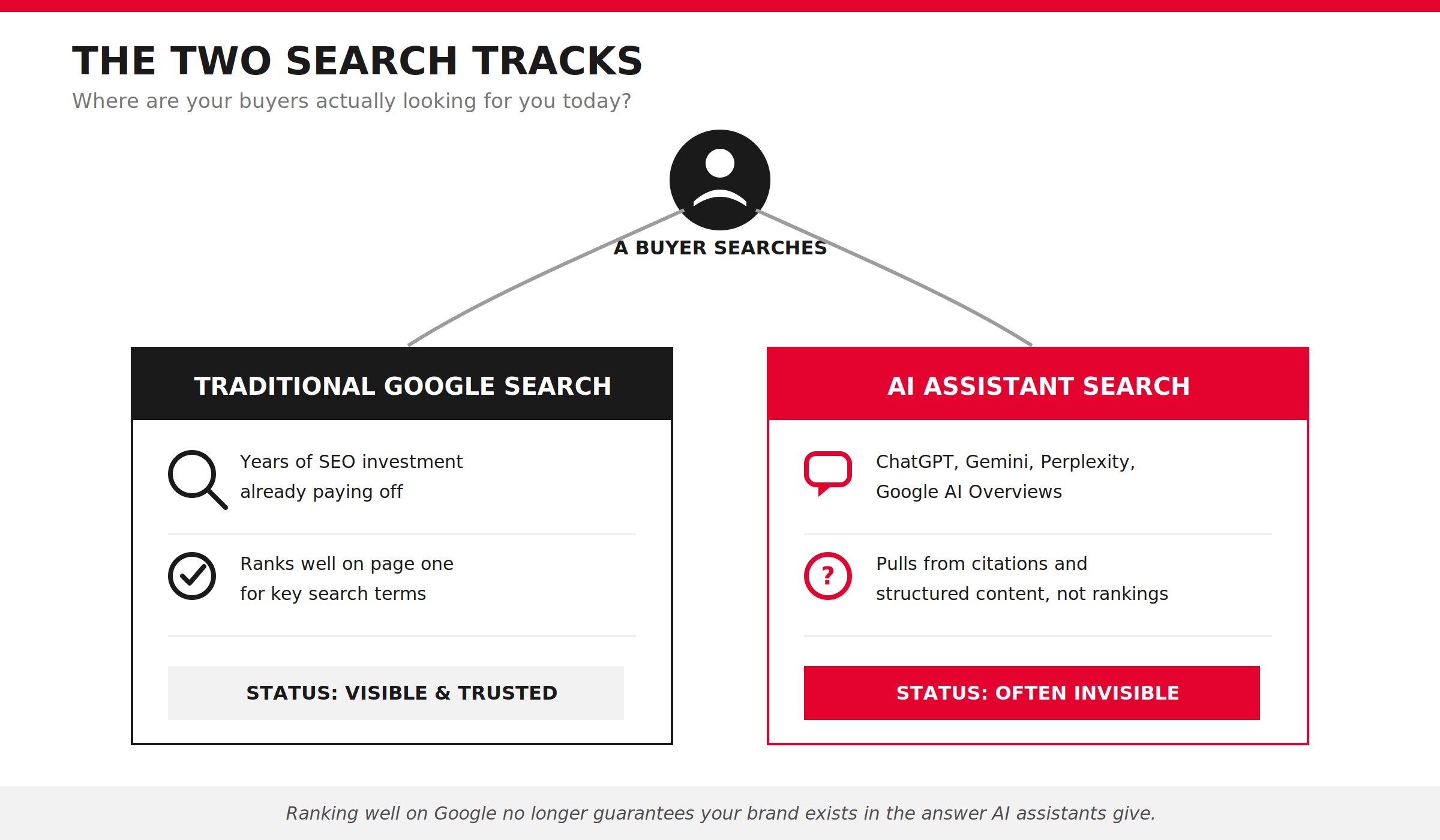
Search behaviour has quietly split into two tracks. One is the Google results page you have optimised for years. The other is a growing habit of people typing questions directly into ChatGPT, Gemini, or Perplexity and trusting whatever answer comes back. If your brand does not show up in that second track, you are invisible to a growing share of your buyers, no matter how well you rank on page one.
This is exactly why running this kind of check has become a non-negotiable exercise for marketing teams in Mumbai and beyond. It is not a vanity check. It tells you, in concrete terms, whether AI assistants know your brand exists, whether they describe it correctly, and whether they recommend you over a competitor when a buyer asks for options.
Most companies discover the same uncomfortable truth once they run an AI visibility audit for the first time. Their website ranks well on Google, yet ChatGPT has never heard of them, or worse, describes them using outdated information pulled from an old directory listing. That gap between traditional AI search visibility and actual AI presence is where deals quietly slip away before a human even opens your website.
The shift is not theoretical. Buyers researching everything from real estate developers to fintech platforms are asking AI tools to shortlist options for them. If your brand is missing from that shortlist, you never get considered, let alone converted.
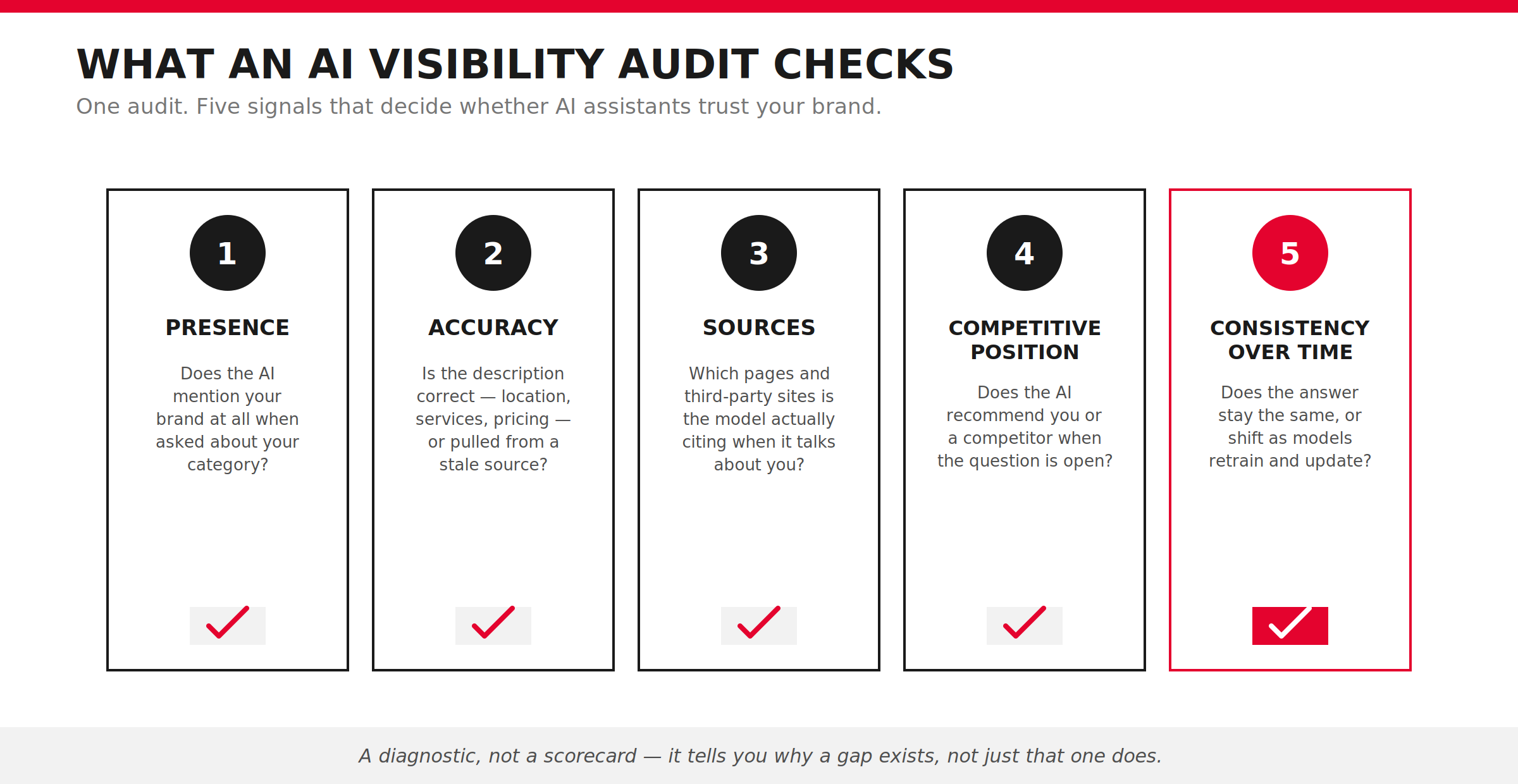
A proper AI visibility audit looks at five things:
Think of it as a diagnostic, not a scorecard. An LLM visibility audit does not just tell you that you scored low; it tells you why. Maybe your site lacks the structured, quotable content that language models prefer to cite. Maybe your competitors have stronger third-party coverage feeding the model’s retrieval data. Maybe your brand mentions in AI search results are outdated, incomplete, or attributed to the wrong category entirely.
This is the layer most companies skip. They check their Google rankings obsessively, then assume AI visibility will follow automatically. It will not. Search engines and AI assistants pull from overlapping but distinct signals, and this kind of review is the only reliable way to see where those signals diverge for your specific brand.
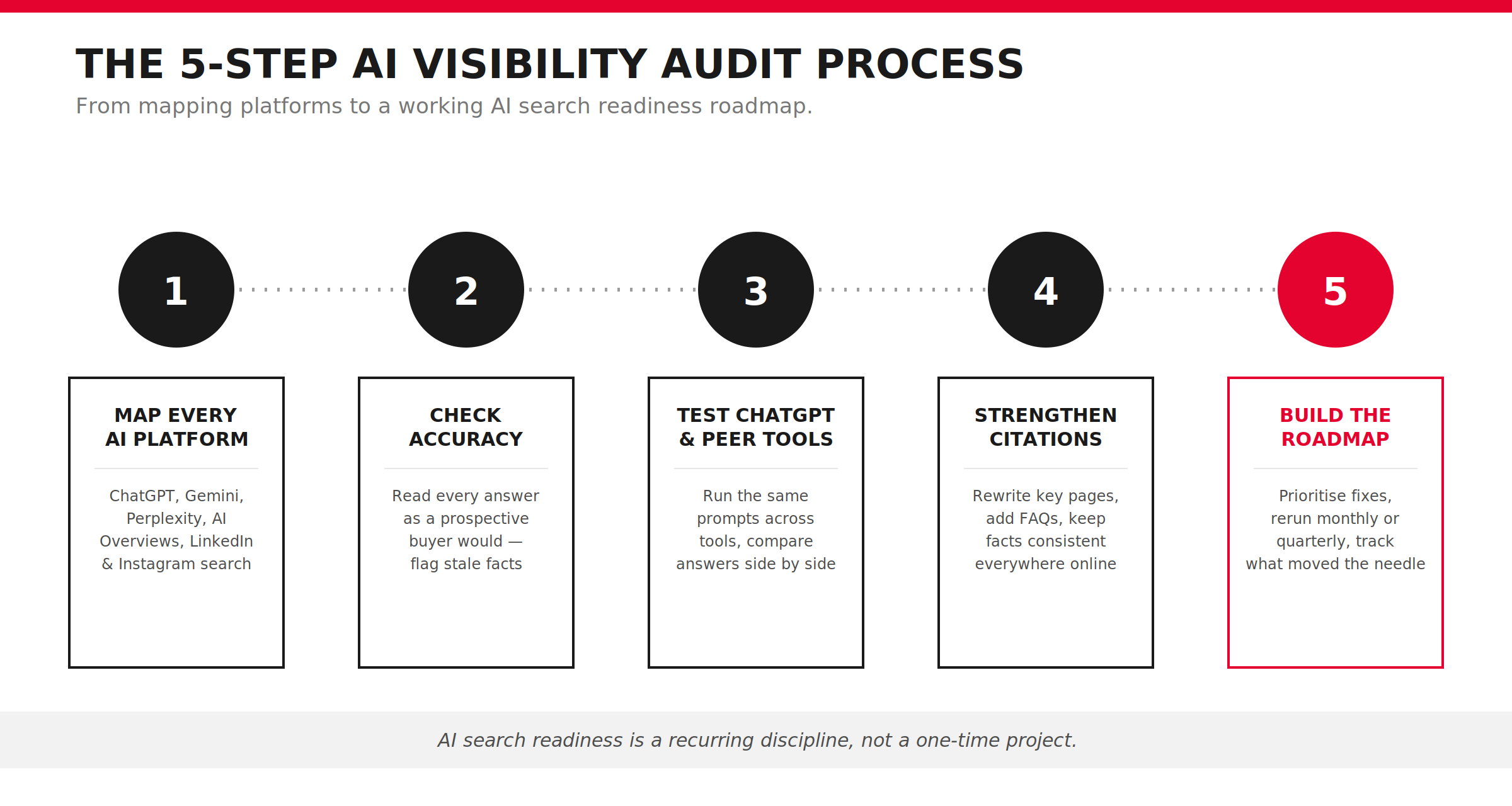
Start by listing every AI platform your buyers are likely to use before they ever reach your website. That usually means ChatGPT, Google’s AI Overviews, Gemini, Perplexity, and increasingly, AI features built directly into LinkedIn and Instagram search.
For each platform, ask three questions in a fresh, logged-out session.
This mapping step is where most teams first realise their AI search visibility is uneven across platforms. A brand might show up reliably on Perplexity, which leans heavily on live web citations, while remaining completely absent from ChatGPT’s default responses. Recording brand mentions in AI search platform by platform, rather than treating AI as one single channel, is what turns this exercise from guesswork into an actual AI visibility audit you can act on.
Once you know where your brand shows up, the next step is judging quality, not just presence. An AI assistant might mention you and still get you completely wrong: the wrong city, the wrong specialisation, or a service you stopped offering years ago.
Read every AI-generated answer as if a prospective client were about to make a decision based on it. Note every stale fact, every missing achievement, and every accurate detail worth reinforcing. This is precisely the piece a thorough LLM visibility audit is built to catch, since it pushes these tools toward your most current, most authoritative pages rather than an old press release or an outdated directory entry.
This is also where you compare tone. Does the AI describe your brand with the confidence of an established player, or does it hedge with phrases like "it appears" or "according to limited information"? That hedging is a signal. It tells you the model does not have enough clean, structured brand mentions in AI search results to speak about you with authority, and it is exactly the gap a focused audit is designed to expose.
ChatGPT deserves its own dedicated check because of sheer usage volume. Ask it direct questions a genuine buyer would ask, such as who the top providers in your category are in Mumbai, or how your brand compares with a named competitor.
If you only have time to check one platform, check what brand visibility ChatGPT delivers today, since it remains the highest-traffic AI assistant among many B2B buyers. Pay close attention to what your brand visibility ChatGPT responses actually reflect versus what you assume they show. Many brand leaders are surprised to learn that ChatGPT’s default answer omits them entirely, even when they dominate Google’s first page. This happens because ChatGPT weighs different signals, including structured data, third-party citations, and consistency of information across the web, rather than backlink profiles alone.
Run the same prompts through Gemini and Claude for comparison. Consistent brand visibility that ChatGPT and other assistants both confirm is a strong sign of genuine AI search readiness, while wildly different answers across tools point to gaps in how your brand information is structured and distributed online. Document every discrepancy, since it becomes your prioritised fix list once the audit is complete.
AI assistants do not invent answers from nothing. They lean heavily on structured, well-sourced content: FAQ pages, comparison pages, clearly labelled statistics, and pages that answer a specific question within the first two sentences.
This is the practical heart of LLM citation optimization. Rewrite your key pages so the most important fact appears immediately, not buried under three paragraphs of introduction. Add clear FAQ sections that mirror the exact questions buyers type into AI tools. Keep your business details, such as location, credentials, and service scope, consistent everywhere they appear online, because inconsistency is one of the fastest ways to lose a citation to a competitor.
Repeat this exercise every quarter, since language models retrain and update their retrieval sources constantly. A brand that ranks well in an AI visibility audit today can quietly disappear from AI answers within months if its content stops meeting the citation standards these systems now expect.
An audit without a follow-up plan is just an interesting document. Turn your findings into a prioritised roadmap: which pages need rewriting first, which facts need correcting across the web, and which new content formats, such as comparison tables or founder interviews, will give AI tools something concrete to cite.
Genuine AI search readiness is not a one-time project. It is an ongoing discipline of publishing clear, factual, well-structured content and monitoring how AI systems respond to it over time. Set a recurring date, monthly or quarterly, to rerun your AI visibility audit and track whether your fixes actually moved the needle. Treat every LLM visibility audit as a snapshot rather than a final verdict, since model behaviour can shift enough to change your standing within a single quarter.
Brands that treat this kind of readiness as seriously as they treat traditional SEO tend to compound their advantage. Early movers are being cited consistently while competitors are still debating whether AI search visibility even matters for their industry. That head start is difficult to close once assistants have learned to trust one brand’s information over another’s.
Some teams can run this process in-house, especially if they already have a strong content and SEO function. Others find that partnering with a specialist AI visibility agency gets them from diagnosis to fixed results far faster, particularly when the audit reveals structural issues across dozens of pages.
A capable AI visibility agency brings three things most internal teams lack: cross-platform testing experience, familiarity with how AI citation patterns differ across industries, and the bandwidth to rewrite and republish content at the pace these systems reward. Bright Brain, recognised as a Google Elevator Partner among 7,000-plus agencies across India, has worked on exactly this problem for clients across fintech, real estate, and e-commerce, helping brands move from being invisible in AI answers to being cited consistently across ChatGPT, Gemini, and AI Overviews.
If you decide to bring in outside help, ask any AI visibility agency you are evaluating for a live demonstration on your own brand name, not a generic case study. Watch how they interpret the results of your AI visibility audit before committing. A good partner will explain the reasoning behind every gap, not just hand you a scorecard.
Running an AI visibility audit for the first time can feel a little humbling. Most brands discover blind spots they did not know existed, and that is genuinely useful. It means you now have a clear, evidence-based starting point instead of a guess about where you stand with AI assistants.
The brands earning attention inside AI answers today are not necessarily the biggest names in their industry. They are the ones who took this kind of readiness seriously before it became obvious, and who kept refining their LLM citation optimization month after month instead of treating the audit as a one-off task. If you want a clearer picture of where your brand stands, Learn More about how a structured AI visibility audit works in practice, and start building the AI search visibility your brand deserves.
This process is a structured check of how AI tools like ChatGPT, Gemini, and Google’s AI Overviews mention, describe, and rank your brand. It reviews accuracy, competitor comparisons, and citation sources, then highlights the fixes needed to improve your AI search visibility.
An SEO audit focuses on traditional search rankings and backlinks. This kind of audit instead examines how language models answer questions about your brand, using signals like brand mentions in AI search, which SEO audits do not typically cover.
Most brands benefit from running an LLM visibility audit quarterly, since AI models update their retrieval sources regularly. Frequent audits catch new inaccuracies early and keep your AI search readiness aligned with how these systems currently evaluate credibility.
Yes. Improving what brand visibility ChatGPT reflects starts with clear, factual content: structured FAQs, consistent business details, and pages that directly answer common buyer questions. Technical help speeds things up, but foundational fixes can be done by most in-house teams.
This kind of partner tests your brand across multiple AI platforms, documents inaccuracies and missing mentions, then prioritises content fixes based on what each model rewards. Agencies like Bright Brain also track results over time to confirm findings translated into real citation gains.
LLM citation optimization ensures AI tools have clean, structured, current information to pull from when answering questions about your brand. Without it, models default to older sources or competitors, weakening your AI search visibility in every AI-generated answer.