By Divya Sharma ·
Getting cited in AI Overviews comes down to three things: answering questions directly, structuring content so machines can extract it cleanly, and building authority that search systems trust. AI overview optimization blends classic SEO with answer-focused writing. This guide explains how Google selects sources, what actually earns AI overview citations, and how to apply the same thinking across ChatGPT.
Search used to be a list of ten blue links. Today, a growing share of queries end with a summary at the top of the page, written by Google’s AI and supported by a handful of cited sources. If your page is one of those sources, you earn visibility, credibility, and often the click. If it is not, you can rank well and still feel invisible.
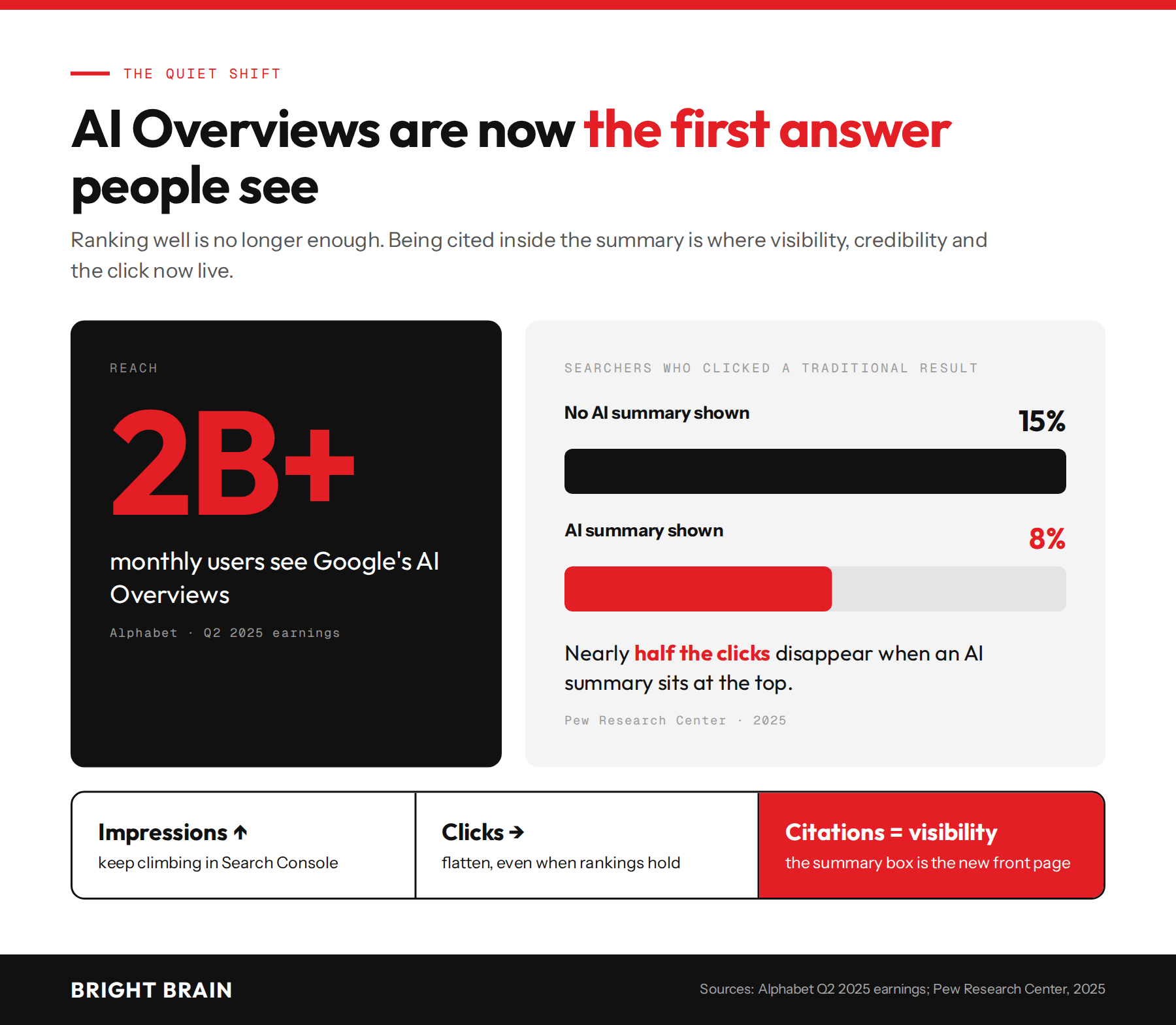
The scale here is hard to ignore. Alphabet reported in its Q2 2025 earnings that AI Overviews reach more than 2 billion monthly users. At the same time, Pew Research Center found in 2025 that people who saw an AI summary clicked a traditional result only 8% of the time, compared with 15% for those who did not.
That gap explains why so many marketing teams feel uneasy. Traffic reports look flatter, yet impressions keep climbing. The answer is not to panic or abandon SEO. It is to understand how to appear in AI Overviews and treat that summary box as a new front page worth earning. For brands that depend on organic discovery, AI search visibility is fast becoming as important as ranking itself.
This is where AI overview optimization comes in. It is not a replacement for search engine optimization. It is the next layer on top of it, focused on making your content the most quotable, trustworthy answer available.
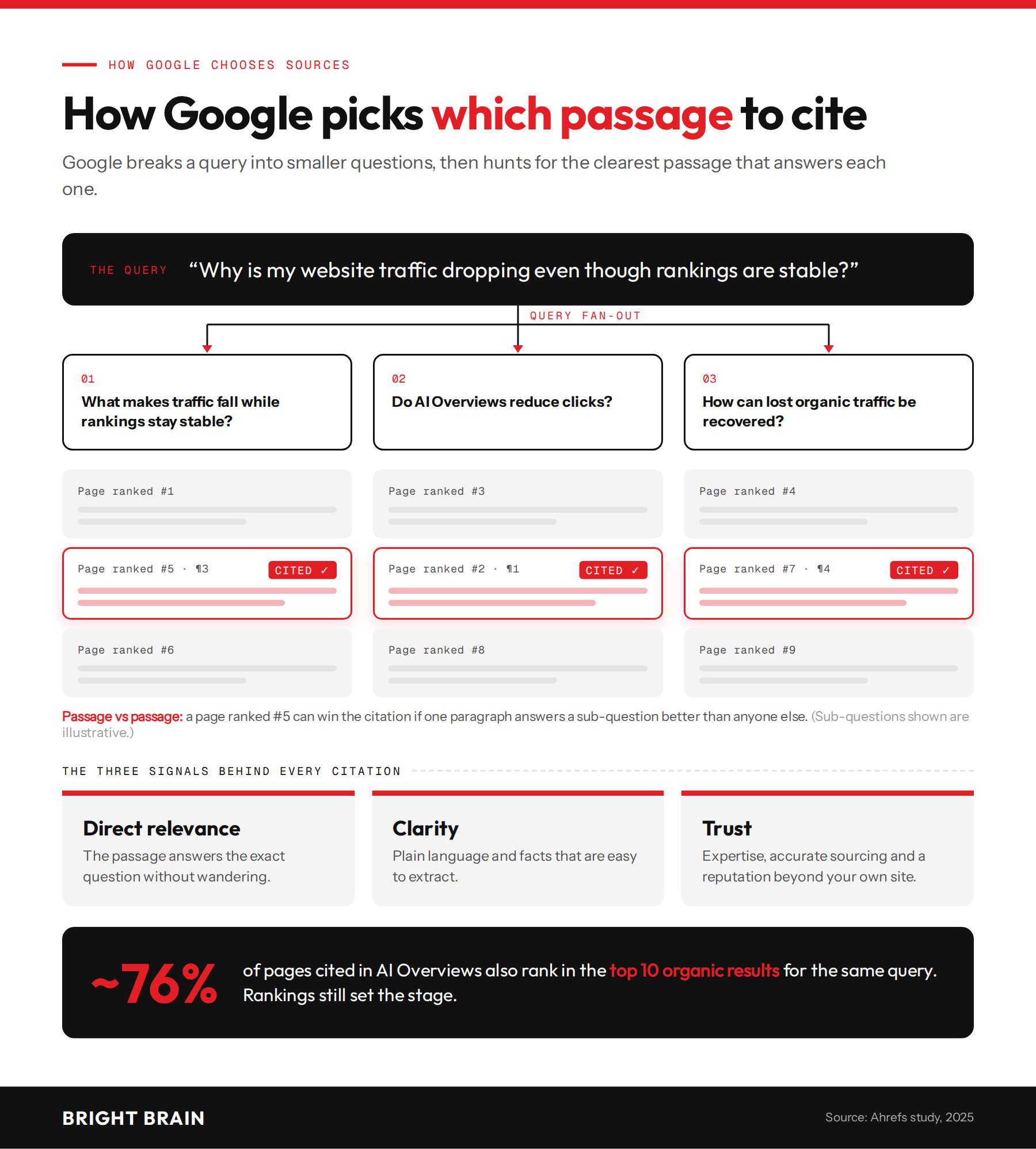
Google has not published a formula, but the patterns are clear enough to act on. AI Overviews draw from pages Google already understands and trusts. An Ahrefs study from 2025 found that around 76% of cited pages also ranked in the top 10 organic results for the same query. In other words, strong rankings still matter a great deal.
However, ranking alone does not guarantee a citation. Google’s system breaks a query into smaller questions, a process often described as query fan-out, and then looks for passages that answer each piece clearly. A page might rank fifth overall yet win the citation because one paragraph answers a sub-question better than anyone else.
This is the heart of AI overview optimization. You are no longer competing only page against page. You are competing passage against passage. Every section of your article has its own chance to be selected, which means every section needs to stand on its own.
Three signals tend to separate cited pages from the rest. The first is direct relevance, meaning the passage answers the exact question without wandering. The second is clarity, meaning the language is plain and the facts are easy to extract. The third is trust, which comes from expertise, accurate sourcing, and a reputation that extends beyond your own website. Earning consistent AI overview citations requires all three working together. Once you see how selection works, how to appear in AI Overviews becomes far less mysterious.
Most content is written to rank. Far less is written to be quoted. If you want to know how to appear in AI Overviews, that difference is the best place to start.
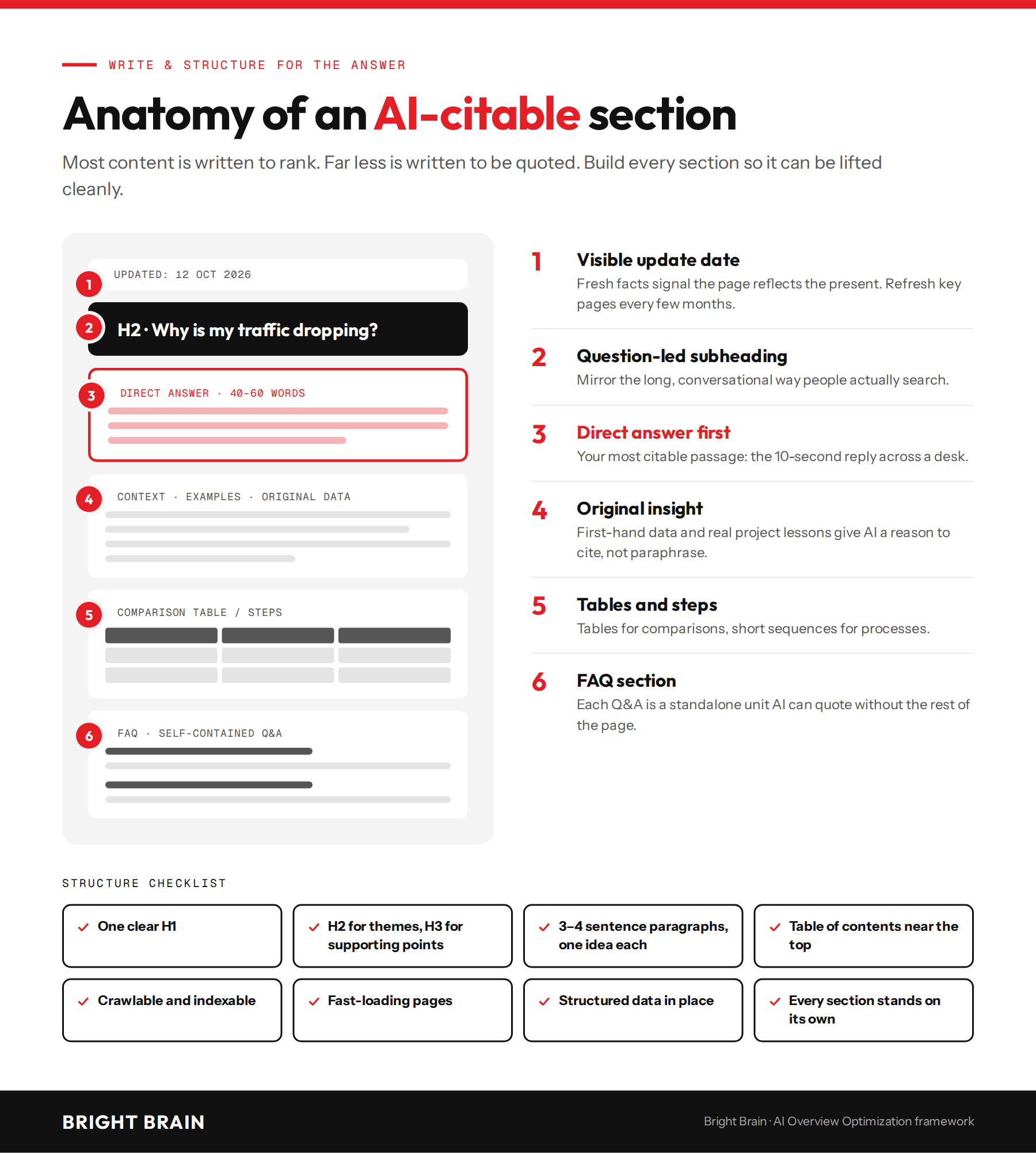
Begin each major section with a direct answer of 40 to 60 words. Imagine someone asked you the question across a desk and you had ten seconds to respond. That answer becomes your most citable passage. After it, add the context, examples, and nuance that make the piece genuinely useful to a human reader.
Next, match the way people actually ask. Search queries are becoming longer and more conversational. Someone might type "why is my website traffic dropping even though rankings are stable." If your subheading mirrors that question and your first sentence answers it, you have given Google an obvious passage to lift.
Original insight is the other half of the equation. AI systems summarise what is already widely known, so they look for sources that add something specific. First-hand data, practical frameworks, and lessons from real projects give your page a reason to be cited rather than paraphrased. Thoughtful AI overview optimization always pairs clear answers with information that cannot be found everywhere else.
Finally, keep facts current. Dated statistics and outdated advice quietly reduce trust. Refreshing key pages every few months, with a visible update date, signals that your content reflects the present.
Good structure is a courtesy to your reader and a gift to search systems. A logical hierarchy of headings tells Google what each section covers and how the ideas connect.
Use one clear H1, then H2 headings for major themes and H3 headings for supporting points. Keep paragraphs short, ideally three to four sentences, with one idea in each. When a paragraph tries to do too much, extraction becomes harder and the passage is less likely to be chosen.
Tables work well for comparisons, and short step sequences work well for processes. A table of contents near the top helps both readers and crawlers understand the shape of your piece at a glance. FAQ sections are especially valuable, because each question and answer forms a self-contained unit that an AI system can cite without needing the rest of the page. Pages built this way tend to win more AI overview citations simply because they are easier to quote accurately.
Technical health underpins all of this. Pages must be crawlable, indexable, and fast. Structured data helps search engines interpret your content, even though it is not a direct switch for AI features. If Googlebot struggles to reach or render a page, no amount of brilliant writing will earn it a citation. Strong AI overview optimization treats technical SEO as the foundation, not an afterthought.
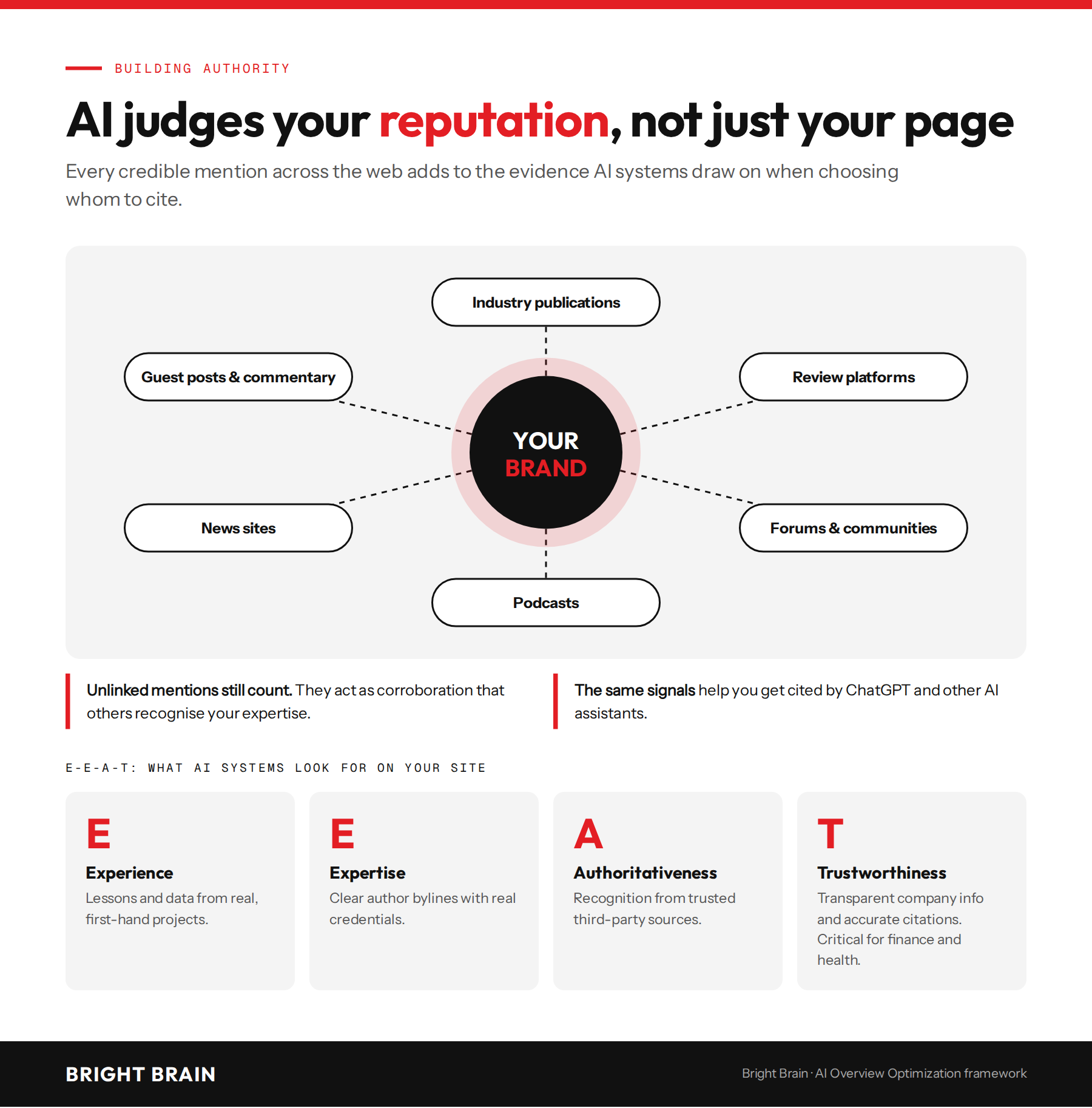
Here is the part many teams overlook. AI systems do not only judge your page. They judge your reputation.
When your brand is discussed on industry publications, review platforms, forums, podcasts, and news sites, search systems build a stronger picture of who you are and what you are known for. This is why brand mentions in AI search have become such an important signal. Even unlinked references act as corroboration, telling the model that your expertise is recognised by others rather than simply claimed by you.
E-E-A-T, which stands for experience, expertise, authoritativeness, and trustworthiness, remains central. Clear author bylines with real credentials, transparent company information, and accurate citations to reputable sources all strengthen it. For sensitive topics like finance or health, this layer becomes even more important. The same reputation signals also help you get cited by ChatGPT and other AI assistants.
Digital PR, expert commentary, guest contributions, and genuine participation in community platforms all expand your footprint. Each one adds to the body of evidence that AI systems draw on. Over time, consistent brand mentions in AI search make your content a natural choice when Google decides which sources deserve a citation. In short, AI search visibility is earned both on your website and far beyond it.
Google is not the only place your audience is asking questions. Millions of people now research products, compare services, and seek advice inside ChatGPT, Perplexity, and Gemini. Naturally, marketers want to know how to rank on ChatGPT as well.
The good news is that the fundamentals overlap. When ChatGPT browses the web, it relies on search indexes, which means pages that perform well in traditional search are more likely to be retrieved. Clear, well-sourced pages make it easier to get cited by ChatGPT when it pulls live results. Many teams ask whether they need a completely separate strategy to rank in ChatGPT. In most cases, they do not. Clear answers, logical structure, and strong authority help you rank in ChatGPT for the same reasons they help with Google.
There are differences worth noting, though. Large language models lean heavily on what the wider web says about you. Brands that rank in ChatGPT consistently tend to be those already discussed across trusted sources, and that wider presence is what helps you get cited by ChatGPT when someone asks for recommendations in your category. Make sure your product names, services, and positioning are described the same way everywhere, from your website to directory listings and partner pages.
Allowing AI crawlers access matters too. If your robots.txt file blocks OAI-SearchBot or similar agents, your pages may never be considered. Reviewing these settings is a simple step that is surprisingly often missed.
We have seen this work in practice. At Bright Brain, our AEO and GEO work for Wright Research, a SEBI-registered investment advisory firm, brought in more than 600 organic users from ChatGPT, Perplexity, and Gemini. The approach was not a trick. It combined answer-first content, steady authority building, and careful technical groundwork, which is exactly the playbook for anyone wondering how to rank on ChatGPT sustainably.
Traditional metrics do not tell the full story anymore. According to Ahrefs research published in 2025, AI Overviews were associated with a 34.5% lower click-through rate for the top-ranking page. If you judge success only by clicks, you may undervalue real progress.
A fuller view of AI search visibility includes several signals. Track impressions in Google Search Console alongside clicks. Monitor which queries trigger AI Overviews and whether your pages appear as cited sources. Watch branded search volume too, because people who see your name in an AI answer often search for you directly later.
For ChatGPT and other assistants, run regular prompt tests. Ask the questions your customers ask and note whether your brand is mentioned or linked. For teams exploring how to rank on ChatGPT, these tests are the clearest feedback loop available. Tracking whether you rank in ChatGPT for your core prompts, and how often you get cited by ChatGPT over time, gives you a practical benchmark to improve against. Referral traffic from these platforms also appears in your analytics, so it is worth reviewing monthly.
The goal is to connect visibility with business outcomes. Enquiries, sign-ups, and sales still matter most. Good AI overview optimization simply widens the path that leads people to those outcomes.
Knowing what to do is one thing. Knowing what to do first is what saves time and budget, a lesson we see again and again with brands in Mumbai and across India.
Identify the queries that matter to your business, check which ones trigger AI Overviews, and study which sources are currently cited and why their passages were chosen.
Make sure your key pages are crawlable, fast, and indexed, and confirm that AI crawlers such as OAI-SearchBot are not blocked in robots.txt.
Add direct 40 to 60 word answers, question-led subheadings, short paragraphs, and FAQ sections so each passage can stand alone and be cited.
Plan digital PR, expert commentary, and community presence that builds consistent brand mentions across trusted publications, review sites, and forums.
Track impressions, AI Overview citations, branded search, and AI assistant prompt tests, then refine the pages and channels that are not yet earning citations.
Most brands begin to see movement within two to four months, though competitive industries can take longer. Patience matters here, because AI overview optimization compounds. Each improved page and each new mention strengthens the next.
The shift to AI-driven search can feel unsettling, especially when familiar metrics start behaving differently. Yet the brands that adapt now will hold a lasting advantage. AI overview optimization rewards the same qualities good marketing has always valued: clarity, honesty, expertise, and a genuine wish to help.
You do not need to rebuild everything overnight. Start with your most important pages, answer real questions well, and build a reputation worth citing. Whether your goal is stronger AI search visibility on Google or learning how to rank on ChatGPT, the path is steady and achievable.
At Bright Brain, a Google Elevator Partner and one of just 15 agencies selected from over 7,000 across India, our team in Mumbai helps brands earn brand mentions in AI search, citations, and qualified enquiries. If you are ready to see where your brand stands and what a focused plan of AI overview optimization could achieve, Learn More about our AEO and GEO services today.
AI overview optimization is the practice of shaping content so Google’s AI Overviews select it as a cited source. It combines traditional SEO with direct, answer-first writing, clear structure, and strong authority signals. The aim is to make your passages the most accurate, quotable answers available for the questions your audience asks.
Most brands notice early movement within two to four months, depending on competition, existing authority, and technical health. Pages that already rank on page one can earn AI overview citations faster. Building the broader reputation that supports long-term AI search visibility usually takes six months or more of consistent effort.
The foundations overlap, but there are differences. Anyone learning how to rank on ChatGPT should focus on consistent brand presence across trusted sources, accessible pages for AI crawlers, and clear answers. Strong Google rankings help, since ChatGPT often retrieves pages from search indexes when it browses the web.
Not always, but it helps significantly. Research from Ahrefs suggests most cited pages already rank in the top 10. Understanding how to appear in AI Overviews starts with strong organic rankings, then adds answer-focused passages that address specific sub-questions better than competing pages do.
AI systems judge reputation, not just individual pages. Consistent brand mentions in AI search help models recognise your expertise and recommend you with confidence. Mentions on publications, review sites, and forums act as third-party proof, which also makes it easier to get cited by ChatGPT and other assistants.
Yes. AI systems reward clarity and relevance, not just size. A focused business that answers niche questions thoroughly can rank in ChatGPT and Google’s AI features ahead of larger competitors. Consistent AI overview optimization on a handful of high-intent pages often delivers stronger results than thin coverage across hundreds.