
By Meghna Jalali ·
A content strategy agency plans what your brand publishes, why it publishes it, where it goes, and who it’s for. It then measures whether that content actually works. Instead of scattered posts and blogs, you get a documented roadmap tied to revenue goals, search demand, and audience intent. For growing brands, that roadmap is often the difference between content that fills a calendar and content that fills a pipeline.
Most brands don’t have a content problem. They have a direction problem. Your team is probably producing plenty: blogs, reels, newsletters, case studies, and LinkedIn posts. Yet traffic plateaus, enquiries stay flat, and nobody can say which piece actually moved the needle.
A content strategy agency steps in before anything gets written. It studies your audience, your competitors, your search data, and even your sales conversations. Then it decides which topics deserve your budget, which formats suit each stage of the buying journey, and how every asset connects back to a business goal.
Think of it as an architect working before the builders arrive. A good content strategy company gives you the blueprint first, so every piece of content has a clear job to do.
Content without strategy feels productive. That’s exactly what makes it risky.
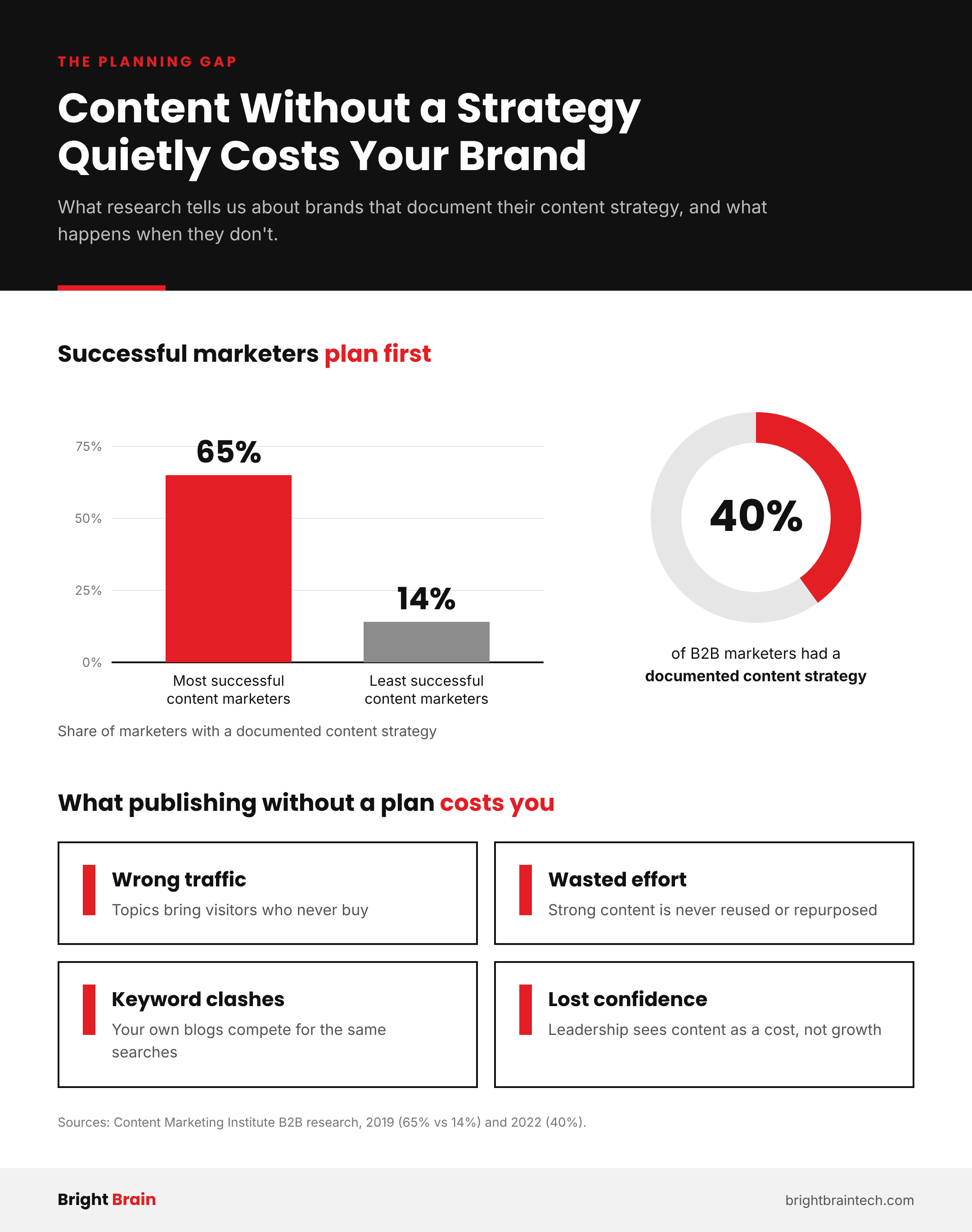
Research from the Content Marketing Institute shows how common this gap is. In its 2022 survey, only about 40% of B2B marketers said they had a documented content marketing strategy. An earlier CMI study found that 65% of the most successful content marketers had documented their strategy, compared with just 14% of the least successful. The difference wasn’t talent. It was planning.
When there’s no plan, the costs pile up quietly. Writers chase trending topics that bring visitors who will never buy. Social teams post every day but rarely reuse what already works, which is precisely the gap a content repurposing agency is built to close. Blogs start competing with each other for the same keywords, a problem any content optimization company will spot within minutes of an audit. Over time, leadership begins to see content as a cost centre rather than a growth engine.
For mid-sized brands in Mumbai and across India, this hurts even more. Budgets are tighter, competition is louder, and every rupee spent on content needs to show a return. Closing that gap is the first thing a capable content strategy company does.
How do you know it’s time to bring in outside help? Most brands don’t hit one dramatic breaking point. Instead, a few quiet patterns show up again and again. Here are the most common ones.
If your sales team never shares your blogs, guides, or case studies with prospects, take that as a strong signal. It usually means the content answers questions buyers aren’t asking, or it doesn’t match the stage they’re at. Good content should make sales conversations easier. When it sits unused, it costs money without supporting revenue.
Rising visitor numbers feel encouraging at first. But if the enquiry form stays quiet, your content is either attracting the wrong audience or failing to guide readers toward a next step. This often happens when topics are chosen for search volume rather than intent. A clear strategy fixes this by focusing on searches that signal genuine buying interest.
When each department creates content on its own, your brand starts to sound like several different companies. LinkedIn feels formal, Instagram feels casual, and the website says something else entirely. Buyers notice this inconsistency, and it quietly weakens trust. A shared strategy gives every team the same message, tone, and priorities.
Many brands keep publishing new content while their older pages slowly lose rankings. Some of those pages once brought in steady traffic and enquiries. Without regular refreshes, they fall behind competitors who keep their content current. A structured plan includes a review cycle, so your best assets keep earning results instead of fading away.
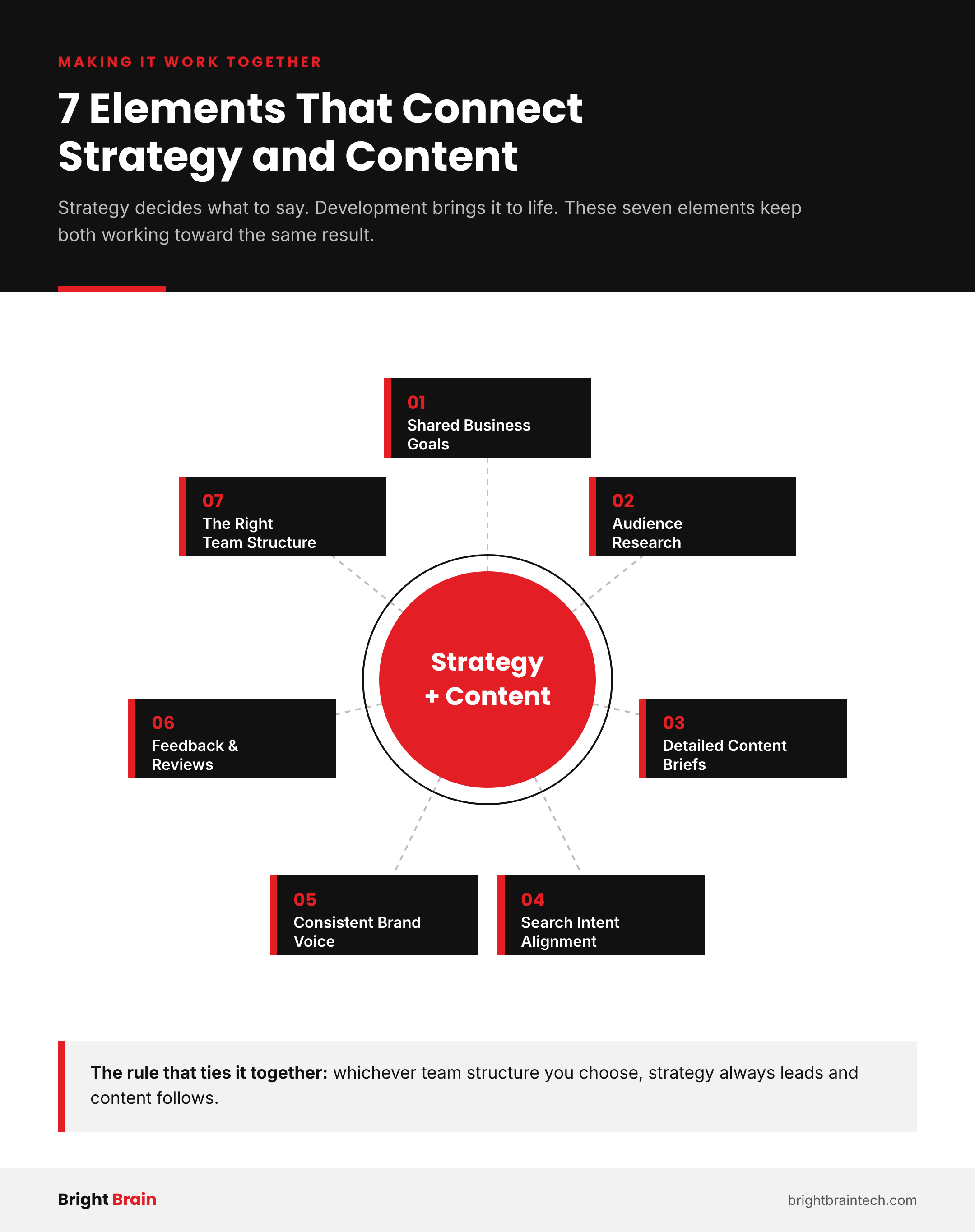
Once the roadmap exists, someone has to bring it to life. That’s where a content development agency fits in. Strategy decides what your brand should say. Development turns those decisions into content people actually read, share, and act on. But the two only deliver results when a few key elements connect them.
Strategy and content work best when both teams chase the same outcome. That might be more qualified enquiries, stronger brand search, or shorter sales cycles. Many brands go wrong here. They hire a content development agency before agreeing on goals, then wonder why polished content still underperforms. Writing quality matters, but it can’t rescue a piece that was never tied to a clear objective.
Strategists study buyer personas, pain points, and the questions people ask before they buy. That research should never stay locked in a planning document. When writers understand who they’re speaking to, they choose better examples, use the right language, and address real concerns. As a result, the content feels relevant rather than generic.
The brief is the bridge between planning and writing. A strong brief explains who the piece is for, which question it answers, which keyword it targets, and what the reader should do next. It also sets the tone, structure, and sources to reference. When briefs are vague, writers fill the gaps with guesswork. When they’re clear, every piece supports the bigger plan and needs far fewer revisions.
Every article, page, and guide should match a specific search intent. Some readers want to learn, some want to compare options, and some are ready to act. Strategy maps these intents to topics, while development shapes each piece to satisfy them. This alignment is what helps content rank on Google and appear in AI-generated answers.
Buyers should recognise your brand whether they read a blog, a case study, or an email. A shared style guide covering tone, terminology, and key messages keeps every writer on the same page. Consistency builds familiarity, and familiarity builds trust over time.
Strategy isn’t a one-time document. Monthly reviews show which topics drive traffic, which formats convert, and which pieces need refreshing. Writers then use those insights to sharpen future content, while strategists adjust priorities. This feedback loop keeps both sides learning and improving together.
Finally, the setup itself matters. Some brands hire one content strategy agency that handles planning and production under one roof, which suits smaller teams wanting a single point of contact. Others hire a strategist and a separate content development agency, which suits larger brands needing specialist writers for technical or regulated industries. Either model works, as long as strategy leads the way.
Social platforms don’t reward the same content that search engines do. A detailed 2,000-word guide can rank on Google and do nothing on Instagram. A punchy 20-second reel can travel far and still bring in zero qualified enquiries. Here’s why social media content needs a playbook of its own.
LinkedIn favours genuine conversation and dwell time. Instagram pushes Reels for reach. YouTube rewards watch time and search-friendly titles. A single approach can’t satisfy all of them. This is why many brands work with a social media content agency alongside their core strategy team, because these specialists track how each algorithm works and how it changes.
On Google, people arrive with a question and actively look for an answer. On social media, they’re scrolling, often without any intent to learn or buy. Your content has to earn their attention first and deliver value second. That calls for different hooks, different tones, and a different way of telling your story.
A blog reader might spend several minutes on your page. A social user decides within seconds whether to stop or keep scrolling. Social content must lead with the most interesting idea, get to the point quickly, and stay visually clear. Long introductions that work on a website simply get skipped on a feed.
Search best practices evolve over months, but social formats can shift within weeks. New features, trending audio, and changing content styles affect what gets seen. A dedicated social plan leaves room to test, learn, and adapt, while still staying true to your brand.
Posting is only half of social media. Replies, comments, community engagement, and direct messages often matter just as much. Brands that respond thoughtfully build stronger relationships and gain more visibility. A social playbook sets out how your team engages, not just what it publishes.
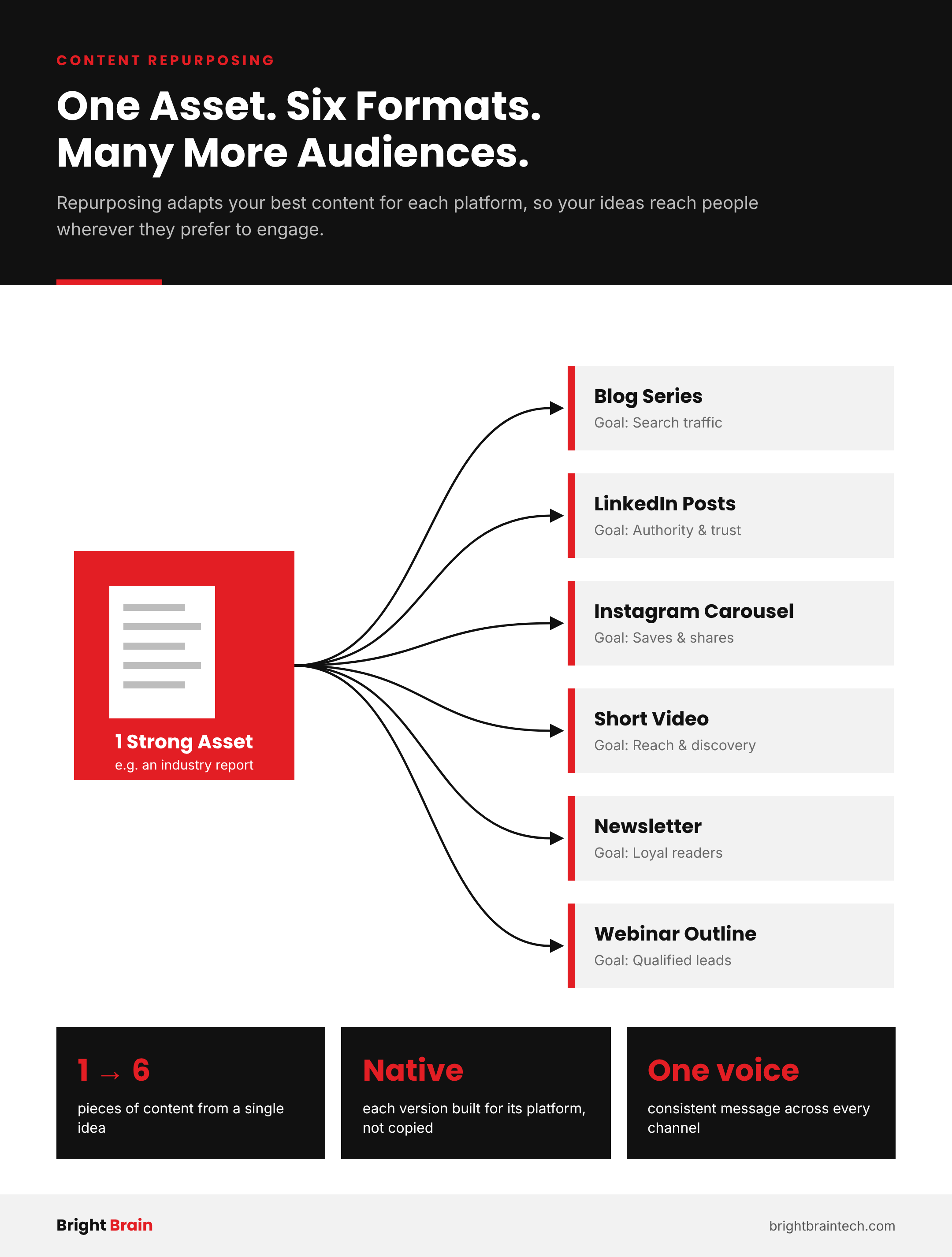
Repackaging a blog post as a plain image rarely works. A dedicated social content creation agency produces carousels, short videos, captions, and graphics designed for each platform from the start. Native content feels natural in the feed, so people are far more likely to watch, read, and engage.
Having its own playbook doesn’t mean social should work in isolation. A social media content agency can plan the channels and a social content creation agency can produce the assets, but both should echo the themes in your wider content plan. That way, a buyer who discovers you on LinkedIn finds the same clear message when they land on your website.
Creating content from scratch every week is exhausting and expensive. Repurposing solves both problems at once.
A content repurposing agency takes one strong asset, such as a detailed industry report, and turns it into a blog series, several LinkedIn posts, an Instagram carousel, a short video, a newsletter, and a webinar outline. Each version is adapted for its platform, not copied and pasted.
Repurposed content also reaches people at different moments. Someone might skip your blog but stop for a carousel. Working with a content repurposing agency means your best ideas reach the audience they deserve.
A thoughtful strategy partner builds repurposing into the plan from day one, so every major asset is designed to travel across channels before a single word is written.
A content optimization company audits existing pages, refreshes outdated information, fills keyword gaps, improves page structure, and rewrites sections that no longer match search intent. Quite often, updating ten older blogs delivers more traffic than writing ten new ones.
Search behaviour has also shifted. Buyers now ask questions through Google’s AI Overviews, ChatGPT, Perplexity, and Gemini. These tools favour content that answers questions directly, cites reliable data, and follows a clean, logical structure. A modern content optimization company plans for this with direct answers, well-organised headings, and FAQ sections that AI systems can easily quote.
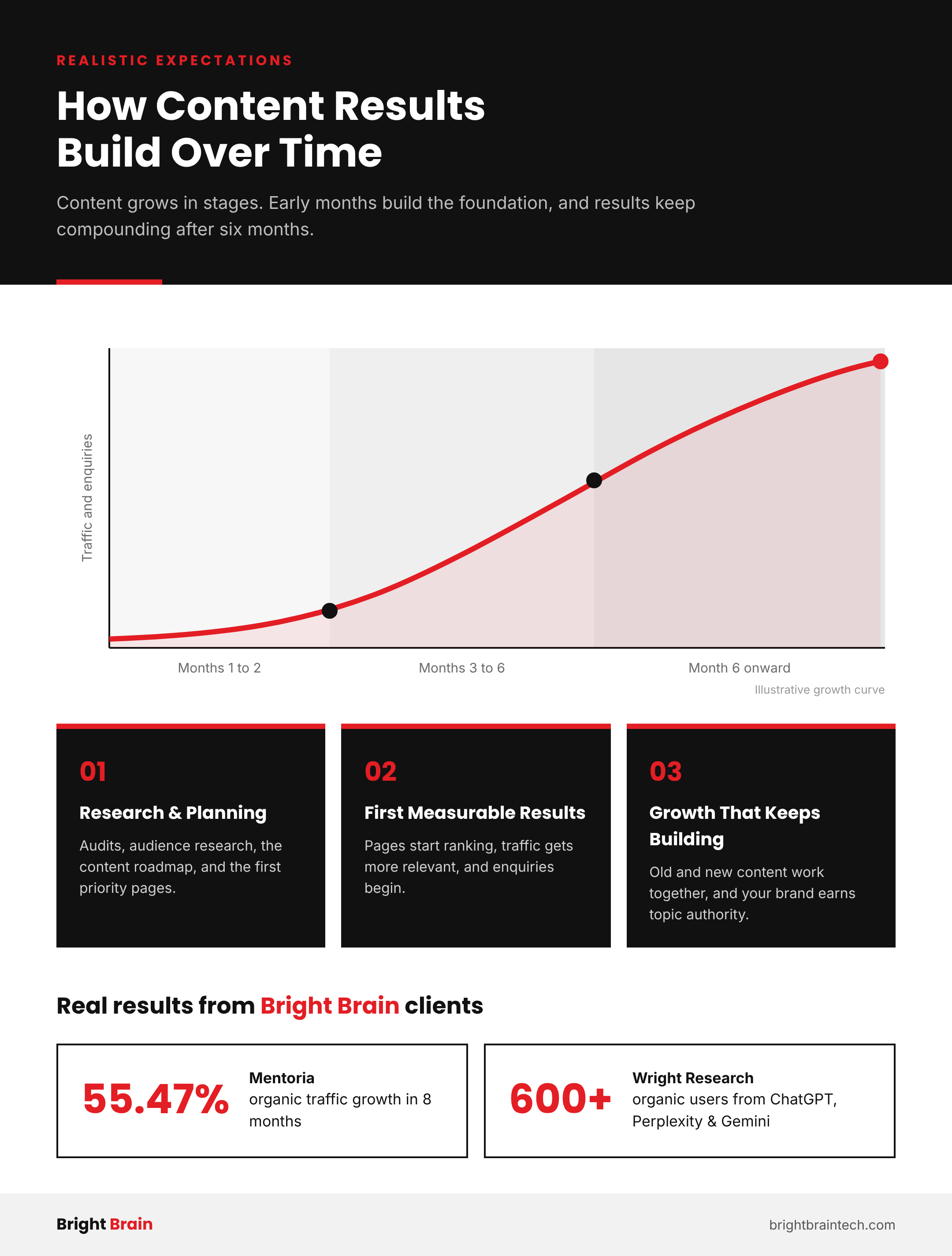
At Bright Brain, we’ve seen this shift up close. Our work with Wright Research brought in more than 600 organic users from ChatGPT, Perplexity, and Gemini. For Mentoria, a consistent content and SEO approach grew organic traffic by 55.47% over eight months. Results like these come from strategy and optimisation working together, not from publishing volume alone.
Some brands already have talented writers and designers but lack senior strategic direction. For them, a content marketing consulting agency is often the right fit. Consultants audit your current setup, build the strategy, train your team, and review performance every month. Your people keep creating, while the consultant keeps them pointed in the right direction.
On the other hand, if your team is small or already overloaded, a full-service content strategy company usually makes more sense. It takes ownership of planning, production, distribution, and reporting. Start-ups and fast-growing brands often begin with full service, then move to a consulting model once they build internal capability.
A simple rule helps here. If your bottleneck is thinking, hire a content marketing consulting agency. If your bottleneck is doing, hire a team that can execute from start to finish.
Directories and “best agency” lists give you a starting shortlist, but rankings alone won’t tell you whether a partner fits your business. These are the areas worth checking before you sign.
Ask for case studies with real numbers, ideally from your industry. Traffic growth is good, but enquiries, sign-ups, and revenue are better. A partner confident in its work will happily walk you through what it did, what changed, and how long it took.
A reliable partner should explain how it researches topics, sets KPIs, and decides what to stop doing, not just what to start. If the process sounds vague or overly generic, the results usually will be too.
Can the team support you as a social media content agency and a social content creation agency when you need it, or will you have to find another vendor? Do their writers work like a specialist content development agency, with people who understand your sector? Fewer handovers usually mean a more consistent brand message.
Content today needs to perform on Google and inside AI tools like ChatGPT, Perplexity, and Gemini. Ask how the team structures content for featured snippets and AI Overviews, and whether it has examples of clients earning visibility there.
Not every brand needs a full-service team. If you only need direction rather than delivery, a content marketing consulting agency might be all you require. Be honest about your internal capacity before choosing a model.
The right content strategy company asks more questions than it answers in the first meeting. It wants to understand your customers, sales cycle, and goals before suggesting tactics. Ready-made pitches with no curiosity are usually a warning sign.
Before you start, agree on what success looks like at 90 days, six months, and one year. Clear milestones keep both sides accountable and make progress easy to measure.
Content is a long-term investment, so results build in stages rather than all at once. Here’s what typically happens at each stage and what you can realistically expect to see.
During the first two months, a content strategy agency focuses on groundwork. It audits your existing content, studies your audience and competitors, and builds a clear content roadmap. Publishing usually begins toward the end of this stage, starting with the most important pages. You won’t see big jumps in traffic yet, but this stage decides how well everything else performs.
By the third month, the first signs of progress start to show. New and refreshed pages begin ranking for target keywords, website traffic becomes more relevant, and content starts generating enquiries. Performance data from this period also shows which topics and formats work best, so the plan can be adjusted accordingly.
After six months, results start to compound. Older content continues to bring in visitors, while new content adds to that base every month. Over time, your brand becomes known for its core topics, which makes new pages easier to rank and more likely to convert visitors into leads.
Social media and search grow at different speeds. Social content often shows engagement within weeks, and a content repurposing agency can speed this up by turning your best-performing pieces into new formats across channels. Search and AI visibility take longer to build, but the results last much longer, especially when a content optimization company keeps updating key pages as search behaviour changes.
If your brand is publishing regularly but still wondering why results feel thin, you’re not alone. Most teams aren’t short on effort or ideas. They’re short on a plan that connects the two.
The right content strategy agency changes that. It gives your content a purpose, your team a direction, and your leadership a clear way to measure return. Sometimes that means a full roadmap. Sometimes it means a social media content agency to sharpen your feeds, a social content creation agency to produce platform-native assets, or a content marketing consulting agency to guide the talented people you already have.
Bright Brain is a Mumbai-based digital marketing agency and one of only 15 Google Elevator Partners selected from more than 7,000 agencies across India. We help brands plan, create, repurpose, and optimise content that earns attention on Google, social platforms, and AI search, and then turns that attention into enquiries.
You don’t need to have every answer before reaching out. You just need to be ready for content that finally works as hard as your team does. Learn More about how Bright Brain can build a content strategy that grows with your brand.
It researches your audience, competitors, and search demand to build a documented content plan for your brand. In simple terms, it decides what to publish, on which platforms, and how to measure success. This ensures every blog, post, and video supports a clear business goal rather than simply filling a calendar.
A content strategy company decides what content to create and why. A content development agency focuses on producing it, including articles, scripts, landing pages, and case studies. Many brands need both functions, and some partners offer strategy and development together under one team.
In most cases, yes. A social media content agency plans content around how people behave on LinkedIn, Instagram, and YouTube. Blog content rarely performs on social without being reshaped. A social content creation agency then produces native formats for each platform that encourage engagement and enquiries.
A content repurposing agency turns one strong piece of content into many platform-specific formats. A single report can become blogs, carousels, short videos, newsletters, and LinkedIn posts. This stretches your budget, keeps messaging consistent, and helps your ideas reach audiences who prefer different formats.
A content optimization company improves the content you already have. It refreshes outdated pages, fixes keyword gaps, and structures content so Google and AI tools like ChatGPT can understand and cite it. Updating existing pages often delivers faster traffic gains than publishing brand-new ones.
Costs depend on scope. A partner offering only planning usually costs less than a full-service team handling production and distribution. A content marketing consulting agency model suits brands with in-house writers. The best approach is to define your goals first, then request a clearly scoped proposal.

