By Suhail Bajaj ·
An ecommerce website development company designs, builds, and maintains online stores that turn browsers into buyers. The right partner combines platform expertise, conversion-focused design, transparent pricing, and dependable support after launch. This guide explains what to evaluate, what development typically costs in 2026, and which questions reveal whether an agency can genuinely grow your revenue.
Most online stores do not struggle because of the product. They struggle because the store quietly gets in the way. A checkout that asks for too much information. A product page that loads slowly on a mid-range phone. A search bar that cannot find “blue kurta” when the catalogue clearly has twelve. Each small friction point costs a sale, and most founders never see it happening.
That is why choosing an ecommerce website development company is less a technical decision and more a business one. You are not simply buying a website. You are choosing the team that will build the place where every rupee of your online revenue is earned.
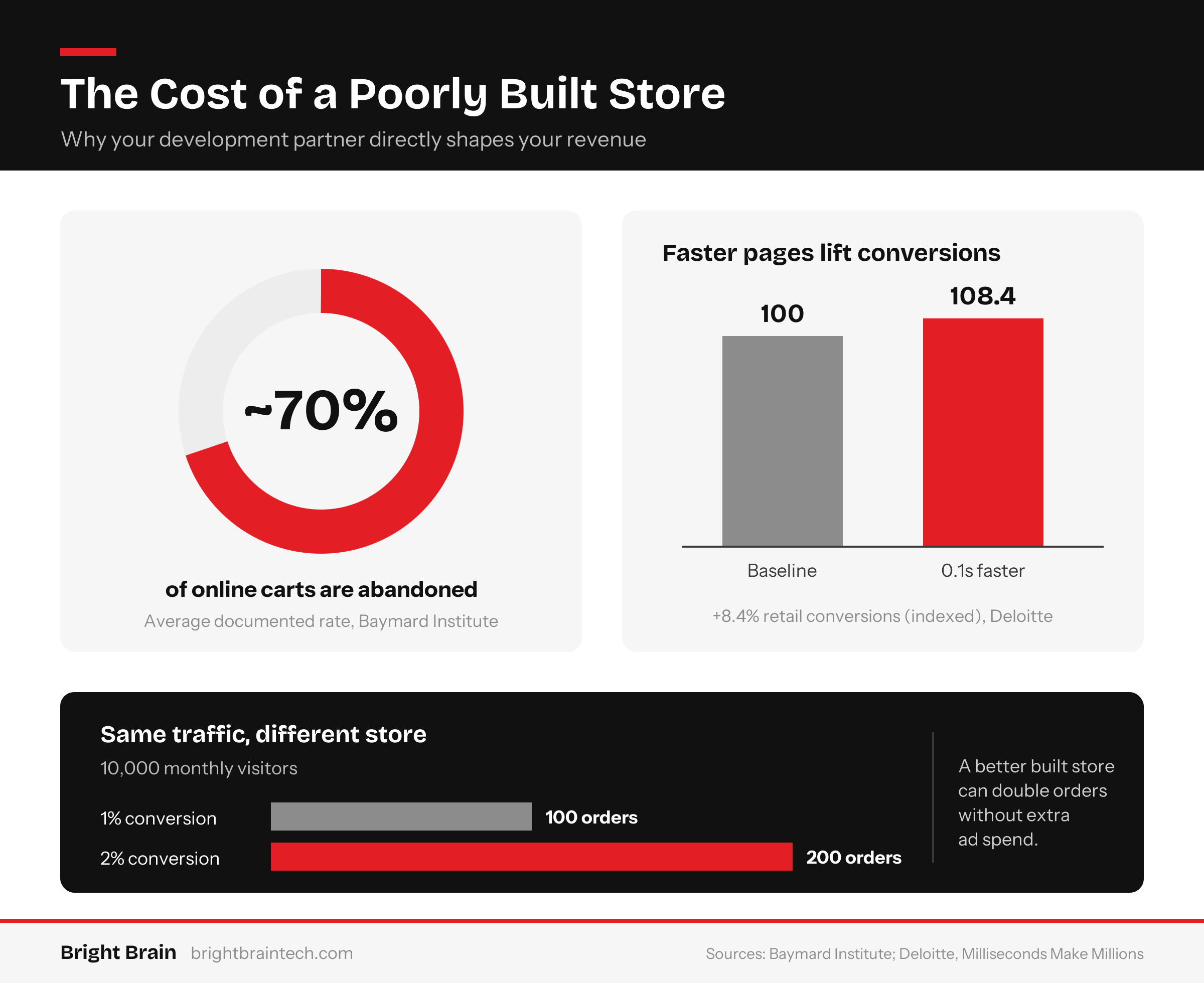
The research makes this real. The Baymard Institute, which has studied checkout usability for well over a decade, puts the average documented online cart abandonment rate at roughly 70 percent. A meaningful share of those lost carts trace back to design and development choices such as forced account creation, surprise costs, long forms, and slow pages. Speed matters just as much. Deloitte’s “Milliseconds Make Millions” study found that a 0.1 second improvement in mobile site speed lifted retail conversions by 8.4 percent.
In other words, the partner you pick affects your conversion rate, your marketing costs, and how quickly you can grow. It deserves the same care you would give to hiring a senior leader.
The phrase sounds simple, but the scope is wide. A capable ecommerce web development company handles far more than the visible storefront. Here is what the work typically covers, from the first conversation to long after launch.
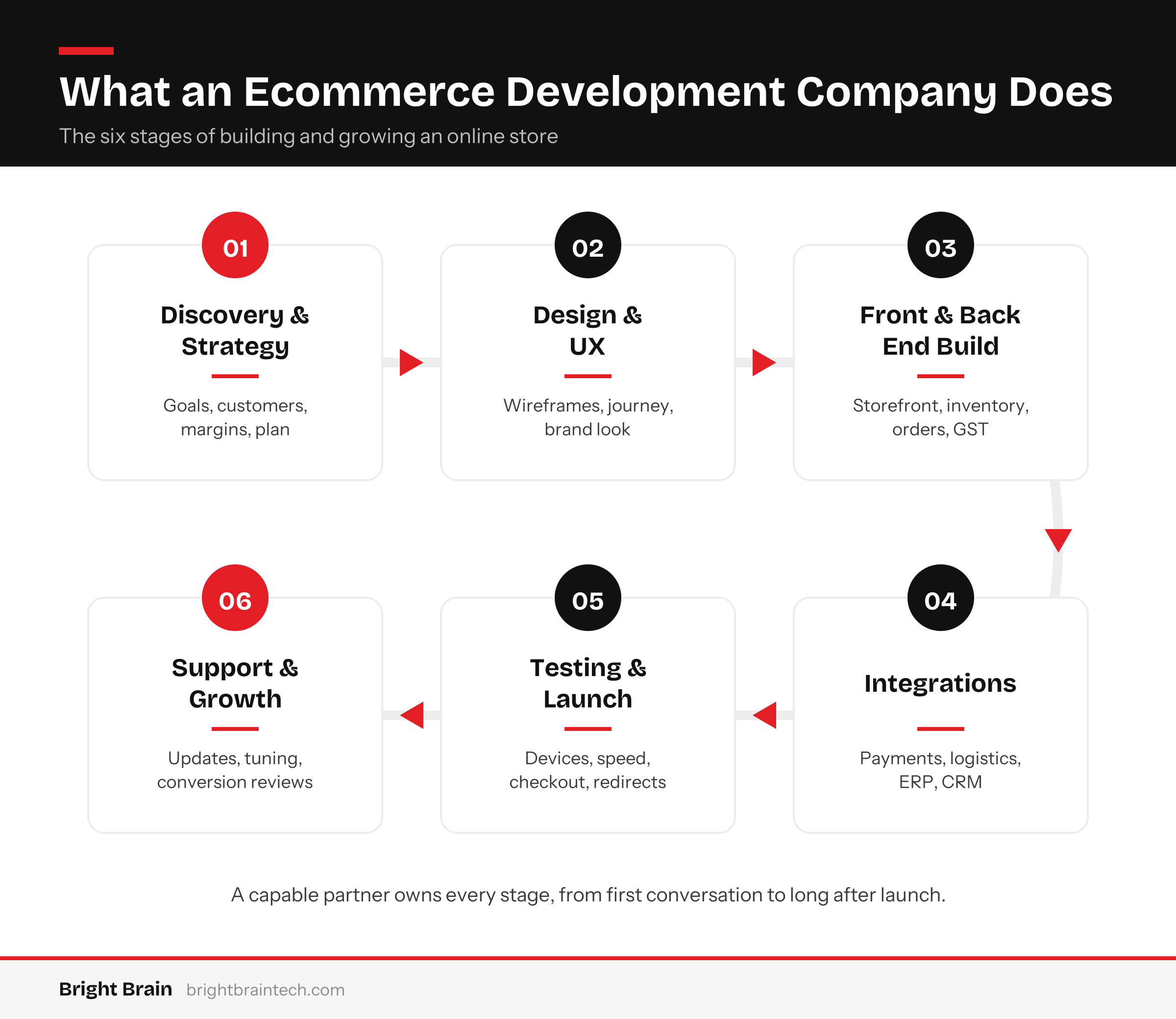
The work usually begins with discovery, where the team learns about your products, customers, margins, and growth plans. Good partners study your competitors, review your current analytics if you have a store already, and identify what is holding sales back. This stage ends with a clear plan covering platform choice, key features, timelines, and budget, so everyone agrees on what success looks like before a single page is designed.
From there, the team maps the user journey and designs the look and flow of the store. This includes wireframes for key pages such as the homepage, category pages, product pages, cart, and checkout. Strong design balances your brand identity with ease of use, so shoppers can find products quickly, trust what they see, and complete a purchase without confusion.
Development follows, covering both the front end customers see and the back end that manages inventory, orders, payments, shipping, and taxes such as GST. The front end needs to be fast, responsive, and accessible across devices. The back end needs to be reliable and easy for your team to manage, with simple tools for updating products, running offers, and processing orders.
Integration is where many projects succeed or stumble. Your store needs to talk to payment gateways like Razorpay or PayU, logistics partners like Shiprocket or Delhivery, your ERP or accounting software, CRM tools, and marketing platforms. A strong ecommerce website development company plans these connections early rather than patching them in later. When integrations work smoothly, stock levels stay accurate, orders flow to shipping automatically, and your team spends less time on manual work.
Before going live, the store should be tested thoroughly across browsers, devices, and payment methods. This includes checking page speed, broken links, checkout flows, tax calculations, and order notifications. A careful launch plan also covers redirects from any old website, analytics setup, and a backup plan in case something goes wrong on the day.
Launch is only the beginning. Security updates, performance tuning, new features, and festive season campaigns all need support. Many brands also benefit from regular conversion reviews, where the team studies how shoppers use the site and suggests improvements. The best relationships continue long after launch day and grow alongside your business.
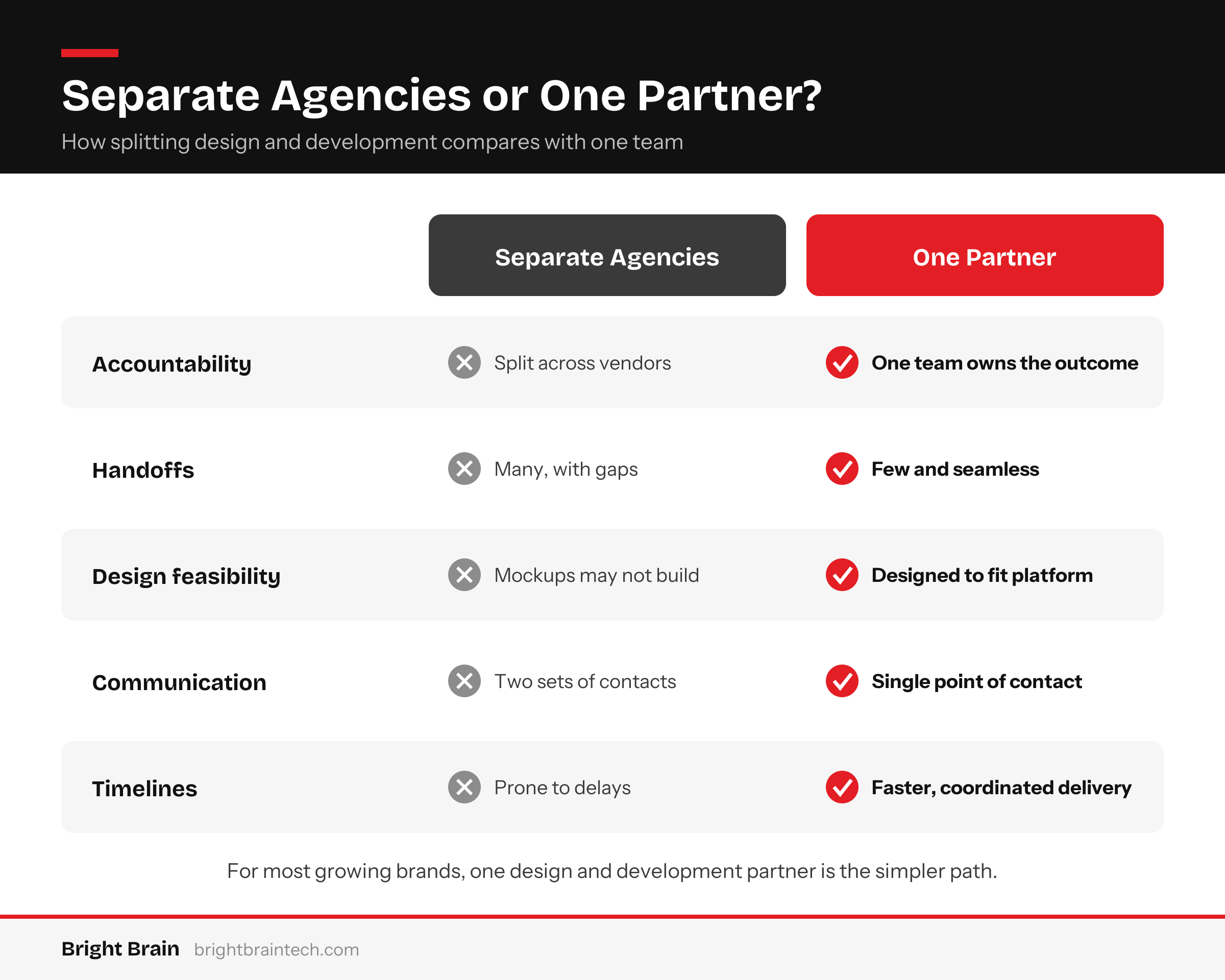
Here is a distinction many buyers miss. An ecommerce web design company typically focuses on visual identity, layout, and user experience. An ecommerce development agency concentrates on engineering, integrations, and performance. Both skills matter, and the gaps between them are where problems tend to hide.
When design and development sit with separate vendors, beautiful mockups sometimes arrive that are expensive or impossible to build on your chosen platform. Equally, developers working without design input can produce a store that functions perfectly but feels generic and unconvincing.
For most growing brands, an ecommerce website design and development company offers the simplest path. One team owns the outcome, so accountability is clear and handoffs are fewer. Many ecommerce website design companies now offer both services, so ask exactly which work stays in-house.
If you prefer specialists, make sure both parties agree on a shared plan, timelines, and decision rights before work begins. If you hire an ecommerce web design company and an ecommerce development agency separately, ask them to meet before signing so the designs match what can actually be built.
Portfolios look impressive on the websites of most ecommerce website design companies, so you need sharper filters. The best ecommerce web design companies tend to share seven qualities that are easy to check once you know where to look.
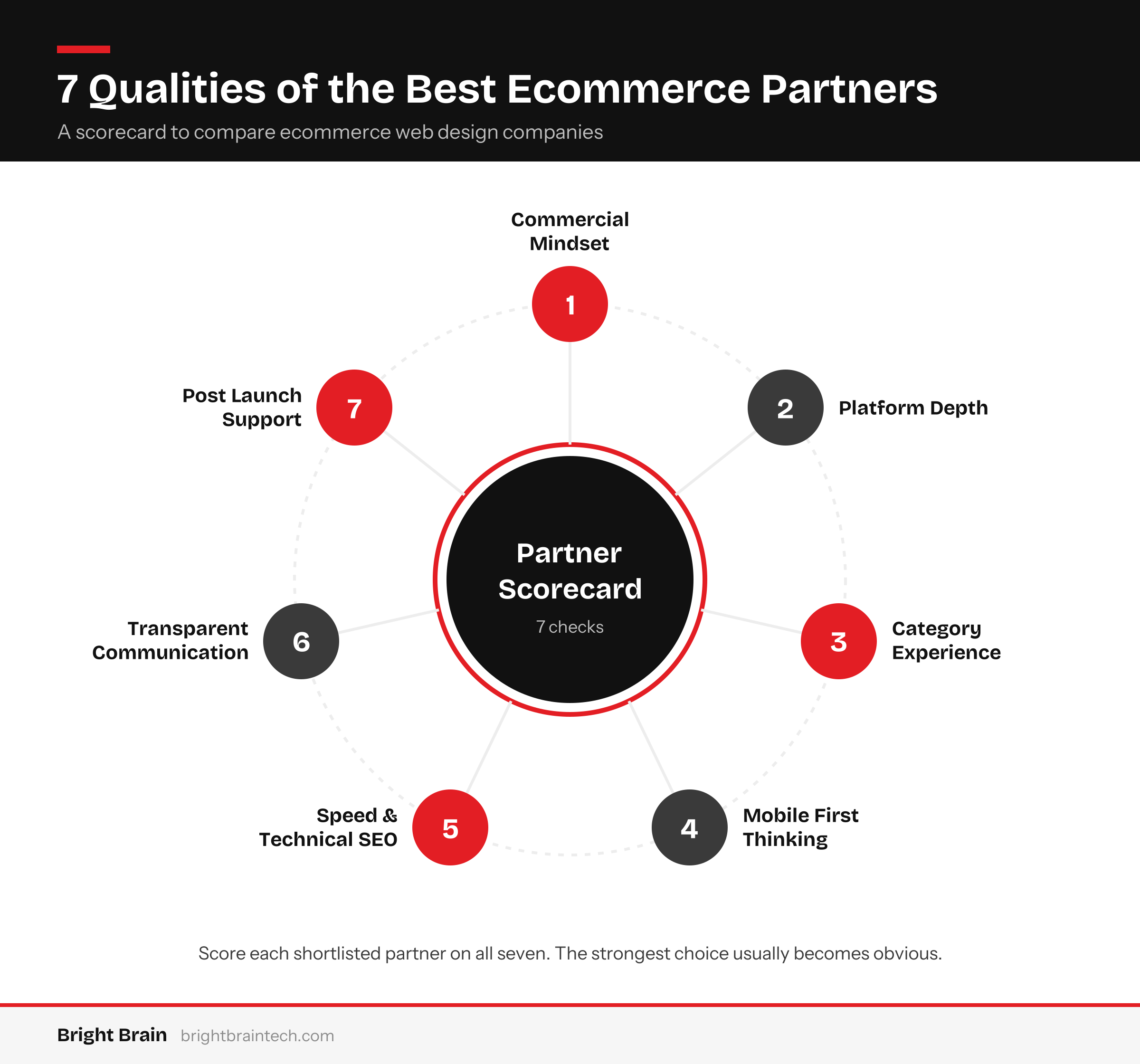
Ask how they measure success. If the answer is “a beautiful site,” keep looking. If they talk about conversion rate, average order value, and repeat purchases, you are in the right conversation. Partners with a commercial mindset ask about your margins, best-selling products, and customer acquisition costs early on, because those numbers shape how the store should be built. They see your website as a sales channel first and a design project second.
A good ecommerce web design company explains why a platform fits your business, not just which one they prefer building on. They should be able to walk you through the trade-offs in cost, flexibility, maintenance, and scalability in plain language. Ask how many live stores they have built on the platform they recommend, and how they have handled migrations or upgrades. Real depth shows up in how confidently they answer questions about limitations, not just strengths.
Stores selling fashion, electronics, wholesale supplies, or subscriptions have very different needs, so look for case studies in your category or something close to it. A fashion brand needs size guides, rich imagery, and easy returns. A wholesale business needs bulk pricing, quote requests, and customer-specific catalogues. A partner who has solved problems like yours before will move faster, avoid common mistakes, and bring ideas you may not have considered.
In India, most online shopping happens on smartphones, so the mobile experience should be designed first rather than squeezed in at the end. An ecommerce web design company that designs for the small screen first usually sees stronger mobile conversions. Look for thumb-friendly navigation, quick-loading product images, simple filters, and a checkout that supports UPI and wallet payments in a few taps. Test their past work on your own phone, ideally on a regular mobile data connection rather than office Wi Fi.
Clean code, optimised images, and sound site structure help your store rank higher and convert more of the visitors it attracts. Slow stores lose shoppers before a single product loads, and they struggle to compete in search results. Ask how the team approaches Core Web Vitals, image compression, URL structure, schema for products, and redirects when pages change. A partner who builds these foundations in from the start saves you costly fixes later.
You should know who is working on your project, how progress is reported, and how changes are priced. The strongest partners assign a dedicated project manager, share timelines with clear milestones, and send regular updates without being chased. They are also honest when something is delayed or out of scope. Clear communication early in the relationship is one of the best predictors of a smooth project.
Your store will need updates, fixes, and new features long after launch, so look for clear support terms and response times written into the contract. Ask what is covered under the maintenance retainer, how urgent issues are handled during sales or festive peaks, and whether security patches and platform updates are included. Good support means problems get solved in hours, not days, when revenue is on the line.
Use these qualities as a scorecard. Any ecommerce website development agency worth hiring will welcome the scrutiny. Comparing two or three ecommerce website design companies against this scorecard usually makes the strongest choice obvious.
Platform choice shapes your costs, flexibility, and speed for years, so it deserves careful thought.
Shopify suits most direct-to-consumer brands that want speed to market, reliability, and a large app ecosystem without managing servers. WooCommerce, built on WordPress, gives more control and works well for content-heavy brands, though it needs more maintenance. Adobe Commerce, formerly Magento, serves larger catalogues and complex wholesale requirements but demands a bigger budget and specialist developers. Headless commerce, which separates the front end from the commerce engine, offers maximum flexibility for brands with serious scale and engineering resources.
A trustworthy ecommerce web development company will not push one platform for every client. It will ask about your catalogue size, order volume, integrations, internal team, and three-year plans before recommending anything. When you compare ecommerce website design companies, notice which ones ask these questions and which ones jump straight to a quote. Before you commit to any ecommerce website development company, ask which platforms it has launched live stores on in the past year.
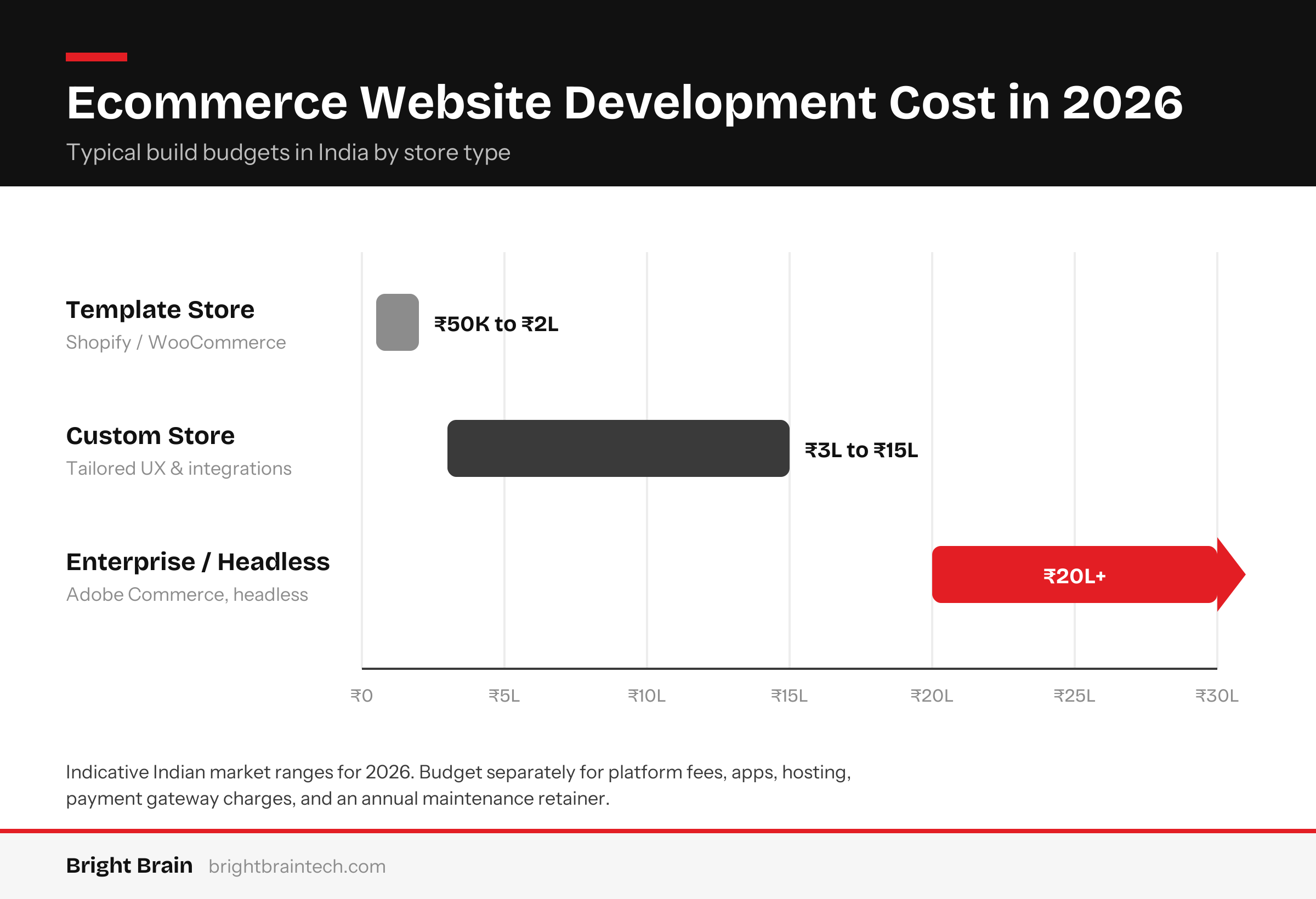
Pricing is the question everyone asks first, and it has the widest range of answers. In the Indian market, costs broadly fall into three bands, although every project is different.
A template-based store on Shopify or WooCommerce with modest customisation often starts at around ₹50,000 and can reach ₹2 lakh. A custom-designed store with tailored features, integrations, and conversion-focused UX commonly ranges from ₹3 lakh to ₹15 lakh. Enterprise builds on Adobe Commerce or headless architecture can go well beyond ₹20 lakh. Beyond the build, budget for platform subscriptions, paid apps, hosting, payment gateway fees, and an annual maintenance retainer. Ask every ecommerce website development agency for an itemised quote so you can compare like for like. A reliable ecommerce web development company will also break the quote into phases, so you can see exactly where the money goes.
The cheapest quote is rarely the cheapest outcome. A poorly built store that converts at one percent costs far more over two years than a well-built one converting at two percent. When an ecommerce website development company shares a price, ask what is included, what is excluded, and what happens when the scope changes.
Remote collaboration works well today, yet proximity still has value. Working with a partner in your city, whether that is Mumbai, Bengaluru, or Delhi, makes workshops, launch planning, and urgent problem-solving easier. A local team also understands regional buying behaviour, festive season peaks, cash on delivery expectations, and the payment preferences of Indian shoppers. For a Mumbai brand, an ecommerce website development agency nearby can join launch day planning at short notice.
That said, location should never outweigh capability. The best ecommerce web design companies combine local market understanding with the discipline to deliver for clients anywhere. If you choose a remote ecommerce website design and development company, agree on overlapping working hours, a single point of contact, and a regular reporting rhythm from the start.
A partner without marketing knowledge judges success by how the store looks on launch day. A partner with it knows the real test comes afterwards, when the site must attract traffic, convert visitors, and bring customers back. That mindset shapes every decision, from site structure and page speed to how products are organised, so your store is ready to grow from the start.
Many stores launch with tracking that is missing or broken, and marketing teams lose weeks fixing it before campaigns can run properly. A marketing-aware ecommerce development agency sets up analytics, conversion tracking, and ad pixels during the build and hands them over cleanly. Your first campaigns can start collecting reliable data immediately.
An ecommerce website development company that understands performance marketing and SEO judges its work by sales, not screenshots. At Bright Brain, a Mumbai-based digital marketing agency and one of only 15 Google Elevator Partners selected from over 7,000 agencies across India, we build the store and the marketing as one system. For Bioclean, this joined-up approach contributed to a 204 percent improvement in ROAS and 224 percent revenue growth. Richfeel Naturals saw a 70 percent increase in conversion rate alongside a 50 percent revenue boost.
When designers understand how customers arrive and buy, pages stop being decoration and start doing commercial work. An ecommerce web design company that thinks this way plans landing pages, product pages, and checkout around campaigns, search intent, and tracking from day one. That is why an ecommerce website design and development company with in-house marketing expertise is often the safer choice for brands that want growth, not just a new website.
Choosing a development partner can feel overwhelming, especially when every proposal promises speed, beauty, and growth. The good news is that the right choice becomes much clearer once you know what to look for. Focus on commercial thinking, platform honesty, transparent pricing, and a team that will still be by your side a year after launch.
Take your time comparing ecommerce website design companies, ask the difficult questions, and trust the partner who listens before they pitch. A well-built store is one of the most valuable assets your business will ever own, and the right ecommerce website development company will treat it that way.
If you would like a partner that brings development, design, and performance marketing together under one roof, Bright Brain is here to help. Learn More about how we build ecommerce experiences that convert visitors into loyal customers.
An ecommerce website development company plans, designs, builds, and maintains online stores. Its work covers platform selection, user experience, product catalogues, payment and shipping integrations, security, speed optimisation, and post-launch support. The best partners also focus on conversion rate, average order value, and repeat purchases, so the store drives measurable revenue rather than simply looking attractive.
Look at live client stores rather than screenshots, and test them on your phone. The best ecommerce web design companies show relevant category experience, explain platform recommendations clearly, share transparent pricing, and offer written support terms. Speak with past clients and favour partners who talk about conversions and growth, not only visual appeal.
An ecommerce web development company in India typically charges around ₹50,000 to ₹2 lakh for a template-based store, ₹3 lakh to ₹15 lakh for a custom build, and over ₹20 lakh for enterprise projects. Ongoing costs include platform fees, apps, hosting, payment gateway charges, and annual maintenance.
An ecommerce development agency usually offers a full team covering design, development, testing, and support, which reduces risk for growing brands. Freelancers can suit small, simple stores with tight budgets. For businesses planning to scale, an agency provides more continuity, accountability, and capacity when problems arise or new features are needed.
An ecommerce website development agency can usually launch a template-based Shopify or WooCommerce store in four to eight weeks. Custom stores often take three to five months, while enterprise or headless builds can take six months or longer. Timelines depend on catalogue size, integrations, content readiness, and how quickly feedback is shared.
An ecommerce website design and development company keeps design, engineering, and testing under one roof. This means fewer handoffs, clearer accountability, and designs that are practical to build on your platform. Separate vendors can work, but they need careful coordination. For most brands, a single partner delivers faster, more consistent results.