By Suhail Bajaj ·
GEO for ecommerce is the practice of making your products, reviews and brand information easy for AI engines like ChatGPT, Gemini, Perplexity and Google AI Overviews to find, trust and cite. It shifts the goal from ranking links to being named inside the answer. This guide explains how online brands build that presence, one practical step at a time.
A shopper in Mumbai asks ChatGPT for the best natural hair oil for a dry scalp under ₹800. Seconds later, she has a shortlist of three brands, a quick comparison and a reason to trust each one. She never scrolled through ten blue links. She never saw your ad. If your brand was missing from that answer, you were never in the race.
This is the reality GEO for ecommerce is built to address. Generative engine optimization, or GEO, is the discipline of shaping how AI platforms understand, describe and recommend your products. Traditional SEO asks how to rank on page one. GEO asks a different question: when an AI assembles an answer, will it mention your brand, and will it describe you accurately?
The two are closely related, but they are not the same. Search engines rank pages. Generative engines read many sources, synthesise them, and produce a single response. In practice, GEO for ecommerce builds on strong SEO foundations rather than replacing them. Your goal is no longer only a click. It is a citation, a recommendation, and a place in the conversation where buying decisions now happen.
This is why AI search visibility has become a leadership-level topic for online brands. It measures how often, and how favourably, your products appear when customers ask AI tools for advice.
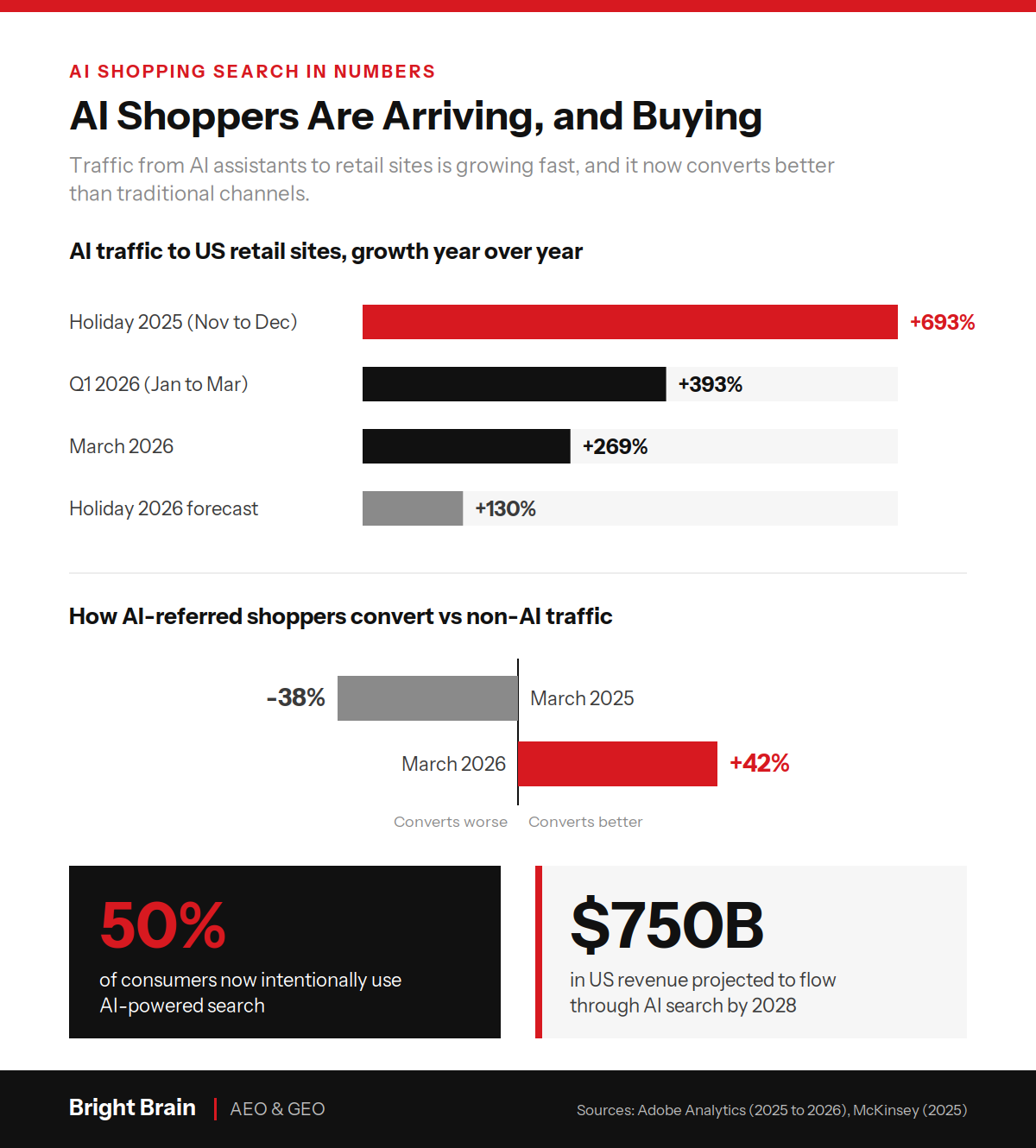
The numbers make this shift hard to ignore. According to Adobe, traffic from AI sources to US retail sites grew 393% year over year in the first quarter of 2026. More telling, Adobe found that in March 2026 this AI-referred traffic converted 42% better than non-AI traffic. A year earlier, it had converted 38% worse.
In other words, shoppers arriving from AI tools are no longer casual browsers. They arrive with a shortlist already formed and intent already high. Adobe’s holiday forecast, released in late September 2026, expects AI traffic to US retail sites to rise another 130% this season.
McKinsey’s research adds another layer. Its 2025 study found that half of consumers now intentionally use AI-powered search, and it projects that $750 billion in US revenue will flow through AI search by 2028. The same research found that a brand’s own website supplies only 5 to 10% of the sources AI engines consult when forming answers.
That last point deserves a pause. Even a beautifully optimised store controls only a small part of what AI reads about it. Reviews, marketplaces, forums, publishers and comparison sites fill the rest. This is exactly why GEO for ecommerce cannot be treated as a small add-on to your SEO checklist. It is a new layer of brand building.
For Indian ecommerce brands, the timing matters too. Behaviour that starts in the US tends to arrive here quickly, especially in mobile-first categories like beauty, wellness, fashion and electronics. Brands that start now will shape how AI describes their category before competitors do.
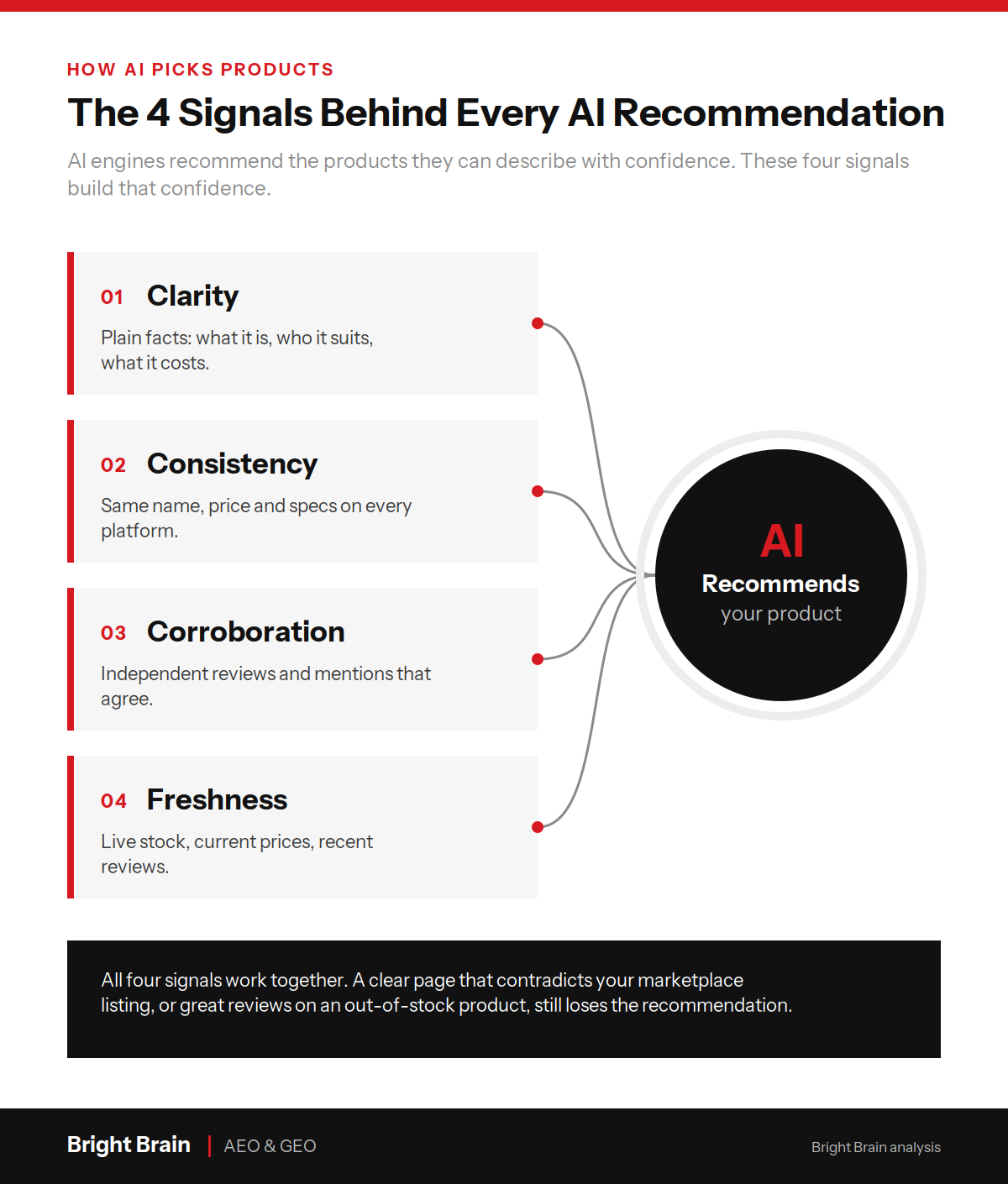
AI engines do not pick products at random, and they do not simply copy whoever ranks first on Google. They look for signals that make an answer safe, useful and specific. When an AI recommends a product, it is effectively putting its own credibility on the line, so it leans towards brands it can describe with confidence.
AI systems favour pages that state facts plainly: what the product is, who it suits, what it contains, what it costs and how it compares. Vague marketing copy gives them very little to work with.
Think of it from the AI’s point of view. A description that says "our bestselling face wash for glowing skin" offers no usable facts. A description that says "a sulphate-free gel cleanser with 2% niacinamide, made for oily and acne-prone skin, 150 ml" gives the AI ingredients, skin type and size in a single sentence. That is exactly the kind of detail it needs to match your product to a shopper’s question.
Clarity also applies to structure. Short paragraphs, descriptive headings, specification tables and plain language make it easier for AI tools to extract the right facts without misreading them.
When your product name, price, specifications and claims match across your website, Amazon listing, Google Merchant Center feed and review platforms, AI tools gain confidence. Contradictions make them hesitate, and hesitation usually means they recommend someone else.
This problem is more common than most brands realise. A product might be listed as 500 ml on your website, 450 ml on a marketplace and "half a litre" in an old press release. A price might be updated on your store but not in your product feed. To a human, these gaps look minor. To an AI weighing several sources, they create doubt about which version is true.
A simple quarterly audit of your key listings, feeds and brand profiles can prevent this. Use the same product names, the same core claims and the same specifications everywhere your brand appears.
AI engines trust what many credible sources agree on. This is where brand mentions in AI search become powerful. When independent reviewers, creators, publications and real customers describe your product in specific terms, AI tools notice those patterns and repeat them.
Corroboration works much like word of mouth. If your website claims your mattress is great for back pain, the AI treats that as a brand claim. If physiotherapy blogs, verified buyers and a respected sleep publication say the same thing, the claim starts to look like an established fact. The more independent sources that agree, the more comfortable the AI becomes in repeating it.
This is also why your weaknesses matter. If several reviews mention slow delivery or poor packaging, AI tools may surface that too. Fixing the underlying issue, and responding openly to feedback, protects how you are described.
Current stock status, pricing, new launches and recent reviews help AI tools avoid recommending products that are outdated or unavailable.
AI shopping answers increasingly pull live information, and no assistant wants to recommend a product that is out of stock or discontinued. Brands that keep availability, pricing and seasonal ranges updated are simply safer to recommend.
Freshness also shows up in content. A buying guide last updated three years ago carries less weight than one refreshed this season. Regularly adding new reviews, updating product pages and dating your guides tells AI engines your information is current and reliable.
Understanding these signals is the foundation of every good GEO for ecommerce strategy. Every tactic that follows strengthens one or more of them.
These four signals also work together rather than in isolation. A clear product page that contradicts your marketplace listing loses trust. Strong reviews on an out-of-stock product lose relevance. The brands that win in AI search are the ones that get clarity, consistency, corroboration and freshness working at the same time.
Your product detail page is still the most important asset you own. The difference now is that it must serve two readers at once: a human shopper and an AI model.
Start by answering real questions directly on the page. Think about what customers ask your support team or type into AI tools. Is this serum safe for sensitive skin? How long does this bottle keep drinks cold? Will this sofa fit through a standard door? Answer these in clear sentences near the top of the page, not buried in a PDF or an image.
"Premium quality" tells an AI nothing. "Cold-pressed coconut oil, suited to curly hair, 200 ml lasts about two months with daily use" gives it something it can quote. This is the heart of AI overview optimization: content that is specific, factual and easy to lift into a summary.
Google’s AI Overviews and AI Mode increasingly surface product summaries directly in results. As a result, AI overview optimization now sits right alongside classic on-page SEO in any serious ecommerce plan.
Shoppers constantly ask AI tools to compare options. Honest comparison pages, buying guides and "which one is right for me" content help AI engines position your products correctly, even against bigger competitors.
Summaries of what customers love, common concerns and verified feedback give AI tools the social proof they look for. Reviews locked inside widgets that crawlers cannot read do far less work.
When brands work with a specialist AI SEO agency, this product-page layer is usually where they see the quickest gains. The content often already exists in some form and simply needs restructuring.
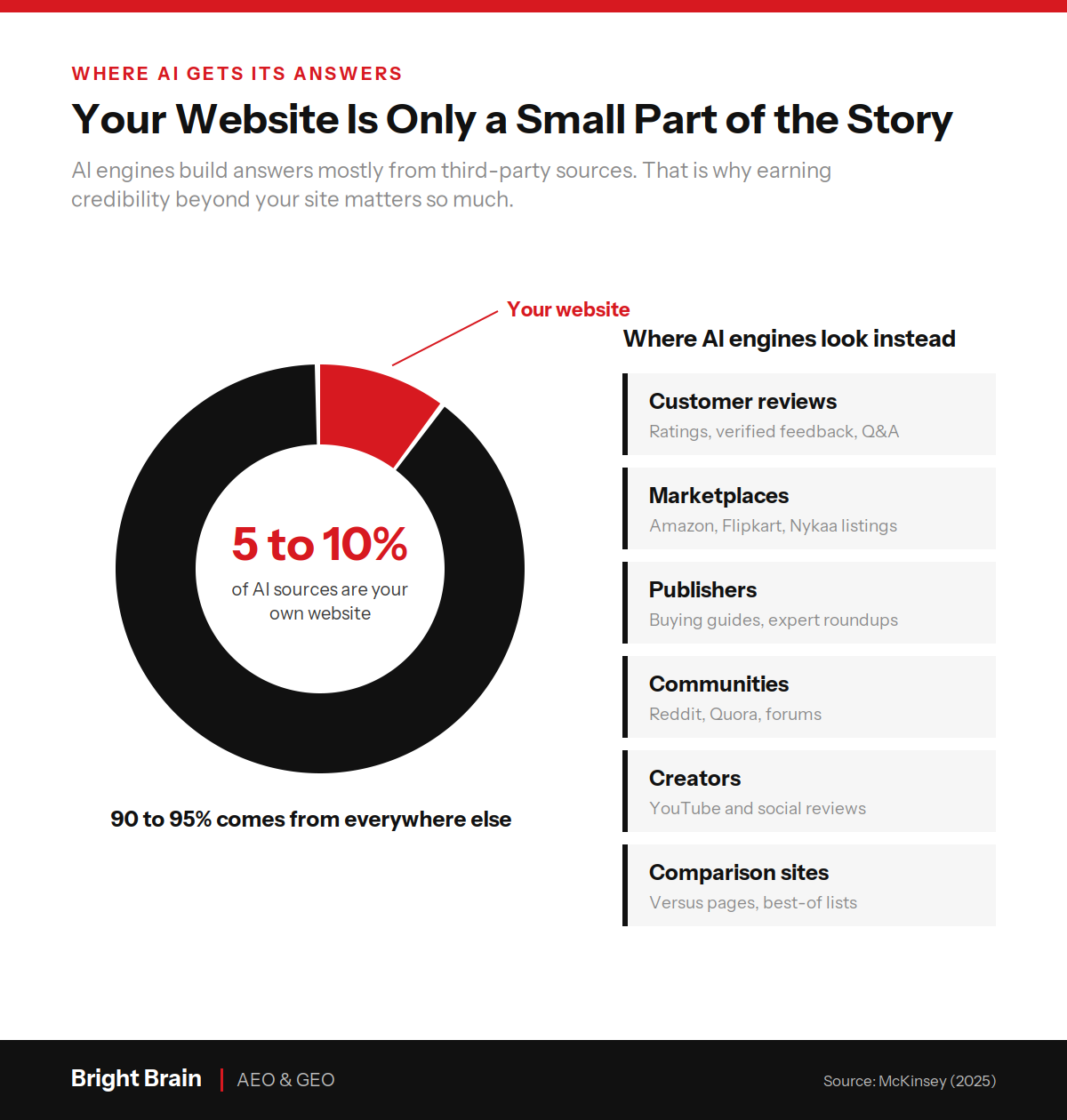
Remember that McKinsey finding: your website is only a small slice of what AI reads. The rest comes from the wider web, and that is where many ecommerce brands are weakest.
Building brand mentions in AI search begins with being discussed in the places AI engines trust. That includes credible review sites, niche publications, comparison articles, expert roundups, community forums like Reddit and Quora, YouTube reviews and marketplace listings with detailed feedback.
A hundred generic mentions matter less than ten specific ones that explain what your product does well and who it is for. When a respected beauty blog writes that your sunscreen is the best lightweight choice for oily skin in humid weather, that phrase becomes material an AI can use.
Digital PR, creator partnerships, expert contributions and customer review programmes all feed this layer. Good generative engine optimization services treat off-site reputation as seriously as on-site content, because AI engines clearly do.
Outdated information, old pricing or an unanswered complaint thread can quietly shape how AI describes you. Tracking brand mentions in AI search over time shows whether your efforts are actually changing how AI talks about your brand.
Great content cannot help you if AI crawlers cannot reach it. Many ecommerce sites unknowingly block AI bots in their robots.txt file, rely on JavaScript that crawlers struggle to render, or hide key details behind tabs and pop-ups.
Structured data is another essential. Product, review, offer, FAQ and organisation markup helps machines understand exactly what each page contains. Clean product feeds to Google Merchant Center and marketplaces then reinforce the same facts across platforms.
Site speed, mobile experience and a clear site structure matter too. AI tools often fetch pages in real time, and slow or broken pages are easy for them to skip.
This is why strong generative engine optimization services almost always begin with a technical audit. The work is rarely glamorous, but it is where effective GEO services create the conditions for everything else to succeed. A quick audit often reveals simple fixes with an outsized effect on AI search visibility.
Measurement is where GEO for ecommerce turns from a guessing game into a growth channel. One of the most common frustrations founders share with us is simple: how do we even know whether AI is recommending us? It is a fair question, because traditional rank tracking does not show it.
Measurement starts with a prompt set. List the questions your customers actually ask, from broad category queries to specific comparisons. Test them regularly across ChatGPT, Gemini, Perplexity, Claude and Google AI Overviews. Track whether your brand appears, where it appears, how it is described and which sources are cited.
Then connect that to business data. Tag and monitor referral traffic from AI platforms in your analytics. Watch branded search volume, because shoppers who discover you through AI often search your name directly afterwards. Compare conversion rates from AI referrals against your other channels.
McKinsey found that only 16% of brands systematically track AI search performance. That gap is an opportunity. Brands that measure early can see what works and double down before their category becomes crowded. A capable GEO agency should provide this reporting as standard, not as an afterthought.
The most common mistake we see is treating GEO as a new label for old SEO habits. Stuffing keywords, publishing thin blogs and chasing backlinks without context rarely move AI recommendations. GEO for ecommerce rewards substance: accurate product information, genuine reviews and genuinely helpful content.
Brands pour effort into their own site while their marketplace listings carry outdated specifications and their reviews go unanswered. AI reads all of it.
AI engines need time to discover, crawl and trust new information. A reliable GEO agency will be honest about this and focus on steady, measurable progress.
Rankings alone do not reveal AI search visibility. You need prompt tracking, citation monitoring and AI referral data to see the full picture. Many brands also forget that AI overview optimization needs its own tracking, since Google’s summaries can change from week to week.
Some brands choose a partner without digging into how they work. An experienced AI SEO agency will ask about your margins, hero products and customer questions before writing a single word, because GEO works best when it is tied to commercial priorities.
Many ecommerce teams can begin GEO in-house. However, doing it consistently across content, PR, technical SEO and measurement takes time and specialist skill. That is why more brands are now exploring generative engine optimization services.
When evaluating a GEO agency, look beyond buzzwords. Ask how they measure AI citations and which platforms they track. Ask to see brands that now appear in AI answers because of their work. A good partner explains their process plainly and sets realistic expectations, because GEO results build over months, not days.
It also helps to choose a partner that understands commerce, not just content. The best AI SEO agency for an online store connects AI visibility to revenue, conversion rate, customer acquisition cost and repeat purchases.
At Bright Brain, a Mumbai-based Google Elevator Partner and one of only 15 agencies selected from over 7,000 across India, we have seen this connection first-hand. Our work with Wright Research brought in more than 600 organic users from ChatGPT, Perplexity and Gemini. On the ecommerce side, our performance work with Bioclean delivered a 204% improvement in ROAS and 224% revenue growth, while Society Tea achieved 3x orders. When AI visibility meets conversion-focused execution, growth compounds.
Our GEO services combine AI search strategy with SEO, content and User Journey Optimisation, so the visitors AI sends your way are more likely to buy.
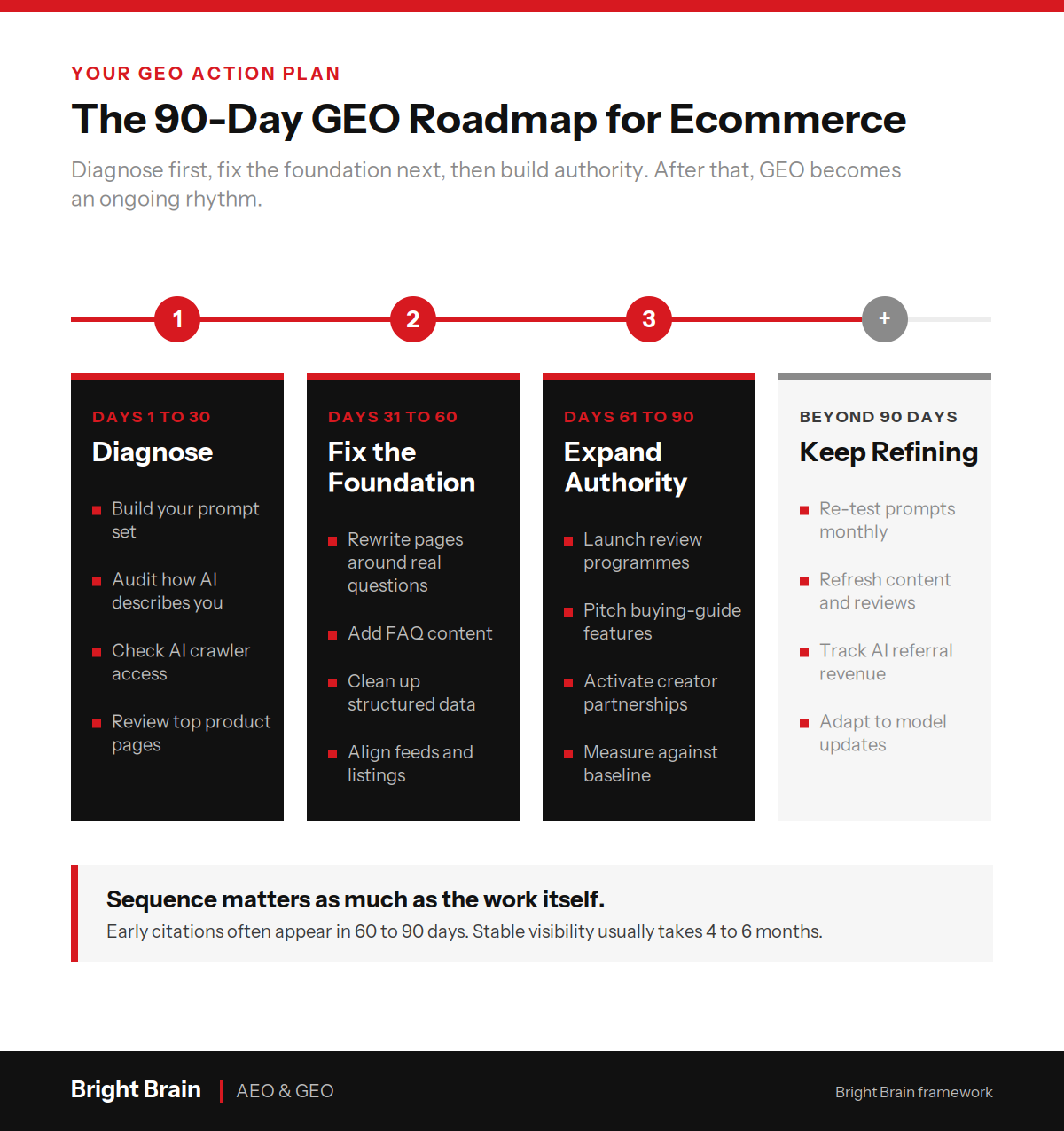
GEO can feel overwhelming at first, so the order of work matters as much as the work itself.
Build your prompt set, audit how AI currently describes your brand and competitors, check whether AI crawlers can access your site and review your top product pages for clarity. This baseline shows exactly where your AI search visibility stands today.
Rewrite priority product pages around real questions, add FAQ content, clean up structured data and align product information across your website, marketplaces and feeds. This phase is usually where AI overview optimization delivers its earliest wins.
Launch review programmes, pitch comparison and buying-guide features, activate creator partnerships and publish helpful category content. Then measure again and compare against your baseline.
At this stage, GEO for ecommerce becomes an ongoing rhythm rather than a one-time project. AI models update, competitors adapt and customer questions evolve. The brands that keep testing and refining are the ones that stay recommended.
AI search can feel like one more disruption in an already demanding market. Yet it is also one of the fairest opportunities ecommerce brands have had in years. AI engines reward clarity, honesty and genuine customer love, qualities the best brands already have.
GEO for ecommerce is not about gaming a new algorithm. It is about making sure the right shoppers hear accurate, compelling things about your products at the exact moment they decide what to buy. Start with your hero products, answer real questions, earn trusted brand mentions in AI search and measure your progress consistently.
You do not have to figure it out alone. Whether you need a one-time audit, ongoing GEO services or a strategic AI SEO agency to guide your team, Bright Brain can help you build a presence that AI engines trust and shoppers act on. As a GEO agency rooted in performance marketing, we deliver generative engine optimization services that connect every citation back to revenue.
The shift to AI shopping is already under way, and the brands that act now will shape how their category is described tomorrow. If you are ready to see how your store appears in AI answers today, and how GEO for ecommerce can change that story, Learn More about how Bright Brain’s GEO services can help your brand get cited, chosen and remembered.
GEO for ecommerce is the practice of optimising product pages, reviews and brand information so AI tools like ChatGPT, Gemini, Perplexity and Google AI Overviews recommend and cite your products. It focuses on clarity, consistency and third-party trust, helping online stores appear inside AI-generated shopping answers, not only in traditional search results.
SEO helps pages rank in search results, while GEO helps brands get mentioned and cited inside AI-generated answers. GEO relies on SEO foundations but adds a stronger focus on factual clarity, structured data, reviews and brand mentions in AI search. Most ecommerce brands need both working together to reach shoppers across every discovery channel.
Most brands see early changes within 60 to 90 days, especially after improving product pages and AI overview optimization. Stronger, more stable citations usually take four to six months, because AI engines need time to crawl updates and find consistent third-party signals. Timelines also depend on category competition and the brand’s starting authority.
Yes. AI engines value specific, well-corroborated information more than company size. A focused brand with clear product pages, genuine reviews and relevant niche mentions can appear alongside much larger competitors. Many GEO services are designed to help growing brands build this credibility efficiently, starting with hero products and the most common customer questions.
Choose a partner that tracks AI citations across multiple platforms, shows real examples of brands it has helped appear in AI answers, and connects AI search visibility to revenue. The right AI SEO agency should understand ecommerce metrics like ROAS, CAC and conversion rate, and report on outcomes rather than content volume alone.
For most online stores, yes. Adobe data shows AI-referred retail traffic is growing rapidly and, in March 2026, converted 42% better than non-AI traffic. Generative engine optimization services help brands capture these high-intent shoppers early, while competition for AI recommendations is still forming in many product categories.