An answer engine optimization agency helps businesses earn citations in AI-generated search responses across platforms like ChatGPT, Google AI Overviews, Perplexity, and Gemini. Unlike traditional SEO, which targets ranked links, answer engine optimization services position your brand as the direct source AI systems quote when users ask questions relevant to your industry.
A decade ago, ranking on page one was the game. Today, for a growing share of queries, there is no page one; there is only the answer. When someone asks ChatGPT which agency handles AI visibility in India, or asks Perplexity to recommend a performance marketing partner, a list of blue links does not appear. One answer surfaces. One brand gets cited. The rest are invisible.
That shift is what an answer engine optimization agency exists to address. This piece explains what these agencies actually do, what their services cover, how pricing works in 2026, and what separates genuine answer engine optimization services from repackaged traditional SEO with new vocabulary.
This discipline specialises in making a brand citable, trustworthy, and retrievable by AI-powered search systems. The work sits at the intersection of technical SEO, content strategy, structured data, and digital authority building, but the objective is different from legacy search optimisation.
Traditional SEO asks: “How do we rank higher in search results?”
Answer engine optimization services ask a different question: “When an AI engine generates an answer to a query in our category, does our brand appear in that answer?”
The platforms that matter here include Google AI Overviews, ChatGPT with web search, Perplexity, Gemini, Microsoft Copilot, and Claude. Each of these systems pulls from live web data, prioritises structured and authoritative sources, and cites only what it deems reliable. Engineering those conditions is what makes a brand worth citing.
The work is not cosmetic. It is not adding a few FAQ schema blocks and calling it done. A credible AI visibility agency addresses three layers: what your site signals to AI crawlers (technical), how your content is structured for AI extraction (on-page), and what the broader web says about your brand (off-site authority).
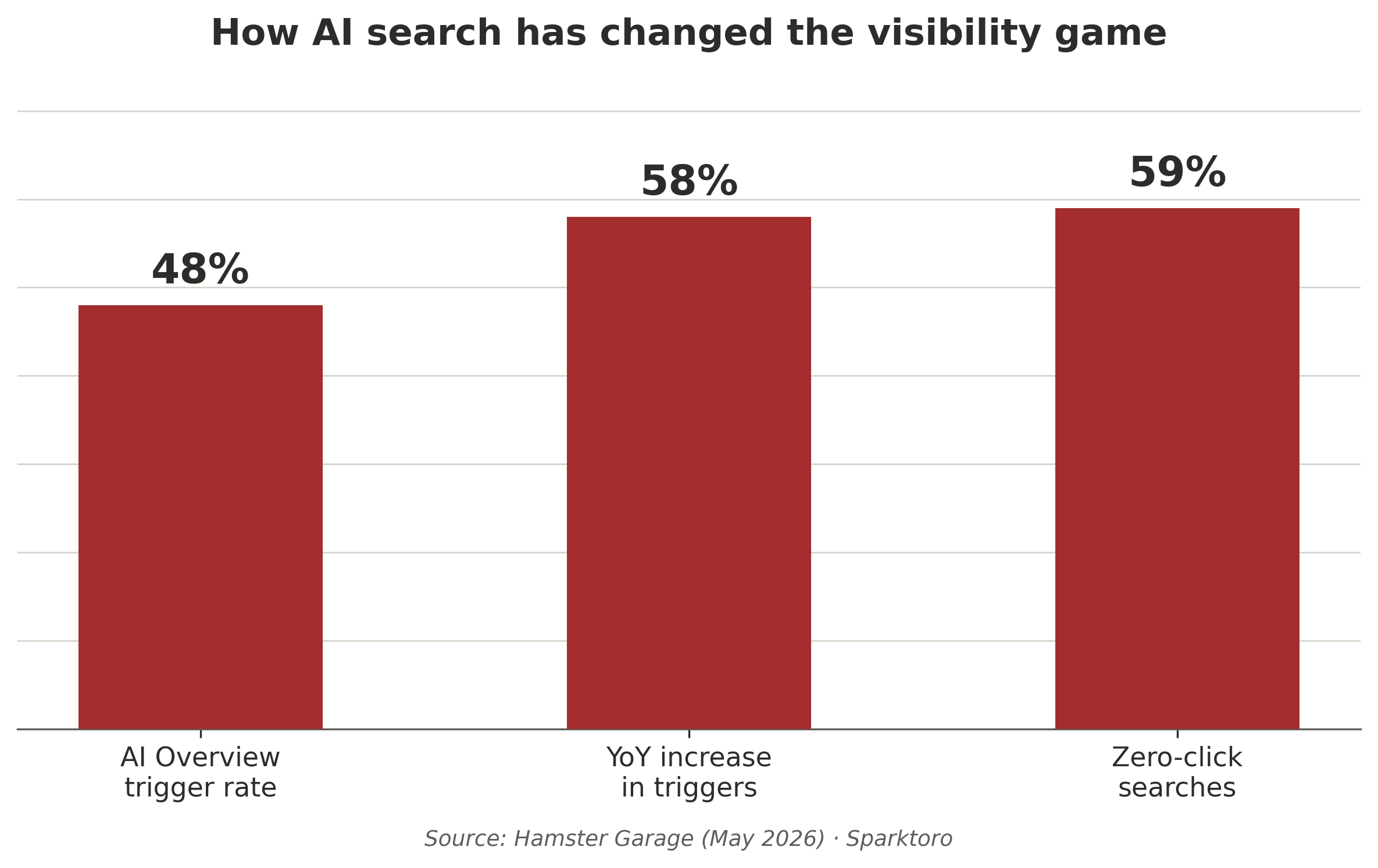
Search behaviour has fragmented significantly. As of early 2026, roughly 48 percent of all Google queries trigger an AI Overview, a 58 percent increase year-over-year (Hamster Garage, May 2026). Platforms like ChatGPT, Perplexity, and Gemini are handling an increasing share of informational and commercial queries that previously resolved on traditional SERPs.
The implication for brands is significant: zero-click search is no longer a future concern; it is a present operational reality. Approximately 59 percent of Google searches end without a click, according to Sparktoro’s research. Appearing directly in the answer is often the only way to capture visibility for high-intent informational queries.
This is the context in which an LLM SEO agency operates. The term reflects the mechanism: Large Language Models (LLMs) are the retrieval engines behind these AI search surfaces. Optimising for LLM citation requires a different technical and content discipline than optimising for a traditional crawler’s ranking algorithm.
An answer engine optimization consultant or full-service AEO agency helps brands close that gap, systematically, with measurable outputs.
The service mix of a credible answer engine optimization agency covers five areas. These are not discrete modules; they interact and compound over time.
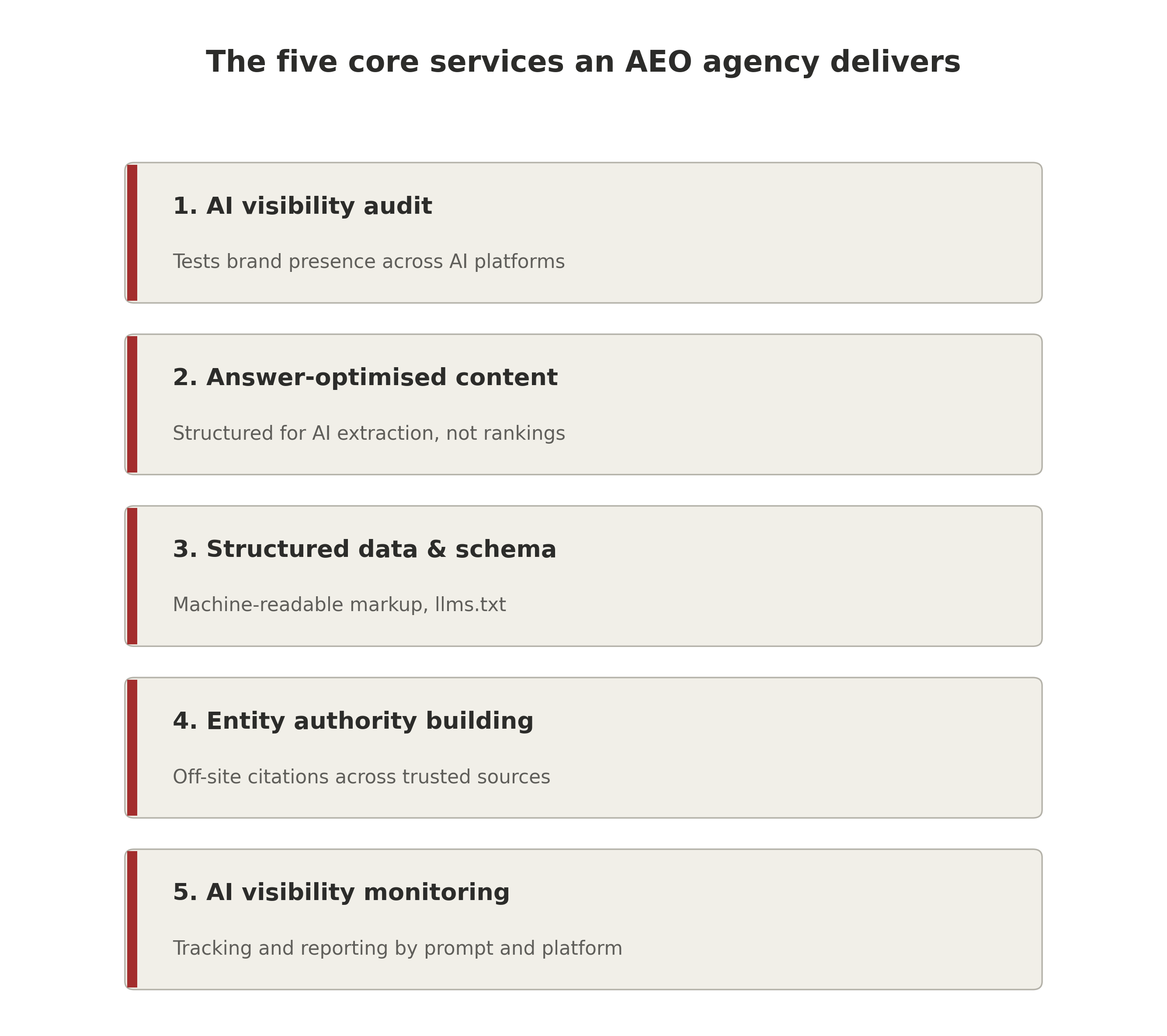
Every engagement should begin here. The audit tests how a brand currently appears across major AI platforms: ChatGPT, Perplexity, Claude, Google AI Overviews, and Gemini. It assesses whether the brand is mentioned at all, how accurately it is represented, what competitors appear instead, and where the citation gaps are most acute.
A quality answer engine optimization agency uses this audit to identify whether the primary bottleneck is on-site technical issues, content gaps, weak brand authority, or insufficient third-party publisher coverage. Different root causes require different interventions.
AI systems pull from content that is structured for extraction. That means clear, direct answers at the top of pages, short declarative paragraphs, semantically organised sections, and coverage that anticipates the full question cluster around a topic, not just the primary keyword.
Answer engine optimization services here include rewriting existing content for citation-readiness, building new content that targets the specific prompts buyers use when querying AI tools, and creating topic clusters that establish topical authority in a defined category. An AI visibility agency writing content for AI extraction writes differently from one writing for Google’s PageRank signals: the former optimises the paragraph, not just the page.
Schema markup is the technical layer that makes content machine-readable. An LLM SEO agency implements Organisation, WebPage, Article, FAQPage, HowTo, and Service schemas, and audits existing markup for errors, inconsistencies, or outdated implementations that weaken trust signals.
This work also includes the emerging practice of llms.txt file management: a lightweight signal to AI crawlers that defines how models should interpret and reference site content. Schema alone is not sufficient for AI citation, but missing or broken schema is a reliable disqualifier.
LLMs weight repeated, consistent mentions of a brand across authoritative third-party sources. A brand that appears only on its own site is a weak entity. A brand cited in industry publications, authoritative directories, review platforms, and credible media is a stronger candidate for AI retrieval.
GEO consulting, generative engine optimisation consulting, heavily emphasises this off-site layer. The on-site technical work is table stakes. The expensive and effective half is getting a brand named in the places AI models draw from most frequently. An answer engine optimization consultant who only addresses schema is doing a fraction of the job.
Unlike traditional SEO, where rankings are a defined output, AI citation tracking requires dedicated tooling. Leading platforms as of 2026 include Profound, Scrunch, and Peec AI, with SEMrush and HubSpot entering the space (Progress Sitefinity, May 2026). An answer engine optimization agency sets up and manages these dashboards, tracking brand visibility by prompt, topic, platform, and competitor, and adjusting strategy as AI models update their retrieval patterns.
The KPIs here are:
GEO consulting, short for generative engine optimisation consulting, and answer engine optimization services are used near-interchangeably in 2026. The distinction that technically exists is narrowing: AEO originally referred to optimising for structured answers in Google’s featured snippets and voice search. GEO refers specifically to optimising for generative AI platforms like ChatGPT and Perplexity.
In practice, most LLM SEO agency engagements treat both as one integrated discipline. The platforms that power AI Overviews (Google) and those that power ChatGPT or Gemini share common retrieval logic: they prioritise structured, authoritative, and clearly attributed content. The optimisation work overlaps almost completely.
A standalone answer engine optimization consultant engagement typically covers audit, gap analysis, a prioritised roadmap, and advisory on content and technical implementation. A full-service answer engine optimization agency retainer covers the same, plus execution: content production, schema deployment, off-site citation building, and ongoing monitoring.
The difference between a consultant and an agency is execution bandwidth, not strategy depth. Neither is automatically superior; the right choice depends on whether internal resources exist to act on the strategy.
Understanding the process helps set accurate expectations. Here is how a rigorous answer engine optimization agency structures an engagement.
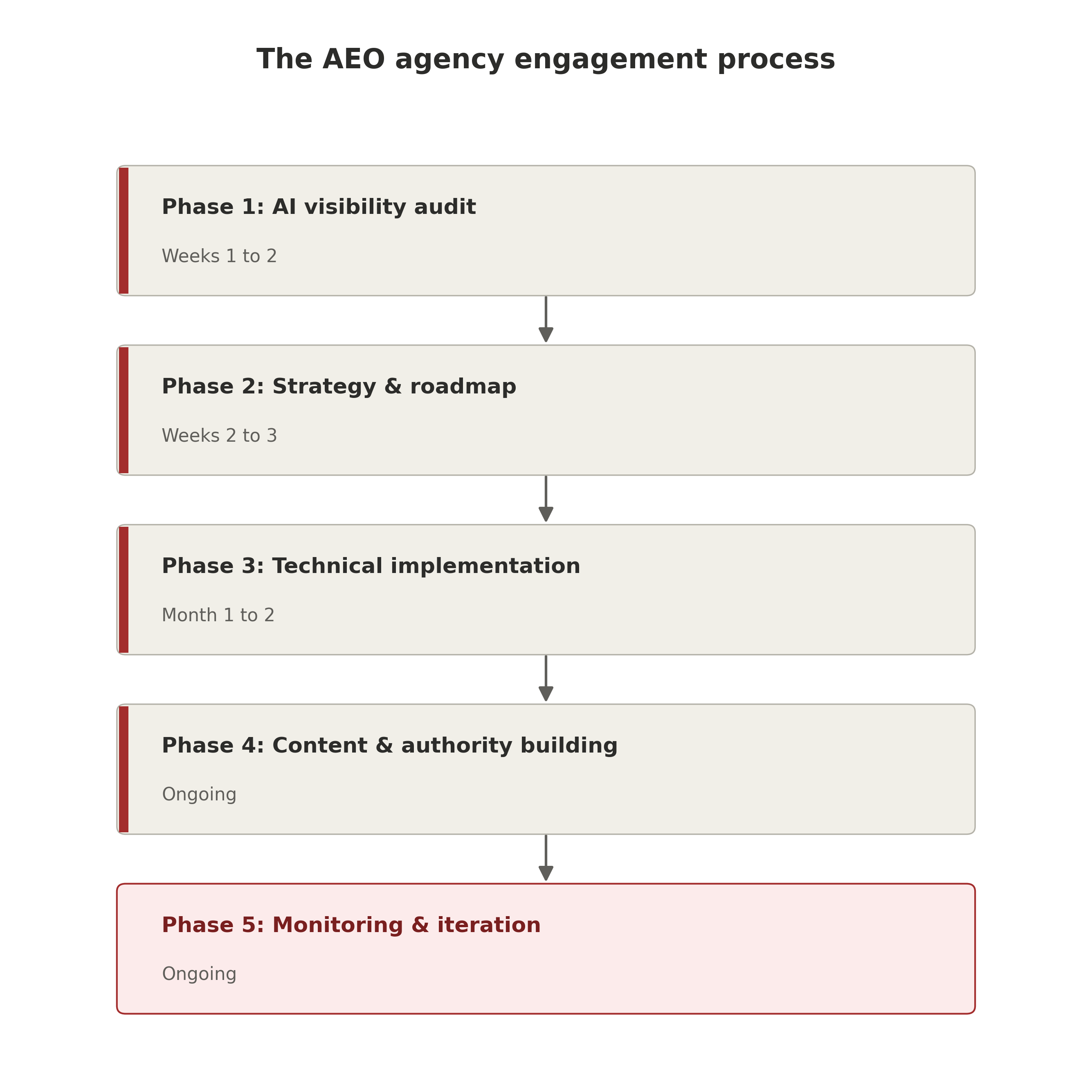
The agency tests brand presence across target AI platforms. It benchmarks against three to five direct competitors. It maps the specific prompts and question clusters where the brand should appear but does not. It identifies whether the gap is primarily technical, content-side, or authority-side.
Answer engine optimization work at this stage produces a prioritised action plan. Technical fixes are sequenced first: broken schema, crawlability issues, missing entity signals. Content gaps are mapped by prompt priority. Off-site citation targets are identified.
Schema deployment, llms.txt configuration, crawlability improvements, entity graph cleanup. This is where an LLM SEO agency with genuine technical depth earns its retainer. Agencies that skip or rush this phase tend to see weak long-term results regardless of content quality.
Answer-optimised content is produced and published. Off-site citation building begins: outreach to authoritative publications, directory optimisation, digital PR. An AI visibility agency that only does on-site work will plateau; the off-site layer is what determines whether an LLM treats a brand as an established entity worth citing.
AI platforms update their models frequently. GEO consulting engagements that do not include active monitoring lose ground as retrieval patterns shift. The agency tracks AI share of voice, adjusts content based on citation data, and surfaces new prompt clusters as they emerge.
AEO pricing is one of the least transparent areas in digital marketing. Most agencies do not publish rate cards because scope varies significantly and measurement standards are still evolving (The Digital Elevator, July 2026). Here is what published market data shows.
| Tier | Price Range | What’s Included |
|---|---|---|
| One-time AI visibility audit | $1,500 to $5,000 | Minimum viable entry point to understand current AI citation status |
| Entry-level retainer | $1,500 to $2,500/month | Basic schema implementation, foundational content adjustments, AI visibility monitoring setup |
| Mid-market retainer | $2,000 to $10,000/month | Full-service AEO/GEO: technical implementation, content, off-site authority building |
| Enterprise retainer | $10,000 to $30,000+/month | Programmatic schema at scale, aggressive off-site sentiment management, AI share of voice reporting, continuous multi-platform prompt tracking |
Mid-market range corroborated by multiple sources, including WebFX 2026 pricing research cited by OutreachBloom and answerlord.com.
One signal worth watching: agencies that price far below the entry range, offering “AEO” at $500 per month, are typically delivering repackaged traditional SEO with no real AI citation tracking or schema implementation (310Creative, August 2026). AEO pricing below market rates almost always means the deliverable does not include actual AI visibility monitoring, which is the baseline output of genuine answer engine optimization agency work.
A few agencies now bundle answer engine optimization services with traditional SEO in one retainer, which can reduce overall cost because content optimisation and technical fixes serve both channels simultaneously.
The market for AI visibility agency services grew faster than the quality of vendors operating in it. These are the evaluation criteria that separate credible agencies from those rebranding old services.
A legitimate agency can walk you through exactly how it tests brand presence across ChatGPT, Perplexity, Google AI Overviews, and Gemini. If the methodology is vague, “we check how you rank in AI,” that is not a process, it is a claim.
The on-site technical layer (schema, crawlability, content structure) is the easier half of the job. The harder and more impactful half is off-site authority: getting the brand cited in sources AI models trust. An agency that only touches your own site will produce limited results.
Legitimate GEO consulting engagements report on AI share of voice, direct LLM citations, and AI-referred traffic, not just traditional rankings or impressions. If the agency cannot name the specific tools it uses to track AI visibility, the reporting will be opaque.
AI systems increasingly prioritise first-hand experience signals. An LLM SEO agency that produces only AI-generated content, with no genuine author expertise, no original research, no first-person credibility signals, is failing the experience filter that makes content worth citing in 2026 (Hamster Garage, May 2026).
Credible answer engine optimization work produces measurable AI visibility results over six to twelve months, not six to twelve weeks. Any answer engine optimization consultant guaranteeing specific AI citations in a short timeframe is overpromising; the platforms update their models independently and no agency controls citation outcomes directly.
Most agencies keep pricing private until a discovery conversation. That is partly because scope varies, but asking for a ballpark range upfront saves time for both sides. Any agency unwilling to give even a range before the call is worth questioning.
This kind of agency makes a brand citable by AI-powered search systems like ChatGPT, Perplexity, Google AI Overviews, and Gemini. The work covers AI visibility auditing, answer-optimised content creation, structured data implementation, off-site authority building, and ongoing citation tracking. The objective is to earn a place in AI-generated answers, not just traditional ranked results.
Traditional SEO agencies optimise for keyword rankings in search results. This kind of agency optimises for AI citation instead: the conditions under which AI systems choose to include a brand in a generated answer. The technical and content skills overlap, but the measurement framework, the content structure, and the off-site work are fundamentally different.
This type of agency specifically addresses how Large Language Models retrieve and cite content. This means optimising for LLM crawlers separately from Googlebot, structuring content so individual paragraphs are retrievable as standalone answers, and building entity signals that LLMs treat as trust indicators. It is a technical specialisation within the broader AEO/GEO category.
It is usually tiered by scope rather than a flat rate: a one-time audit, an entry-level monthly retainer, a mid-market full-service retainer, and an enterprise programme. What changes between tiers is the depth of technical implementation, the volume of content produced, and how aggressively off-site authority building is pursued.
This path is the right choice if internal resources exist to execute a strategy and you need expert guidance on audit findings and roadmap priorities. A full agency is the right choice when you need execution handled end-to-end.
A consultant typically delivers an audit, a gap analysis, and a roadmap, then steps back. A retainer with a full answer engine optimization consultant or agency team includes ongoing content production, schema deployment, off-site citation building, and monitoring. Most small and mid-market brands benefit more from the retainer model because the discipline requires ongoing execution, not just a one-time playbook.
It varies widely. One-time AI visibility audits run $1,500 to $5,000. Entry-level monthly retainers start around $1,500 to $2,500. Mid-market full-service retainers run $2,000 to $10,000 per month. Enterprise programmes reach $10,000 to $30,000 per month or more. Any agency offering pricing well below $1,500 per month is almost certainly delivering repackaged traditional SEO without genuine AI citation tracking.
Credible answer engine optimization work produces measurable AI visibility results over six to twelve months. The timeline depends on the starting state of a brand’s AI presence, the competitive density of the category, and the pace of off-site authority building. No legitimate AI visibility agency guarantees specific AI citations within a defined timeframe; the platforms update their retrieval models independently.