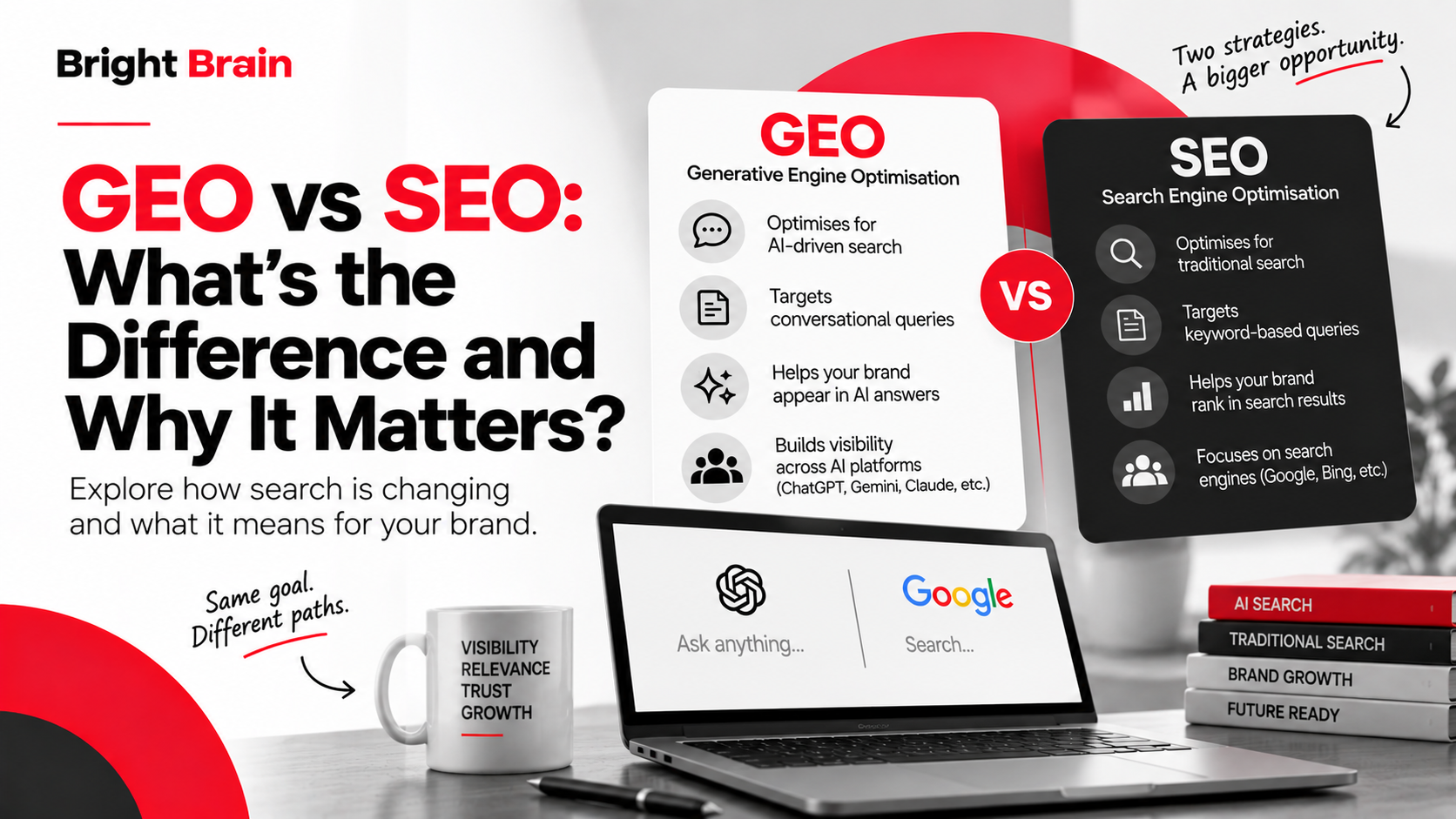
GEO (Generative Engine Optimization) and SEO (Search Engine Optimization) are distinct disciplines that together determine where your brand is discovered in 2026. SEO earns ranked positions in Google search results. GEO earns citations inside AI-generated answers on ChatGPT, Perplexity, and Google AI Overviews. Understanding geo vs seo is the foundation of any visibility strategy that covers both channels.
Search Engine Optimization (SEO) is the practice of improving your website so that it ranks higher in traditional search engine results pages, primarily Google and Bing. The goal is straightforward: when a buyer types a query into a search bar, your page appears at or near the top, they click through, and the visit begins.
SEO works through three core levers. Technical SEO ensures your site is fast, crawlable, and structurally sound. On-page SEO ensures your content matches what users are searching for, using relevant keywords, proper headings, and clear metadata. Off-page SEO builds authority through backlinks, third-party sites linking to yours as a credible source.
For industrial B2B companies, SEO has driven qualified organic traffic for years. A well-ranked product page for “centrifugal pump suppliers India” consistently attracts engineers and procurement managers at the moment they are researching options. That intent-matching remains one of the most valuable things SEO delivers.
But the search landscape has shifted.
Generative Engine Optimization (GEO) is the practice of structuring your content and digital presence so that AI-powered platforms, including Google AI Overviews, ChatGPT, Perplexity, Gemini, and Microsoft Copilot, cite, reference, or recommend your brand when users ask questions.
Where SEO earns you a ranked position in a list of blue links, generative ai seo earns you a place inside the AI’s synthesised answer. The distinction matters because AI-powered search experiences increasingly answer questions directly, without sending users to any website at all.
A buyer in a manufacturing plant searching “what pump type handles fibrous slurry” on Perplexity does not get ten links. They get a direct, synthesised answer. If your brand and your technical content informed that answer, your name appears. If it did not, you are invisible, regardless of where you rank on Google.
Geo vs seo is therefore not a debate about which one wins. It is a recognition that two different visibility mechanisms now operate in parallel, rewarding different optimization behaviours.
Understanding geo vs seo clearly means mapping out where each discipline focuses its effort.
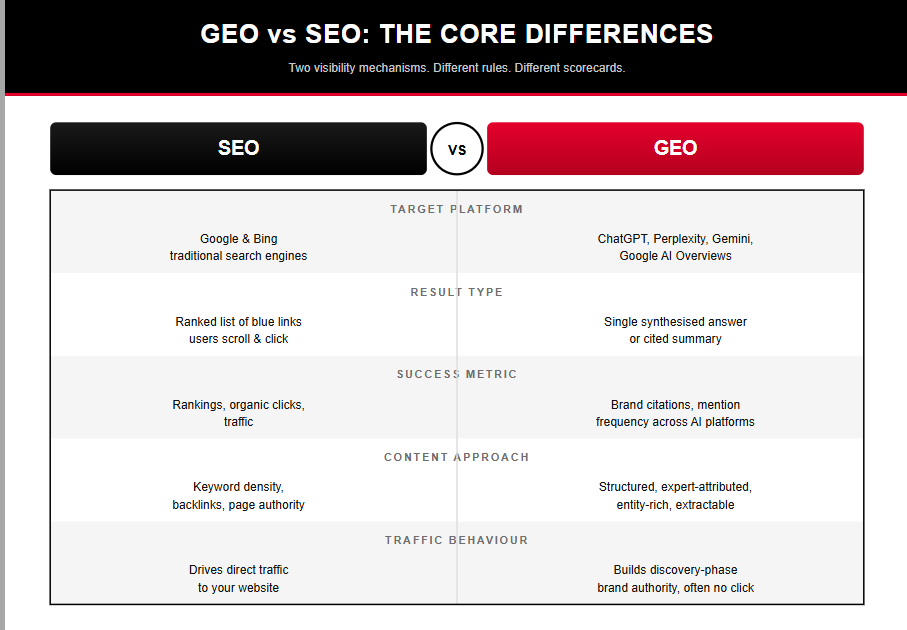
Target platform. SEO targets traditional search engines, primarily Google. Geo vs seo separates here immediately: GEO targets AI-powered answer platforms, including Google AI Overviews, ChatGPT, Perplexity, Gemini, and other large language model environments.
Result type. SEO produces a ranked list of links. Users scroll, evaluate, and click. GEO produces a single synthesised answer or a cited summary. The AI does the synthesis; your brand either contributed to that answer or it did not.
Success metric. SEO measures rankings, organic clicks, and traffic. Generative ai seo measures brand citations, mention frequency across AI platforms, and inclusion in AI-generated responses, a fundamentally different scorecard.
Content approach. SEO content is optimised for keyword density, backlink acquisition, and page authority. GEO content must be authoritative, structured, clearly attributed to a named expert, and written in a way that AI systems can extract and trust. Entity recognition replaces pure keyword matching as the primary signal.
Traffic behaviour. SEO drives direct traffic to your website. GEO often does not, but it builds brand authority in the discovery phase, influencing which brands buyers shortlist before they ever visit a website.
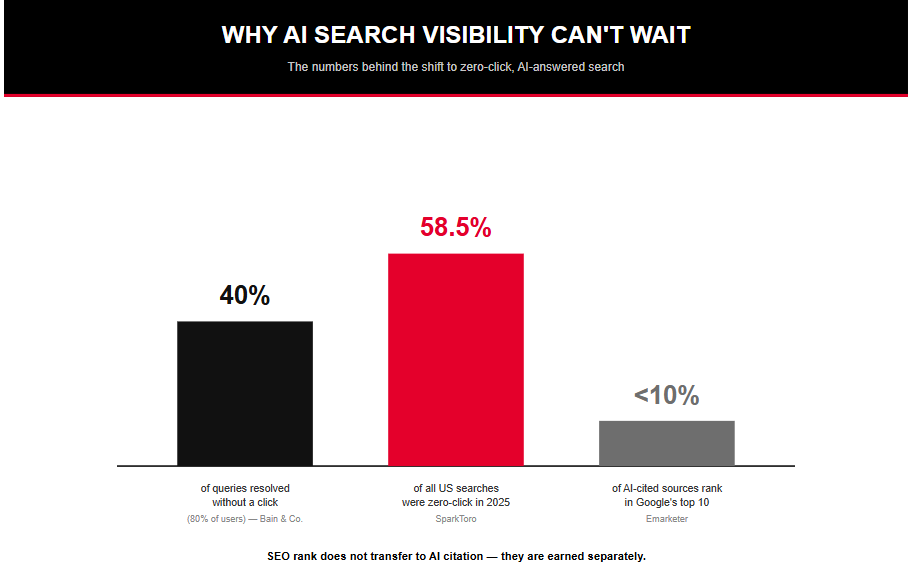
A study by Bain and Company found that 80% of users resolve 40% of their queries without clicking any link. Zero-click searches reached 58.5% of all US searches in 2025 (SparkToro). When the majority of discovery happens inside AI answers, ai search visibility becomes the metric that precedes everything else.
The geo vs seo conversation is often framed as a competition. It is not. The right frame is coverage: which visibility channels does your brand own, and which ones are you absent from?
Gartner predicted in February 2024 that traditional search engine volume would drop 25% by 2026 as AI chatbots and virtual agents take over user queries. The actual picture is more nuanced. Google adapted by embedding AI Overviews into its own results, rather than ceding ground to standalone AI tools. But the net effect for brands is identical: a large and growing share of searches now resolve inside AI-generated answers, whether those answers come from ChatGPT or from Google’s own AI layer.
Emarketer reports that fewer than 10% of the sources cited in ChatGPT, Gemini, and Microsoft Copilot rank in the top 10 Google organic results for the same query. SEO rank does not transfer to AI citation. The two visibility signals are earned separately, through different mechanisms.
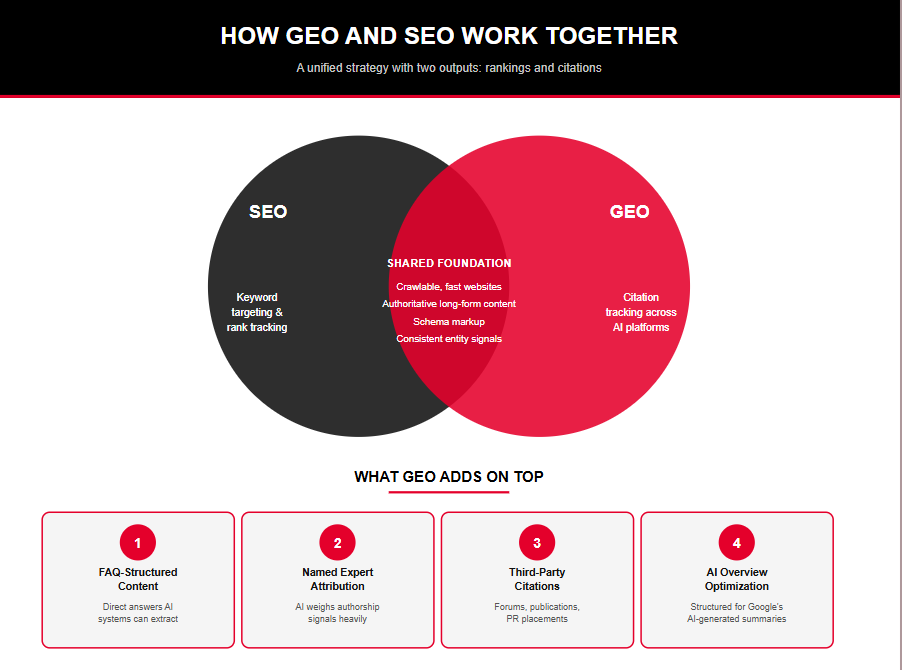
This is the practical argument for treating geo vs seo as a dual mandate rather than a binary choice. Strong SEO gives you the technical and authority foundation that generative ai seo also depends on: crawlable pages, structured data, credible backlinks. But it does not automatically earn you AI citations. The additional layer of GEO work- structured FAQ content, named expert attribution, schema markup, entity-rich writing- must be built on top.
AI search visibility in 2026 is the combination of both.
The most effective brands treat geo vs seo as a unified strategy with two outputs: rankings and citations. The foundational work overlaps significantly.
For an industrial B2B brand, the implication is that your product pages, application guides, and technical articles need to be written with AI extractability in mind, not just keyword optimisation. A torque flow pump application guide that clearly states the pump type, the application context, the operating conditions, and the manufacturer’s name in structured, authoritative prose is far more likely to be cited by an AI system than one that buries those facts in marketing language.
Llm optimization services specifically address this layer: auditing how AI systems currently represent your brand, identifying gaps between your on-site content and what AI platforms are citing, and restructuring content so that AI models can read, trust, and recommend it.
The term ai seo agency covers a broad range of capabilities. Understanding what a competent partner actually does, versus what a generalist agency retrofits into an existing SEO engagement, is important for any B2B brand evaluating options.
A genuine AI search optimization agency will typically offer the following as distinct, measurable services:
A credible geo agency will be able to show you baseline citation data before they begin, a content and entity-building roadmap tied to specific queries, and a reporting framework that tracks AI mention trends alongside traditional SEO metrics.
An agency that bundles generative ai seo into a legacy SEO retainer without separate deliverables, separate measurement, and a distinct technical approach is unlikely to deliver meaningful AI search visibility improvements.
Geo vs seo strategy does not require rebuilding your entire content programme. The most effective starting point is an audit and a prioritised action list.
Llm optimization services will continue to evolve rapidly. The AI platforms themselves change their citation logic, their training data, and their interface formats on a pace that traditional SEO has never experienced. The brands that build the operational muscle to monitor, adapt, and respond will accumulate a compounding ai search visibility advantage over those that treat GEO as a one-time project.
The question for B2B industrial brands is not whether to invest in generative ai seo. It is how quickly to move and how to sequence the work. The buyers are already there. The AI systems are already answering their questions. The only variable is whether your brand is the one being cited.
Geo vs seo separates on where visibility is earned. SEO earns you ranked positions in traditional search engine results pages. GEO earns you citations inside AI-generated answers from platforms like ChatGPT, Perplexity, and Google AI Overviews. Both are visibility channels; they reward different optimisation behaviours and measure success differently.
Yes. Research from Emarketer confirms that fewer than 10% of sources cited in ChatGPT, Gemini, and Microsoft Copilot rank in the top 10 Google organic results for the same query. SEO rank does not transfer to AI citation. Ai search visibility must be built separately, on top of, not instead of, strong SEO foundations.
A specialist geo agency audits your current AI citation presence across multiple platforms, restructures content for AI extractability, builds entity authority off-site, implements ai overview optimization, and tracks brand mention rates inside AI systems over time. Generalist SEO agencies rarely have the measurement infrastructure or the content methodology for this.
If you have solid technical SEO in place, meaningful AI citations can emerge within 2 to 3 months of structured GEO work. Starting from scratch typically takes 4 to 6 months. Llm optimization services are ongoing, since AI platforms update their citation logic continuously, so the discipline requires sustained effort, not a one-time engagement.
AI overview optimization is the practice of structuring content specifically to earn inclusion in Google’s AI Overviews, the AI-generated summaries that appear above organic results for a significant share of commercial and informational queries. It involves direct-answer openings, FAQ structure, schema markup, and named expert attribution.
Generative ai seo is the broader practice of optimising your content and digital presence to appear in AI-generated answers across multiple platforms, not just Google. It includes content restructuring, entity authority building, schema implementation, and ongoing citation monitoring across ChatGPT, Perplexity, Gemini, and similar platforms.
A credible ai search optimization agency should show you baseline citation data before they begin, a content and entity-building roadmap tied to specific buyer queries, separate measurement for AI citation rates versus traditional SEO rank, and a distinct technical approach to llm optimization services, not just a legacy SEO retainer with a GEO label on it.
Not exactly. AEO (Answer Engine Optimization) is a related concept that overlaps with GEO but typically refers more narrowly to earning featured snippets and direct answers in traditional search. Geo vs seo as a frame is broader: GEO specifically addresses AI-generated answers from large language model platforms, not just Google’s featured snippets. In practice, the optimisation techniques for GEO and AEO share significant overlap.