A doctor in Bandra sees 40 patients a week. Her outcomes are excellent. Reviews from patients who find her through a friend, a referral, or an old Practo listing are uniformly positive. She has no website. Her Google Business Profile shows the wrong phone number. When a new patient searches “cardiologist Bandra,” she doesn’t appear.
She isn’t losing to a better doctor. She’s losing to a better-marketed one, and often the difference is simply whether a practice has invested in digital marketing services for doctors in the first place.
This is the pattern across hundreds of clinics and hospitals in India right now. 82% of Indian patients research online before selecting a physician (Redwud Creations, 2025). 77% use online search before booking an appointment consistently across urban and tier-2 markets.
If your practice isn’t where patients are looking, the quality of your medicine is irrelevant to them. They never find you. This is exactly the gap a capable digital marketing agency for doctors is built to close.
Digital marketing for doctors in India isn’t about becoming a social media personality. It’s about making sure that when a patient searches for what you do, they find you, and when they find you, they trust what they see. A well-run programme of online marketing for medical professionals does both jobs at once: visibility and credibility.
The two problems are different. Most agencies solve only the first one. A structured digital marketing agency for doctors solves both.
Before any marketing strategy makes sense for a doctor or hospital, the compliance layer has to be clear. The National Medical Commission governs what medical professionals can and cannot say online, and any credible digital agency for healthcare builds its process around these rules from day one.
India’s NMC permits informational and educational content, factual service listings, and online directory presence for doctors. What is restricted includes misleading claims, guaranteed cure promises, comparative advertising against other doctors, and patient endorsements that imply specific outcomes (NMC Ethics and Medical Registration Board, 2023).
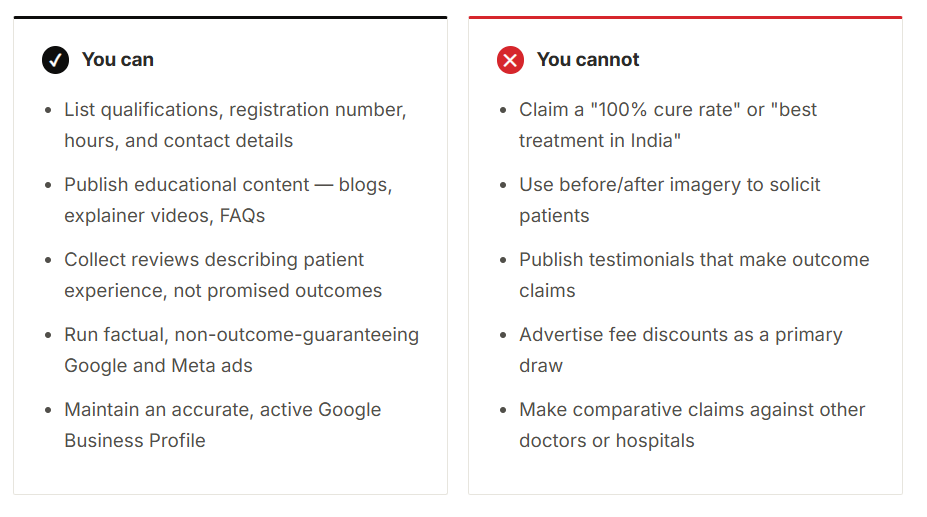
In practice, this means:
You can:
You cannot:
A compliant digital marketing agency for doctors uses educational content, verified credentials, factual service descriptions, and patient reviews that describe experience rather than outcomes.
The compliance frame isn’t a restriction on good marketing; it’s the brief. Every high-performing doctor’s digital presence in India is built within these rules, and every reputable digital marketing company for hospital engagements starts with this framework rather than treating it as an afterthought.
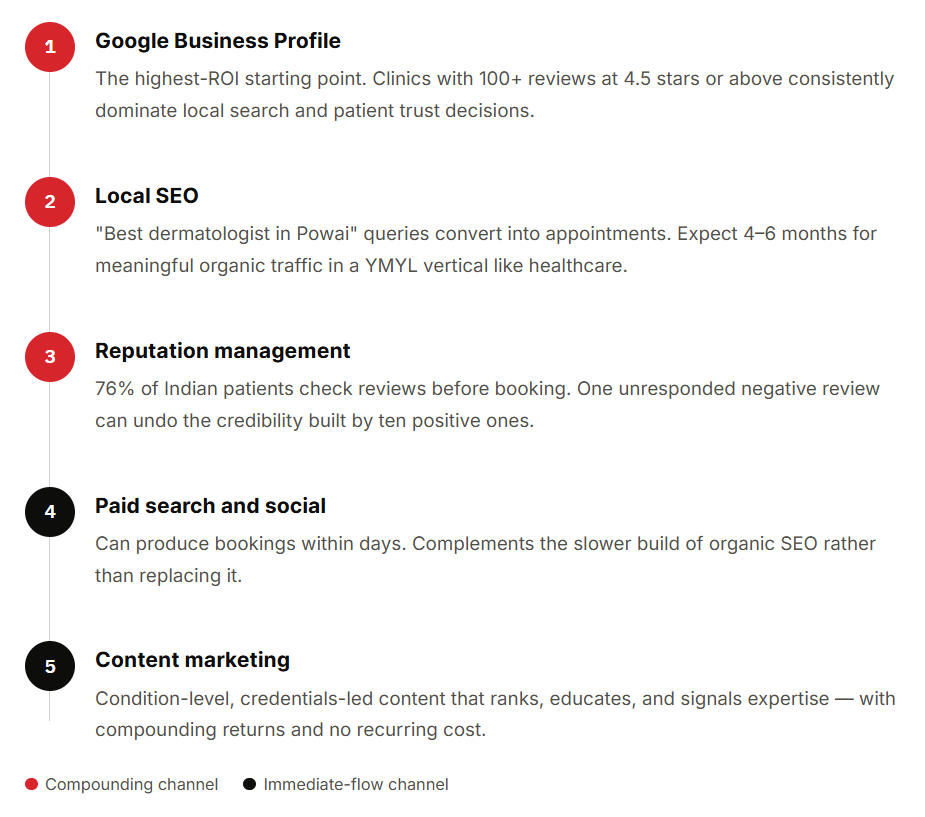
Digital marketing for doctors isn’t one thing. It’s five things, in a priority order that most agencies get wrong. A digital marketing agency for doctors should be able to explain why this order matters before it touches your budget.
A well-optimised Google Business Profile works 24 hours a day, answering patient questions, building credibility, and attracting bookings even when the clinic is closed. For any doctor with a physical location, this is the single most important digital asset and the most commonly neglected one.
The Google Local Pack, the map-box of three results that appears at the top of local healthcare searches, captures the majority of appointment-intent clicks. Getting into it requires a claimed and verified profile with an accurate name, address, phone, and hours; regular updates including health tips, clinic news, and service announcements; and an active review profile with responses to every review within 24 hours. This is one of the first deliverables any marketing agency for doctors should set up.
Clinics with 100 or more Google reviews at 4.5 stars or above consistently dominate local search rankings and patient trust decisions. A review strategy is not optional; it is a core part of the marketing system.
46% of all Google searches are local (Google, 2024). For healthcare, the proportion is higher. “Best dermatologist in Powai,” “orthopaedic surgeon near Connaught Place,” “diabetologist Koramangala”: these are the queries that produce actual appointments.
Local SEO for doctors involves a website with dedicated service pages and location-specific content, technical setup (fast load speed, mobile optimisation, schema markup), consistent NAP listings across Practo, Lybrate, JustDial, Sulekha, and Google, and backlinks from credible healthcare directories. This is where digital marketing services for doctors compound in value over time rather than resetting every month like paid media.
Expect 4 to 6 months for meaningful organic traffic growth in healthcare. YMYL content (Your Money or Your Life) takes longer to gain trust signals in Google’s eyes compared to non-YMYL verticals (upGrowth, 2026). That’s not a reason to delay starting. It’s a reason to start today.
We produced a 37.41% organic traffic increase and 1,022 keywords ranking for Samarpan Recovery, a healthcare client, through a structured SEO programme. The compounding traffic ran without additional ad spend, the kind of result that separates the best digital marketing agency for healthcare from a generic vendor.
Reviews are the single most important trust signal in healthcare. 76% of Indian patients specifically check doctor reviews and credentials before booking (Redwud Creations, 2025).
Reputation management is a system, not a reaction: a post-visit WhatsApp workflow making it easy to leave a Google review; responding to every review within 24 hours; a protocol for handling negative reviews professionally; and monitoring across Google, Practo, and Lybrate.
One unresponded negative review can undo the credibility built by 10 positive ones. Most clinic teams know this. Very few have a system in place to prevent it, which is why this workstream is usually one of the first things a digital marketing agency for doctors takes over.
Paid search on Google targeting “doctor + city + speciality” keywords can produce appointment bookings within days of going live. It complements the slower build of organic SEO and doesn’t wait for the algorithm to recognise your domain authority.
Running both simultaneously makes sense: paid for immediate patient flow, SEO for compounding long-term growth.
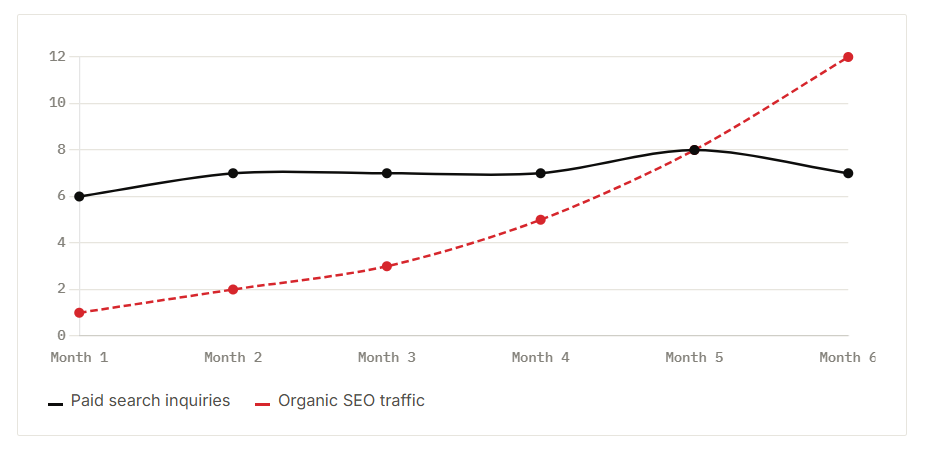
This is one of the clearest places where a digital marketing for hospital programme diverges from a solo-clinic campaign, since institutional budgets can support both channels running at once from month one.
For hospitals and multi-speciality clinics, Meta Ads work well for procedure-level campaigns: laser eye surgery, cosmetic procedures, dental implants, where the patient is in consideration mode rather than search mode. This is also where a social media marketing agency for doctors earns its fee, since organic reach on Instagram and Facebook for healthcare accounts has become negligible without paid support. Both channels need NMC-compliant creative: factual service descriptions, not outcome-guaranteeing.
As a Google Elevator Partner, one of 15 agencies selected from 8,000 in India, Bright Brain operates at the top tier of the Google Ads ecosystem. Healthcare campaigns benefit from beta features, account-level support, and a performance standard most agencies can’t match, one reason clients looking for a social media marketing agency for doctors and a paid search partner in the same team tend to end up here.
Educational content serves simultaneously as an SEO asset, a patient education resource, and proof of expertise. A blog post answering “what are the early signs of kidney disease?” does three things: ranks on Google, educates the patient who reads it, and signals that the doctor publishing it knows what they’re talking about.
Publishing educational videos explaining common conditions and treatment options positions a practice as the most trusted authority in its speciality. A single well-titled video answering a common patient question can generate consistent appointment inquiries for years without recurring cost, a core reason content sits inside almost every serious package of digital marketing services for doctors.
Content that works in healthcare is specific, practical, and credentials-led. The doctor’s name, qualifications, and practice context need to be present for Google to assign the author authority that YMYL content requires.
Most doctors who invest in digital marketing get one of two things wrong. Either they invest in awareness (running ads, building social followings) without the trust infrastructure to convert awareness into appointments. Or they build a technically correct website that looks like no one works there.
Healthcare trust is earned through specificity. Here’s what the trust layer looks like in practice, and what any digital marketing agency for doctors should be building on your behalf:
This isn’t a checklist to complete once. It’s a system to maintain. The practices that dominate local healthcare search in their city aren’t necessarily the most skilled clinically; they’re the ones who built and maintained this infrastructure consistently over 12–24 months, usually with a dedicated digital marketing agency for doctors running the system rather than an in-house team squeezing it in between clinical duties.
For multi-location hospital groups, the same discipline applies at scale, which is why a growing number of hospital chains now retain a dedicated digital marketing company for hospital operations rather than splitting the work across freelancers per city.
Healthcare digital marketing is not a vertical inside general marketing. It is a different discipline with different rules, and it’s the reason a generic vendor rarely performs as well as a specialised digital agency for healthcare.
Every piece of healthcare content falls under Google’s YMYL classification: Your Money or Your Life. That means higher scrutiny, stricter ranking requirements, and zero tolerance for unsubstantiated claims. An agency that applies its real estate or D2C playbook to a hospital client will get two things wrong.
First, the compliance risk. An agency unfamiliar with NMC guidelines will write copy that makes outcome claims, run ads with before/after imagery, or publish patient testimonials that promise results. Each creates professional and regulatory exposure for the doctor. The agency moves on; the doctor faces the consequences.
Second, the content authority requirement. Google’s quality raters assess healthcare content under the E-E-A-T framework: Experience, Expertise, Authoritativeness, Trustworthiness. A blog written by an agency writer without clear medical attribution and a named practitioner will rank below a correctly attributed piece from a competitor who understands YMYL requirements. The content work isn’t just SEO; it’s building the public credibility record that Google uses to evaluate the domain, and it’s the clearest test of whether you’ve hired the best digital marketing agency for healthcare or just a generalist with a healthcare client on their roster.
India’s digital health market is projected to reach $21.3 billion by 2028, growing at a CAGR of 27.4% (Statista). The competitive window for establishing search authority in your city and speciality is open now. In most Tier-1 cities, the practices that establish their Google authority in 2025–26 will have a structural advantage that new entrants in 2027 will find very difficult to close.
The right digital marketing agency for doctors understands both the compliance constraints and the content authority requirements and treats them as the brief, not as limitations.
Whether you’re a standalone specialist, a multi-doctor clinic, or a hospital marketing head, these questions separate a genuine digital marketing agency for doctors from one still learning healthcare at your expense.
Ask for healthcare client references. Not just case studies on a website, but a reference call with a doctor or hospital administrator. Ask how the agency handled compliance, how they responded when a campaign needed to change, and whether they understand the patient acquisition funnel in a healthcare context.
Ask how they handle NMC compliance review. A good marketing agency for doctors has a compliance protocol built into their content and ad creative process, not a check that happens after the content is already written. If they can’t name the NMC advertising framework immediately, they haven’t worked with regulated healthcare clients before.
Ask what happens to your organic traffic if you stop the paid ads. The honest answer: paid stops, paid traffic stops. But if the agency has been building SEO and your GBP in parallel, your organic floor should be growing throughout the engagement. An agency only running your ads without building any organic asset is creating dependency, not equity.
Ask for the attribution model. Phone call tracking, UTM parameters, form submissions by source: this is not optional for a practice spending ₹1 lakh or more per month on digital marketing. If the agency can’t tell you where consultations are coming from, they can’t optimise the budget toward what’s working.
Ask who works on your account day-to-day. The seniority of the pitch team is often not the seniority of the delivery team. Ask for the account manager by name, their healthcare experience, and their escalation path when something needs to be fixed. If you run a hospital rather than a solo practice, also confirm the team has handled digital marketing for hospital engagement before, since multi-department, multi-doctor accounts run very differently from a single-practitioner clinic.
Ask whether social is run in-house or by a specialist. If Instagram, Facebook, and YouTube are part of the plan, ask whether the same team runs them or whether it’s handed off to a separate social media marketing agency for doctors with its own compliance checks. A gap between the two teams is where NMC-sensitive posts most often slip through.
Not every provider suits every practice. A solo dermatologist in Andheri needs a different scope than a 200-bed multi-speciality hospital in Pune, and the vocabulary reflects that difference.
Bright Brain works with solo doctors, multi-doctor clinics, and hospital groups across India as a dedicated digital marketing agency for doctors, combining local SEO, Google Business Profile management, reputation systems, and NMC-compliant paid campaigns under one team. If you already have some pieces in place (a website, a few good reviews), the fastest path forward is usually not starting over with a new marketing agency for doctors, but plugging the specific gaps: a stronger digital marketing services for doctors programme for the channels you’re missing, or a social media marketing agency for doctors layer if your existing team has never managed healthcare-compliant social content. For hospital groups evaluating a digital marketing company for hospital partners, the same due-diligence questions above apply, just multiplied across departments. Book a consultation call to see what a structured programme could do for your practice.
Yes. India’s National Medical Commission permits informational and educational content, factual service listings, and online directory presence for doctors. Educational blogs, Google Business Profiles, clinic websites, and Google Ads that describe services factually are all compliant. What is restricted is misleading claims, guaranteed outcomes, and comparative advertising.
Google Business Profile is the highest-priority starting point for any single-location practice. It determines whether you appear in local map-pack results, which capture the majority of appointment-intent searches. After GBP, local SEO and reputation management are the compounding investments a digital marketing agency for doctors should prioritise next.
Paid search can produce appointment inquiries within two to four weeks. Expect 4 to 6 months for meaningful organic traffic growth in healthcare. A parallel strategy (paid for immediate flow, organic for long-term compounding) is the standard approach used by most digital marketing services for doctors and providers.
Yes. General hospital advertising for procedures and specialities is permitted. NMC guidelines restrict individual doctor advertising, so campaigns should promote the institution and its specialities rather than individual practitioners. Ads must be factual, not outcome-guaranteeing- a nuance a specialised digital marketing for hospital partners will already know to build into creative.
Educational content, condition explainers, treatment FAQs, and health awareness posts are safest and most effective. Doctor credentials, clinic updates, and team introductions are all compliant. Before/after imagery, outcome-promising testimonials, and comparative claims against other doctors are not. A capable social media marketing agency for doctors will already have compliant content templates ready before the first post goes live.
Clinical excellence and digital visibility are independent variables. A hospital with outstanding outcomes and a neglected Google Business Profile will rank below a competitor whose GBP has 200 reviews, regular posts, and keyword-rich service listings. Digital marketing amplifies visibility; the objective is to make your clinical quality discoverable, the core mandate of any serious digital marketing company for hospital engagement.
Reviews are the primary trust signal that converts a search result into a booked appointment. 76% of Indian patients specifically check doctor reviews and credentials before booking (Redwud Creations, 2025). Volume, recency, star rating, and responsiveness to reviews all influence both patient decision-making and local search ranking. A structured review acquisition and response system is a core component of any healthcare digital marketing programme.
A general agency applies standard frameworks without adjusting for YMYL content requirements, NMC compliance, or the specific trust signals that convert healthcare search intent into consultations. A digital agency for healthcare builds compliance into the brief, understands E-E-A-T requirements for medical content, and knows that the metric that matters is consultations booked, not impressions or clicks, which is ultimately what separates the best digital marketing agency for healthcare from a generalist shop taking on a healthcare client for the first time.
The best digital marketing agency for healthcare shows named case studies, builds NMC compliance into every workflow, and behaves like a genuine digital agency for healthcare rather than a general shop that happens to accept medical clients. This is also the standard to hold any online marketing for medical professionals initiative to, whether it’s run in-house or outsourced.
Yes. Online marketing for medical professionals has to work inside NMC rules and Google’s YMYL scrutiny, which most small-business marketing playbooks ignore. A digital agency for healthcare designs campaigns around this from the start rather than retrofitting compliance later, and a genuine digital marketing for hospital programme applies the same discipline at institutional scale.
Not necessarily a different provider, but a different scope. A digital marketing company for hospital accounts typically manages multiple departments, multiple doctor profiles, and institution-level advertising rather than individual-practitioner campaigns, so confirm the team you’re hiring has run online marketing for medical professionals at that scale before signing on. This is the same diligence that separates a serious digital marketing for hospital partner from a generalist agency picking up its first healthcare account.