
A marketing head at a mid-sized Indian brand sits down, lists the monthly cost of a content marketing agency retainer, lists the salary of a content writer hire, and concludes that the hire is cheaper. Decision made.
Eighteen months later, the blog has twenty posts, nine of them written by whoever had time that week, and the marketing head is back at the spreadsheet, this time trying to figure out why organic traffic hasn’t moved.
The agency vs in-house decision isn’t a cost calculation. It’s a capability question. And most Indian brands get it wrong because they’re comparing the wrong things: the cost of an agency retainer against the cost of a single hire, rather than the cost of the agency’s output against the cost of replicating that output in-house. Most of these comparisons also skip a basic step: actually shortlisting a few best content marketing agencies and pricing out what their retainers include before assuming an in-house hire is cheaper.
Those are very different numbers.
A saas content marketing agency retainer buys more than a writer. It buys a system.
Specifically, it buys:
That’s what the agency retainer buys. The in-house hire buys a writer, sometimes a strategist, if you hire well, but rarely all five functions in one person. And rarely at the production volume that content marketing requires to move organic metrics. This is also where the distinction between a content agency and a plain content writing agency matters: a content agency is built around that full system, while a content writing agency is built around output alone.
That said, the in-house model has real advantages, and the brands that make it work understand what those advantages are.
Brand-voice depth. An in-house writer who has spent twelve months inside your brand knows things an agency writer never will: the product decisions that didn’t make it to market, the sales call objections that keep coming up, the founder’s framing of a problem that always lands in pitches. That institutional knowledge produces content with a specificity and authenticity that’s hard to replicate from the outside.
Speed on reactive content. When a regulation changes, a competitor makes a move, or a news event creates a moment, an in-house writer can respond faster than an agency. They’re in the room. They don’t need a briefing.
Cross-functional integration. An in-house content person sits in the same Slack channels as the sales team, the product team, and the founders. That proximity produces content ideas that emerge from real conversations rather than keyword research alone.
The problem isn’t that in-house teams can’t produce good content. It’s that most brands understaff and under-resource them, then hold them to results that require the full agency system to achieve.
A single content hire who is also the social media manager, the email writer, the PR coordinator, and the blog editor is not a content marketing function. That person is a content operations firefighter. The output is reactive, inconsistent, and rarely tied to a strategic content calendar that compounds in SEO value over time. Many of the content marketing companies that win this comparison do so simply by staffing every one of these roles instead of loading them onto one person, which is exactly what separates them from the best content marketing agencies on any credible shortlist.
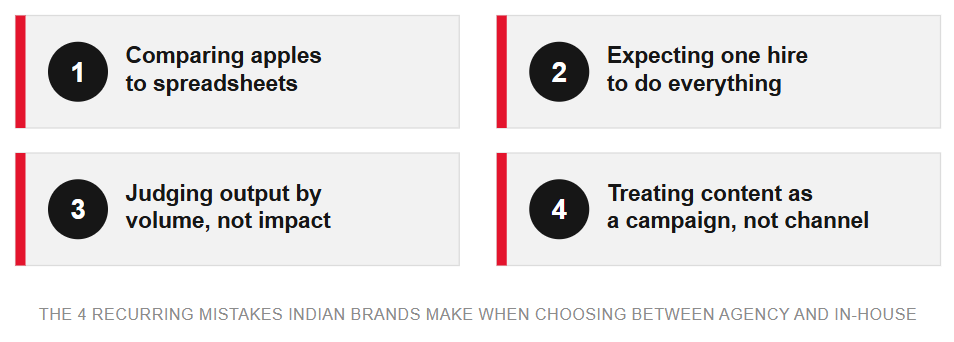
The most common mistake is comparing an agency’s monthly retainer to a single writer’s CTC. The numbers look unfavourable to the agency.
But the right comparison is: what does it cost to replicate the agency’s full output in-house?
A content marketing agency producing four long-form SEO blog posts per month, a content calendar, twelve social posts, and a monthly newsletter typically requires, at minimum, a content strategist, an SEO specialist, a senior writer, and a junior writer working in coordination. That’s three to four people. At market salaries for mid-level hires in Mumbai, that’s ₹8-15 lakh per month in CTC before benefits, tools, and management overhead.
Most agency retainers cost a fraction of that, which is exactly why so many Indian brands end up shortlisting content marketing agencies once they run this comparison honestly. For a SaaS brand specifically, a well-run saas content marketing agency retainer almost always beats the cost of replicating the same output in-house, and this is precisely the arithmetic most content marketing companies show new prospects in the first sales call.
Indian marketing teams frequently hire one “content person” and expect them to own the entire content function: strategy, writing, SEO, social, distribution, and analytics. The brief they write for this hire looks more like a job description for a team of four.
The result is predictable: the hire burns out producing reactive, low-quality content that moves no metrics, and the marketing head concludes that “content doesn’t work for us”, when what actually didn’t work was the resourcing model. It’s the same mistake brands make when they expect a single content development agency contact, rather than a full team, to cover strategy, SEO, and production all at once. The best content marketing agencies solve this by assigning a small pod, not a single point of contact, to every retainer.
A content marketing agency that produces eight blog posts per month is not twice as valuable as one that produces four. The metric that matters is organic traffic growth, keyword ranking improvements, and the contribution of content to inquiry and lead volume, not post count.
Indian brands that evaluate agency performance by “how many pieces did we get this month” consistently end up optimising for the wrong output. The output is the content. The outcome is the business result the content produces. This is also why comparing content creation agencies on volume alone, rather than on ranking and revenue impact, almost always leads to the wrong hire. A content agency that reports post count as its headline metric is optimising for the wrong scoreboard entirely.
A campaign has a start date, an end date, and a budget. A content channel has a compounding curve; it grows slowly at first and then accelerates as topical authority builds, backlinks accumulate, and the content library reaches critical mass.
Brands that treat content marketing as a campaign, “let’s run three months of blog posts and see what happens”, consistently conclude that content doesn’t work. Brands that treat it as a channel, “we’re building this for 18 months”, consistently see the compounding curve kick in.
The switch from campaign-thinking to channel-thinking is the single most important mindset shift in content marketing. Agencies that understand this build differently. In-house hires who don’t understand this produce differently.
A saas content marketing agency outperforms an in-house team in specific conditions:
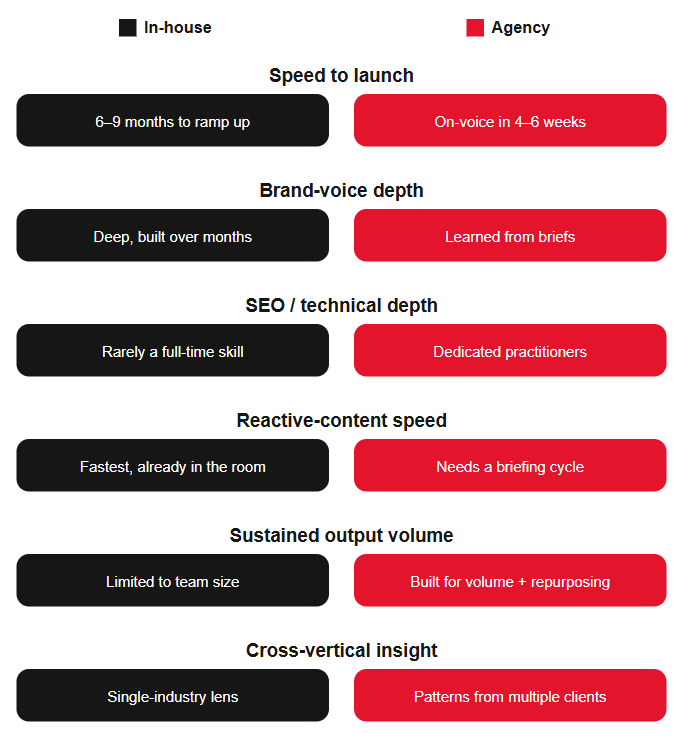
When speed to competence matters. Building an in-house content function from scratch takes 6-9 months: hiring, onboarding, calibrating voice, building the content calendar, establishing the SEO baseline. An experienced agency can begin producing on-brief, on-voice content within four to six weeks. For brands in growth mode where time-to-results matters, that difference is significant.
When cross-vertical pattern recognition adds value. An agency working across multiple industries sees what’s working in adjacent markets before those patterns appear in your vertical. A content approach that’s generating leads for a D2C brand in Mumbai is often adaptable for a SaaS brand targeting the same decision-maker demographic, and a good saas content marketing agency sees that connection.
When SEO is a core channel. Content for SEO is a technical discipline, not just a writing function. Keyword research, topical authority mapping, internal linking architecture, structured data: these require SEO practitioners who work on content strategy full-time. Most in-house content hires aren’t built to carry this expertise alongside the production workload.
When sustained output volume is required. A content calendar that drives meaningful organic growth typically requires four to eight long-form pieces per month, plus supporting social content, email nurture, and repurposing. That’s a team’s worth of work. If you can’t hire the team, the agency is the efficient route, and this is usually the point at which brands start actively comparing content marketing agencies rather than individual freelancers. Most established content marketing companies publish their own case studies precisely so brands can compare this kind of output before signing.
The in-house model wins in specific conditions:
When brand voice is the primary differentiator. In category-crowded markets where the brand’s distinctive voice is the competitive advantage, not information, but perspective, an in-house writer embedded in the brand’s culture will consistently outperform an agency writer who learns the brand from a brief.
When reactive content is the strategy. For brands where the content edge comes from speed, real-time commentary on industry news, rapid product announcements, daily social, in-house wins. Agencies can’t match the response speed of someone who’s already in the room.
When the content function is genuinely staffed. The in-house model only works when the team is resourced to match the scope of the strategy: strategist, writer, SEO, editor. A single hire against a multi-function brief is not an in-house content team. It’s a cost-cutting measure that produces cost-cutting results.
The brands getting the best content marketing results in India aren’t choosing between agency and in-house. They’re running a hybrid: an in-house content lead who owns brand voice, editorial direction, and cross-functional integration, paired with a saas content marketing agency partner that provides SEO strategy, long-form production, and distribution scale.
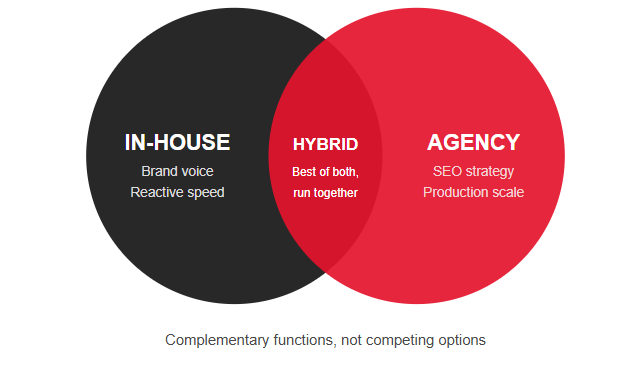
The in-house lead knows things the agency can’t know. The agency produces things the in-house lead can’t produce alone. The two functions are complementary, not competitive.
This model costs more than either option alone, but it consistently outperforms both on content quality, SEO velocity, and business-outcome attribution. It’s also the model most of the genuinely best content marketing agencies recommend to clients themselves, rather than pushing for a fully outsourced arrangement. A dedicated content repurposing agency relationship inside that hybrid setup is usually what keeps the output multiplying instead of stalling at one blog post per topic.
Wright Research is a case in point. Bright Brain’s content and AEO/GEO strategy work delivered 600+ organic users from ChatGPT, Perplexity, and Gemini citations, alongside an 18% improvement in signups and a 33% subscription spike in two months. That outcome required both the strategic depth of an experienced agency and tight alignment with Wright Research’s brand and audience, a collaboration, not a substitution.
Content Marketing Agency vs In-House: Capability Comparison
The quality signal in agency evaluation isn’t the pitch deck. It’s the portfolio. Specifically:
Ask for case studies with business outcomes, not just traffic metrics. An agency that shows you “we grew organic traffic by 200%” without telling you what that traffic did to the business is showing you a vanity metric. The right case study shows: keyword rankings, organic traffic, and the inquiry or revenue contribution that traffic generated.
Ask how they handle voice calibration. A content marketing agency that produces generic, formulaic content across clients hasn’t solved the voice problem. Ask to read three pieces from different clients; if they sound the same, the agency is a content factory, not a content partner. This is one area where many content creation agencies cut corners, since genuine voice calibration takes real time upfront, and it’s one of the clearest ways to tell the best content marketing agencies apart from the rest. Reading a handful of samples across different content creation agencies before signing is one of the cheapest due-diligence steps a marketing head can take.
Ask about their SEO methodology. Content and SEO are not separate functions in a high-performing content marketing programme. The agency that can’t explain their keyword research process, topical authority approach, and internal linking strategy is producing content that won’t rank.
Ask about repurposing and distribution. Content that’s written and published is content that earns one unit of ROI. Content that’s published, repurposed across three formats, and distributed to a newsletter, LinkedIn, and a social calendar earns five units. A content repurposing agency, or a repurposing workflow inside a broader retainer, is what turns one asset into five. Brands that skip this step are effectively paying full price for a content repurposing agency function they never actually get.
Finally, ask directly whether they operate as a content development agency end-to-end, covering ideation through publication, or whether they only fill briefs someone else writes; the answer tells you which of the two models you’re actually hiring. Any genuine content development agency worth its retainer should be able to answer this in one sentence, not a slide deck.
Q1: Is a saas content marketing agency worth the cost for a mid-sized Indian brand?
Yes, if the brand treats content as a channel, not a campaign, and has patience for the 9-12 month compounding curve. The ROI of well-executed content marketing, measured in organic traffic growth and reduced paid-ad dependency, consistently outperforms the retainer cost of a saas content marketing agency by the 18-month mark. Most brands find this out only after comparing a shortlist of content marketing agencies side by side.
Q2: What does a content marketing agency typically cost in India?
Credible content marketing agency retainers in India typically range from ₹1.5-6 lakh per month, depending on output volume, channel scope, and SEO integration. Avoid content marketing companies priced below ₹1 lakh per month for full-scope work, since both writing quality and strategic depth tend to suffer at that price point. This range holds whether you’re hiring a general content agency or a specialised saas content marketing agency.
Q3: How long does it take to see results from content marketing?
Meaningful organic traffic movement typically takes 6-12 months in competitive verticals. Content published in month 3 often starts ranking around month 9, so patience is a prerequisite. Brands that judge content agency performance at the 3-month mark are stopping before the returns begin, regardless of whether they hired one of the content creation agencies on their shortlist or built a team in-house.
Q4: What is the difference between a content marketing agency and a content writing agency?
A content writing agency produces written deliverables, blog posts, articles, social copy, on request. A content marketing agency builds and executes a strategy: keyword research, content calendar, production, SEO optimisation, distribution, and performance measurement. The content writing agency fills a brief; the content marketing agency writes the brief. Most content development agency teams sit somewhere between the two, depending on the scope of the retainer.
Q5: Can a content marketing agency maintain my brand voice?
A good one, yes. The best agencies invest in a voice calibration process, reading existing content and interviewing stakeholders before producing the first piece. Voice drift is the most common failure mode among content creation agencies, so ask any prospective saas content marketing agency how they handle calibration and what their first-three-pieces review looks like.
Q6: What content formats produce the best results for Indian B2B brands?
Long-form SEO blog posts (1,500-2,500 words) targeting high-intent keywords, detailed case studies with named outcomes, LinkedIn thought leadership from senior leaders, and email nurture sequences for mid-funnel prospects. These formats are what separates the best content marketing agencies from generic content development agency shops running the same generic playbook for every client. A capable content repurposing agency then multiplies each of these formats across channels instead of publishing once and moving on.