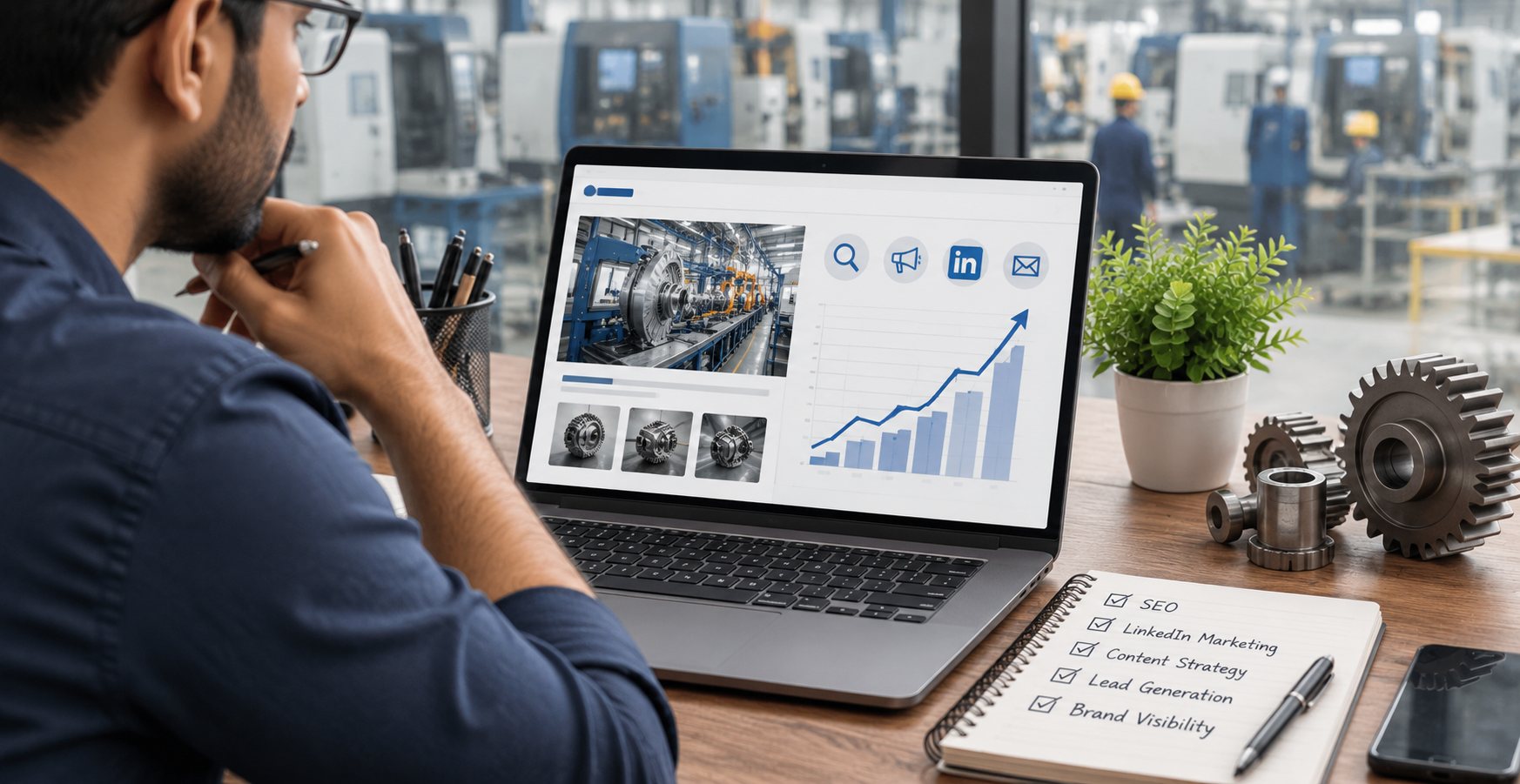
A procurement manager at a mid-sized industrial firm in Pune needs a new crane supplier. She opens Google, types in a product category, clicks three or four results, reads through two websites, checks one company’s LinkedIn, scans a case study, and sends a request for quote to two vendors. The whole process takes forty minutes.
Your sales team hasn’t received a call. But the decision is already halfway made.
This is how B2B manufacturing deals begin in 2026. Not with a trade show handshake, but with a Google search. And if your company isn’t credibly visible at each step of that forty-minute journey, you aren’t being evaluated. You’re being skipped.
Digital marketing for manufacturers isn’t about going viral or running flashy campaigns. It’s about being present, credible, and specific when the right buyer is looking, and building the kind of trust that gets you to the final two on a shortlist.
Here’s how Indian B2B industrial brands are doing it.

Trade shows, word-of-mouth, and distributor networks built most manufacturing businesses in India. They still matter. But they now cover a smaller share of the buyer’s journey than they did five years ago.
Research consistently shows that B2B buyers complete a significant portion of their evaluation process before speaking to a vendor. By the time a procurement manager sends your team an inquiry, they’ve likely already visited your website, read at least one piece of your content, and compared you against two or three competitors. If your website is thin, your case studies are locked behind a login, or your LinkedIn hasn’t been updated in two years, you’ve already lost ground you didn’t know you were competing for.
The manufacturing brands winning new business today aren’t the ones spending the most on digital marketing. They’re the ones who’ve built a consistent online presence that answers the questions procurement managers are actually asking about capacity, certifications, lead times, and quality standards before a sales conversation begins. This is exactly the gap that effective digital marketing for manufacturers is built to close.
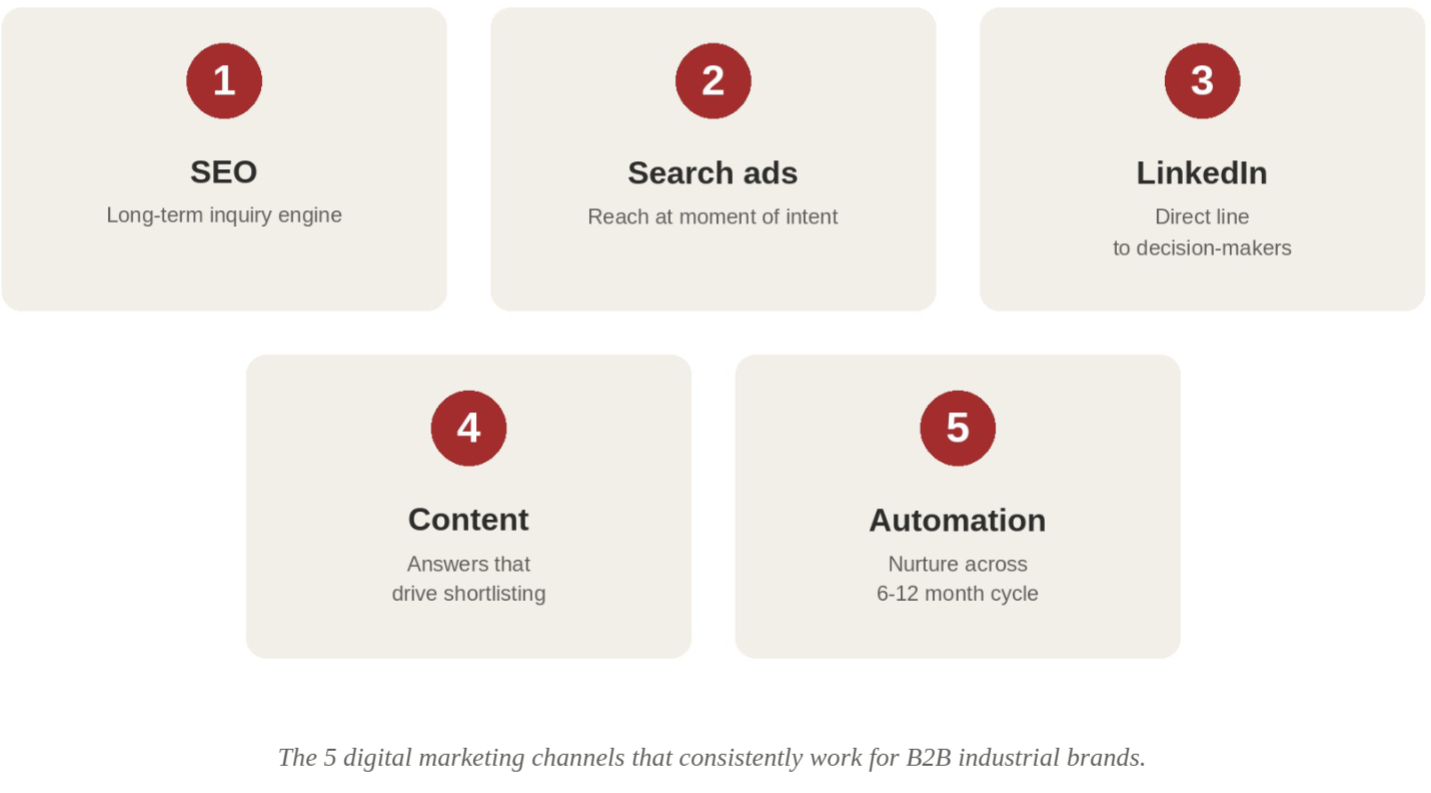
These five channels form the backbone of effective digital marketing for manufacturers, and each plays a different role across the buyer’s journey.
Search engine optimisation for manufacturers isn’t about ranking for generic terms. It’s about being the first result when someone searches for exactly what you make: “hydraulic cylinder manufacturer India,” “industrial pump supplier Mumbai,” “crane components supplier export.”
These are low-volume, high-intent searches. The person typing them isn’t browsing. They have a specific need and a budget.
A well-executed B2B SEO strategy for manufacturing companies targets three layers of search:
This is the model that delivered results for Manitowoc Potain, the global crane manufacturer. Bright Brain’s SEO work helped the brand achieve a 270% increase in organic traffic and a 300% increase in quality leads, not through volume tactics, but by building content and technical infrastructure around the specific queries their target buyers were using. For manufacturing companies, SEO is the foundation of digital marketing for manufacturers because it compounds over time and keeps working long after a campaign ends.
SEO takes time, typically 4–6 months before meaningful results in competitive B2B verticals. But once established, it generates qualified inquiries without ongoing ad spend. It’s the closest thing to a permanent lead generation asset a manufacturing company can build.
While SEO builds long-term organic presence, Google Search Ads fill the gap immediately. For B2B industrial keywords, Google Ads allows you to appear at the top of results the moment a procurement manager or plant engineer types a relevant search. This is where digital marketing for manufacturers delivers immediate, measurable pipeline while SEO is still building momentum.
The key discipline here is specificity. Generic ad campaigns for manufacturing companies waste budget on broad terms. Effective campaigns target:
B2B industrial keywords in India typically have lower competition and lower cost-per-click than consumer categories, which means well-targeted campaigns can generate high-quality inquiries at a cost that makes the economics work, even for high-value, low-volume industrial products.
For manufacturing companies, LinkedIn is the most direct channel to the people who actually make purchasing decisions: plant managers, heads of procurement, engineering leads, and managing directors of industrial firms.
LinkedIn’s targeting allows you to filter by job title, company size, industry, and geography with a level of precision no other platform offers. An industrial pump manufacturer can serve content and ads to procurement heads at automotive OEMs in Maharashtra. A packaging machinery supplier can target operations managers at FMCG companies across India.
But LinkedIn’s biggest payoff for B2B manufacturers isn’t advertising; it’s organic credibility. LinkedIn plays a distinct role in digital marketing for manufacturers, one built on trust rather than transaction. A company page with consistent technical content, verified case studies, and active leadership posts signals to a buyer that this is a real business with real expertise. That signal matters enormously in the trust-building phase of a long B2B sales cycle.
Manufacturing buyers research intensively before making contact. They read technical specs, watch process videos, and look for case studies from companies in their own industry. Content marketing for B2B industrial brands is about being the company that provides those answers, and it’s the content engine that powers digital marketing for manufacturers across the entire buyer journey.
The highest-value content formats for manufacturing companies:
This content serves two purposes simultaneously: it ranks on Google (building SEO), and it builds the trust that moves a prospect from inquiry to shortlist to contract.
B2B industrial sales cycles are long. A procurement manager who submits an inquiry today may not be in a position to place an order for six months. Most manufacturing companies lose that lead in the gap, because there’s no systematic follow-up.
Marketing automation changes that. A structured email nurture sequence, educational content in month one, case studies in month three, specific product information by month five, keeps your company top of mind throughout the evaluation period without requiring manual effort from your sales team. Nurture sequences are the piece of digital marketing for manufacturers that most companies skip, and it costs them the most qualified deals.
The companies that convert the highest percentage of initial inquiries into contracts are the ones that stay present, relevant, and useful across the entire buying cycle.
The challenge with most digital marketing content for manufacturing companies is that it describes tactics without evidence. Here’s what the numbers look like when the approach is right.
Manitowoc Potain is a global crane manufacturer operating in a highly competitive B2B industrial segment. When Bright Brain took on their digital marketing mandate, the brief was straightforward: generate more of the right inquiries from the right buyers.
The approach: a combination of technical SEO targeting the specific queries Manitowoc Potain’s buyers were using, content built around application-specific use cases, and a website structure that made it easy for procurement managers to find and evaluate exactly what they needed.
The result: 270% increase in organic traffic. 300% increase in quality leads.
Not total leads, quality leads. That distinction matters in B2B manufacturing. Volume is easy to manufacture with broad tactics. The harder problem is generating inquiries from buyers who have the right project, the right budget, and the right timeline. That’s what a strategy built around buyer intent, rather than generic visibility, delivers.
Understanding what works is only half the picture. Most B2B industrial brands that invest in digital marketing and see poor results are making one of three consistent mistakes. Almost every one of them comes down to treating digital marketing for manufacturers as a campaign to run instead of infrastructure to build.
Mistake 1: Treating the website as a brochure, not a sales tool. The website’s job is to convert a visitor’s question into a reason to contact you. A website that lists products without addressing buyer concerns, capacity, certification, lead time, minimum order quantity, export capability fails at the only moment it matters. The visitor leaves. The shortlist gets built without you.
Mistake 2: Targeting broad keywords instead of buyer-intent keywords. “Digital marketing for manufacturing” is a broad term. “Industrial pump manufacturer India” is a buyer-intent term. The first attracts researchers. The second attracts buyers. Most manufacturing companies running Google Ads target too broadly and generate inquiries that don’t convert, then conclude that digital marketing doesn’t work for their business.
Mistake 3: Running campaigns without a nurture system behind them. Generating the inquiry is step one. Converting it into a contract is steps two through twelve. Without a structured follow-up sequence, content, email, retargeting, sales alignment, even high-quality inquiries go cold. B2B industrial deals require multiple touchpoints across months. A campaign without a nurture system behind it leaves most of that investment on the table.
Not every digital marketing agency understands B2B industrial sales cycles, procurement processes, or the trust dynamics that govern manufacturing buyer decisions. Choosing the right partner is one of the highest-leverage decisions in digital marketing for manufacturers, since a wrong fit costs months of pipeline. The right partner needs to demonstrate:
Bright Brain is one of only 15 Google Elevator Partners selected from 8,000+ agencies in India. Our B2B manufacturing work spans international industrial brands like Manitowoc Potain and industrial leaders like Piaggio, delivering 90,000+ leads for the latter across a sustained performance marketing programme.
If you’re a B2B manufacturing company looking to build a digital marketing presence that generates real inquiries, this roadmap is the practical starting point for digital marketing for manufacturers, built as a 6–9 month programme, not a 30-day fix. Start here:
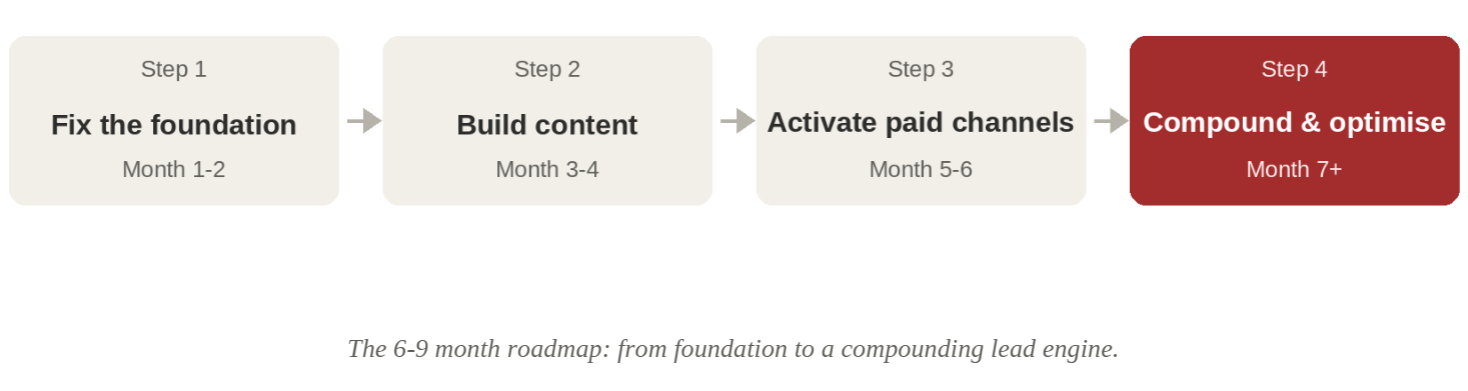
Month 1–2: Fix the foundation
Month 3–4: Build the content infrastructure
Month 5–6: Activate paid channels
Month 7+: Compound and optimise
This is a 6–9 month build, not a 30-day fix. The manufacturing companies that win online are the ones that treat digital marketing as infrastructure, something that compounds in value over time, rather than a campaign to run and evaluate in a quarter.
Yes. Digital marketing for manufacturers works when backed by the right strategy. B2B industrial buyers in India increasingly research suppliers online before making contact. A well-executed digital marketing programme targeting buyer-intent keywords and building trust through case studies and technical content generates qualified inquiries that often outperform trade show leads in both conversion rate and contract value.
SEO delivers the best long-term ROI in digital marketing for manufacturers because it generates inquiries without ongoing ad spend once rankings are established. Google Search Ads provide the best short-term ROI for high-intent, low-volume buyer keywords, while LinkedIn is ideal for building brand credibility and reaching decision-makers in target companies.
A credible digital marketing for manufacturers programme for a mid-sized manufacturing company in India typically starts at ₹2–4 lakh per month, covering SEO, paid media, and content marketing. The investment is often offset by reduced trade show costs and higher-quality inquiries that improve close rates.
SEO in digital marketing for manufacturers typically delivers results within 4–6 months in competitive industrial sectors. Google Ads can start generating qualified inquiries within 2–4 weeks if campaigns target high-intent buyer keywords. The full impact of an integrated strategy usually becomes visible within 9–12 months.
The most effective digital marketing for manufacturers content includes case studies with measurable outcomes, technical guides that answer buyer questions, product and application pages focused on procurement criteria such as certifications, capacity, lead time, and MOQ, along with factory and process videos that showcase manufacturing capabilities.
Digital marketing for manufacturers focuses on procurement managers, plant engineers, and business decision-makers rather than individual consumers. The sales cycle is longer, typically 3–12 months; the content is more technical, and the primary channels are Google Search and LinkedIn. Success is measured by inquiry quality and business opportunities, not impressions or engagement alone.