
Most store owners assume their rankings stalled because of one missing thing, usually backlinks. The truth is less comfortable. The package they bought was never built for an ecommerce store in the first place. It was a generic service template with the word “ecommerce” stamped on top.
That distinction matters more than people expect. A blog site has dozens of pages. A store has thousands, most of them product and category pages that search engines struggle to crawl, index, and rank without deliberate structure. When ecommerce seo packages ignore that reality, the work looks busy but the revenue line stays flat.
“We see the same pattern every month. The store is paying for SEO, the reports look full, and organic sales have not moved in a year. The package was treating a 4,000-product catalogue like a 12-page brochure site.”
This is why the stakes are high. Organic search drives roughly 43% of all traffic to ecommerce websites, according to Reboot Online (2025). If nearly half your potential demand flows through search, a misfit package is not a small inefficiency. It is a slow leak in your largest acquisition channel. For many Mumbai-based and pan-India stores, that leak runs for quarters before anyone questions it.
The first step is knowing what you are actually paying for, and that starts with a proper audit.
A serious ecommerce seo audit is a diagnosis, not a checklist. It tells you why money is leaking and which fixes will move revenue first. Skip it, and every later activity is a guess dressed up as strategy.
Here is where weak audits go wrong. They report surface metrics like domain authority and total keywords, then recommend more blog posts. A strong audit goes deeper. It examines crawl budget waste, duplicate product URLs, thin category pages, faceted navigation chaos, indexing of filter parameters, and broken internal linking between products. These are the issues that quietly suppress an entire catalogue.
The contrast is stark. A poor audit counts problems. A strong ecommerce seo audit prioritises them by revenue impact, so you fix the category driving thirty percent of sales before the blog nobody reads. One approach generates a to-do list. The other generates a sequence.
The data backs this urgency. The first organic position captures around 27.6% of all clicks, according to a Backlinko search study, with a steep drop after that. For a store, ranking a high-intent category page one spot higher can shift real revenue, which is exactly what a good audit is designed to find. Quality ecommerce seo services always begin here, never with content for its own sake.
Once the audit names the priorities, the package should be built around them.
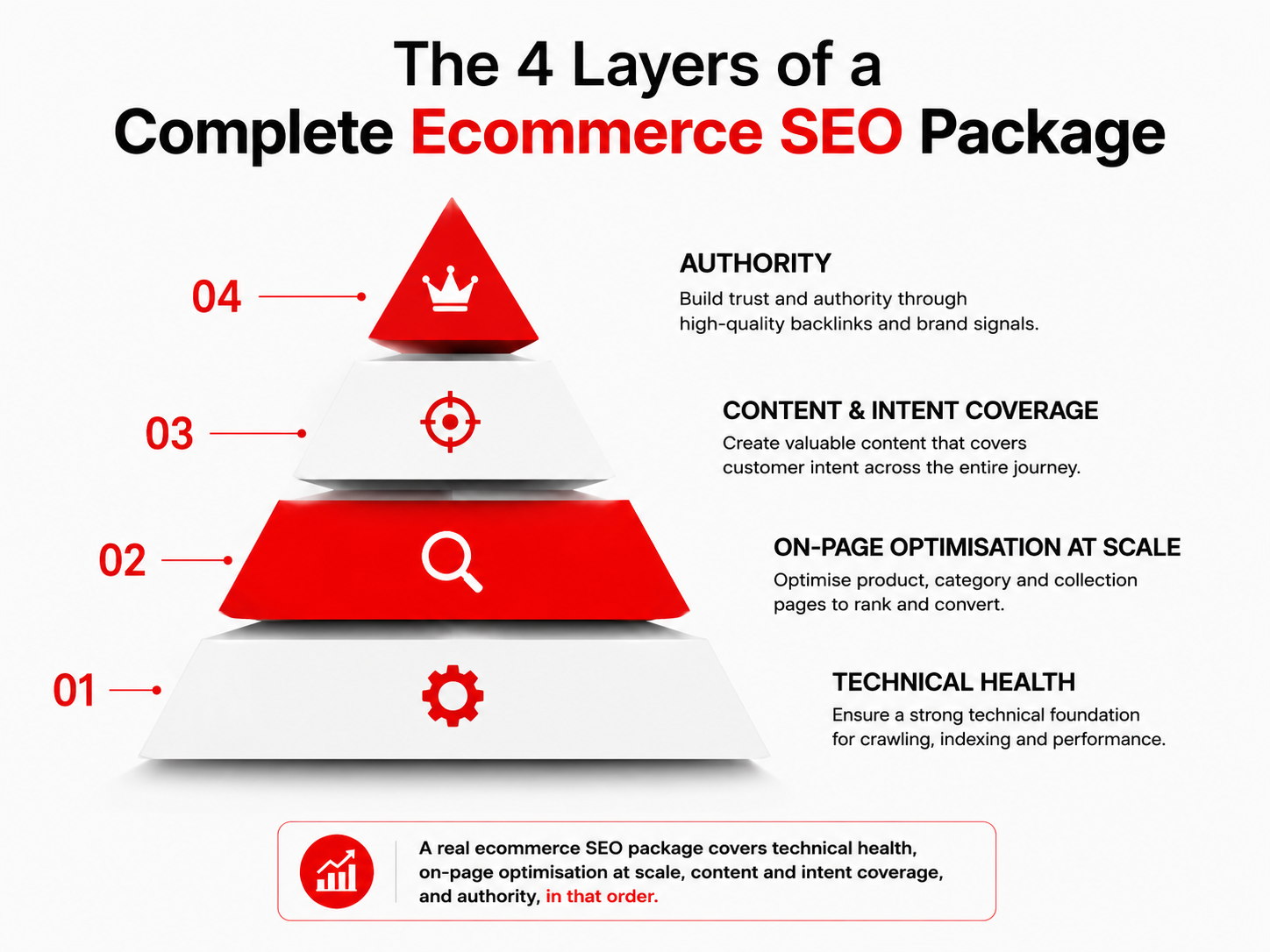
A complete package covers four layers: technical health, on-page optimisation at scale, content and intent coverage, and authority building. Anything missing a layer is not a package. It is a fragment sold at full price.
Start with the technical foundation. This means clean site architecture, logical category hierarchy, canonical tags to control duplicate product variants, an optimised crawl path, fast mobile load times, and proper schema markup for products, prices, and reviews. Strong ecommerce seo services treat this as ongoing maintenance, not a one-time setup, because catalogues change weekly.
The second layer is where ecommerce differs most from regular SEO. You cannot hand-write one page at a time across thousands of products. Good ecommerce seo packages include templated yet unique title tags, meta descriptions, and category copy, plus a system for handling out-of-stock and seasonal products without losing ranking equity. This is the unglamorous engine room of organic growth.
The third layer connects search demand to your catalogue. That means mapping buyer-intent keywords to the right category and product pages, then filling genuine gaps with buying guides and comparison content. The point is to capture shoppers before they reach a marketplace, not to publish for a content calendar. This is the heart of effective seo for e commerce website growth, and it is where most cheap packages stop short.
The reason this works is structural. The average ecommerce brand ranks for only about 1,783 organic keywords, according to Reboot Online (2025), which is a fraction of the demand most catalogues could capture. The gap between that number and your true potential is the opportunity a serious package is built to close. The best ecommerce seo services are measured by how much of that gap they recover and convert.
Some line items appear in invoices across the country and quietly waste budget. Knowing them protects you from paying premium money for filler.
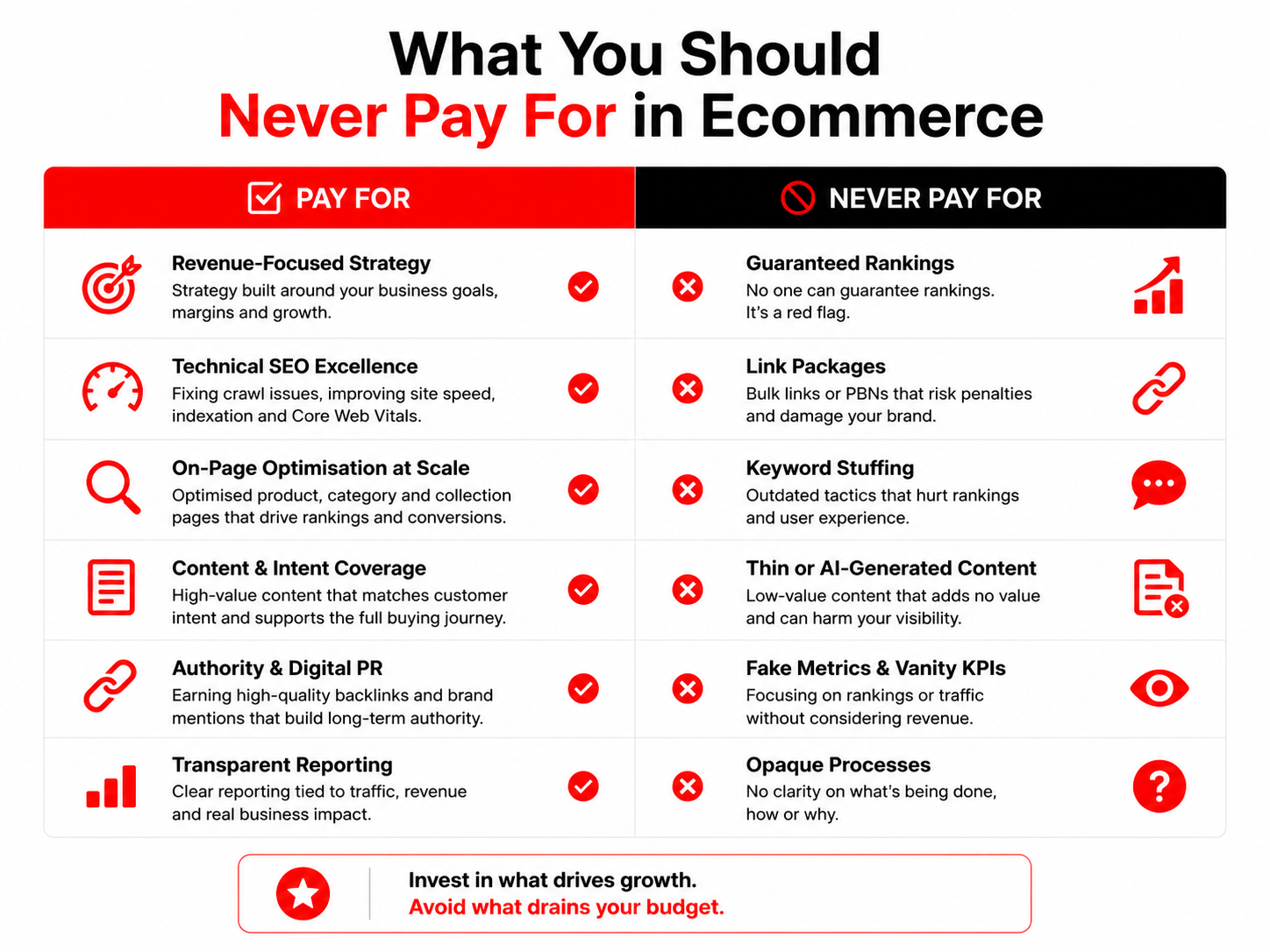
Never pay for bulk, low-quality backlinks. Buying hundreds of directory or PBN links is a fast route to a manual penalty, and the short-lived ranking bump is not worth the risk. Authority should be earned through digital PR, genuine partnerships, and content people actually cite.
Never pay for keyword-count reports presented as results. A package that bills you for “500 keywords tracked” while organic revenue stays flat is selling activity, not outcomes. The honest ecommerce seo agency reports traffic value, assisted conversions, and revenue from organic, because those are the numbers that pay salaries.
Never pay for blog volume with no commercial intent. Twenty articles a month on tangential topics will not move a store. They drain budget that belongs on category optimisation and high-intent guides. Be equally wary of any ecommerce seo agency promising guaranteed page-one rankings in thirty days. No one controls Google’s algorithm, and that promise usually signals black-hat tactics you will pay for later. Reputable ecommerce seo companies sell process and proof, not impossible certainty.
Once you can spot the filler, pricing becomes far easier to judge.
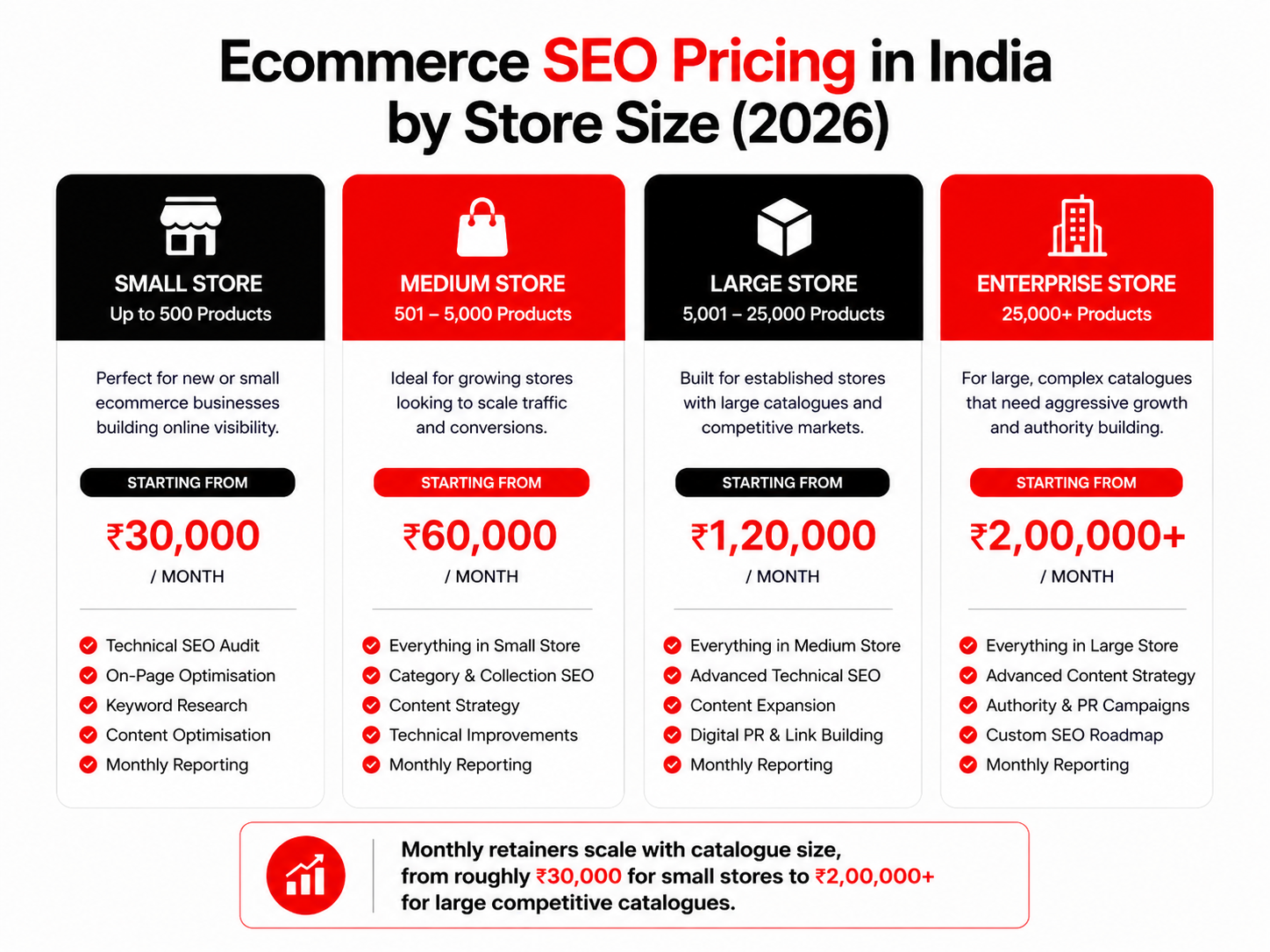
Ecommerce seo pricing in India is driven mostly by catalogue size, competition, and the depth of technical work required, not by a fixed rate card. A 50-product store and a 50,000-SKU marketplace cannot cost the same, and any quote that ignores this is guessing.
As a working range, small stores often see monthly retainers between ₹30,000 and ₹60,000. Mid-sized catalogues typically fall between ₹60,000 and ₹1,20,000. Large or competitive stores frequently run from ₹1,20,000 to ₹2,00,000 or higher. Project-based ecommerce seo audit engagements usually sit between ₹40,000 and ₹1,50,000 as a one-time investment before a retainer begins. These figures shift with vertical competition and city, with Mumbai and metro brands often investing at the higher end.
The reason ecommerce seo pricing varies so widely is the work itself. Fixing faceted navigation across 10,000 products is a different job from optimising 80 pages. When you compare quotes, compare scope first. A cheaper package that skips technical health is not cheaper. It is incomplete. Transparent ecommerce seo pricing ties every rupee to a deliverable and a metric, so you always know what you are funding.
This is also why the agency you choose matters as much as the price.
The single most reliable filter is proof. The best ecommerce seo agency for your store is the one that can show revenue and conversion outcomes for stores like yours, not screenshots of ranking graphs detached from sales.
Bright Brain, a Mumbai-based agency and one of only 15 Google Elevator Partners selected from over 7,000 agencies across India, applies this revenue-first lens to every engagement. For Richfeel Naturals, a full-funnel approach drove a 70% increase in conversion rate and a 50% revenue boost. For Bioclean, the work delivered a 204% improvement in ROAS alongside 224% revenue growth. These are the outcomes a credible ecommerce seo agency should be able to point to, because rankings only matter when they convert.
The math explains why this discipline pays off. Ecommerce SEO delivers an average ROI of around 317% with a break-even of roughly nine months, according to FirstPageSage (2025). Slower than paid ads at first, but it compounds. That is the long-term case for choosing carefully among ecommerce seo companies rather than buying the cheapest plan.
When you shortlist, ask three questions. Can they show ecommerce-specific results with revenue attached? Do they audit before they propose? Will they explain reporting in plain language? The best ecommerce seo agency answers all three without hesitation, while weaker ecommerce seo companies sell activity instead of outcomes.
The goal is durable seo for e commerce website performance: rankings that keep converting long after a campaign ends. That is the standard the best ecommerce seo services are ultimately judged on, and it is what protects your investment over the long term.
Choosing a package should feel less like buying a service and more like hiring a system that pays you back. The stores that win at search are not the ones spending the most. They are the ones who understood what to fund, what to question, and what to walk away from. If you remember one thing,
let it be this: pay for structure, proof, and reporting tied to revenue, and refuse to pay for activity dressed up as results. Get that balance right, and organic search stops being a cost line and starts becoming the most reliable, compounding part of your growth. You do not need to have every answer before you start.
You only need a partner who will diagnose honestly, sequence the work sensibly, and show you the numbers without spin. When you are ready to take that step, the path forward is simpler than it looks.
A strong package includes a technical audit, site architecture and crawl fixes, product and category page optimisation, keyword-to-intent mapping, schema markup, content, and revenue-based reporting. The exact mix scales with your catalogue size and competition, so always confirm scope before comparing prices.
Most ecommerce seo services in India run between ₹30,000 and ₹2,00,000 per month, driven by catalogue size, competition, and technical depth. Small stores sit at the lower end, large or competitive catalogues at the higher end. Transparent pricing ties every cost to a clear deliverable and metric.
An ecommerce seo audit diagnoses why revenue is leaking, from duplicate URLs to thin category pages, and prioritises fixes by impact. Without it, every activity is guesswork. A proper audit turns a generic checklist into a revenue-ordered plan, which is why credible agencies always start here.
Never pay for bulk low-quality backlinks, keyword-count reports framed as results, high-volume blogs with no buyer intent, or guaranteed page-one rankings. These waste budget or risk penalties. A trustworthy ecommerce seo agency sells measurable process and proof, never impossible promises or vanity activity.
Pick the best ecommerce seo agency by proof, not promises. Ask for ecommerce-specific results tied to revenue and conversions, confirm they audit before proposing, and check that reporting is clear. The strongest ecommerce seo companies treat your catalogue as a revenue system, not a content calendar.
Most stores see early movement in three to six months and meaningful revenue gains by six to twelve months. Ecommerce SEO breaks even at around nine months on average, then compounds. This is why the best ecommerce seo services focus on sustainable structure over short-lived ranking spikes.