
Founders searching for a digital marketing agency for startups usually have the same core problem. They’re not short on ideas. They’re short on clarity about which channels deserve budget right now, and which ones will drain runway without delivering results.
Most early-stage brands in India make the same sequence of mistakes. They launch Google Ads before their landing page converts. They hire a social media manager before they’ve validated their positioning. They chase brand awareness when they need bottom-of-funnel leads. The order is wrong, and the wrong order is expensive.
The challenge for a Mumbai-based startup is especially sharp. You’re competing for digital attention against funded companies with dedicated marketing teams and agencies running full-funnel operations. Spending more isn’t the answer. Spending precisely is.
Startup marketing isn’t about doing everything at once. It’s about knowing which one or two channels will prove unit economics fastest, committing there, and only expanding when the numbers justify it.
According to a 2023 report by Tracxn, India added over 1,100 new startups in a single quarter. Every one of those businesses is trying to get found online. The ones that survive their first 18 months tend to be the ones that solved distribution before they scaled production.
Direct answer: Most startups aren’t competing on budget. They’re competing on relevance. The startup that shows up with the most specific answer to a buyer’s exact search query wins, regardless of spend. The diagnostic question isn’t “how much should we spend?” It’s “what does our buyer search for, and are we the clearest answer to that query?”
Before any startup marketing strategy makes sense, you need a clear-eyed audit of three things: your search landscape, your conversion funnel, and your current cost per acquired lead or customer. Without these three numbers, every channel decision is a guess.
According to WordStream, the average landing page conversion rate across industries is 2.35%, but the top 25% of pages convert at 5.31% or higher. For a startup, closing this gap before scaling paid spend is the single highest-leverage action available.
Choosing a digital marketing agency for startups without first answering the diagnostic questions above means handing over budget without a compass. Any agency worth hiring will run this audit before recommending a channel strategy.
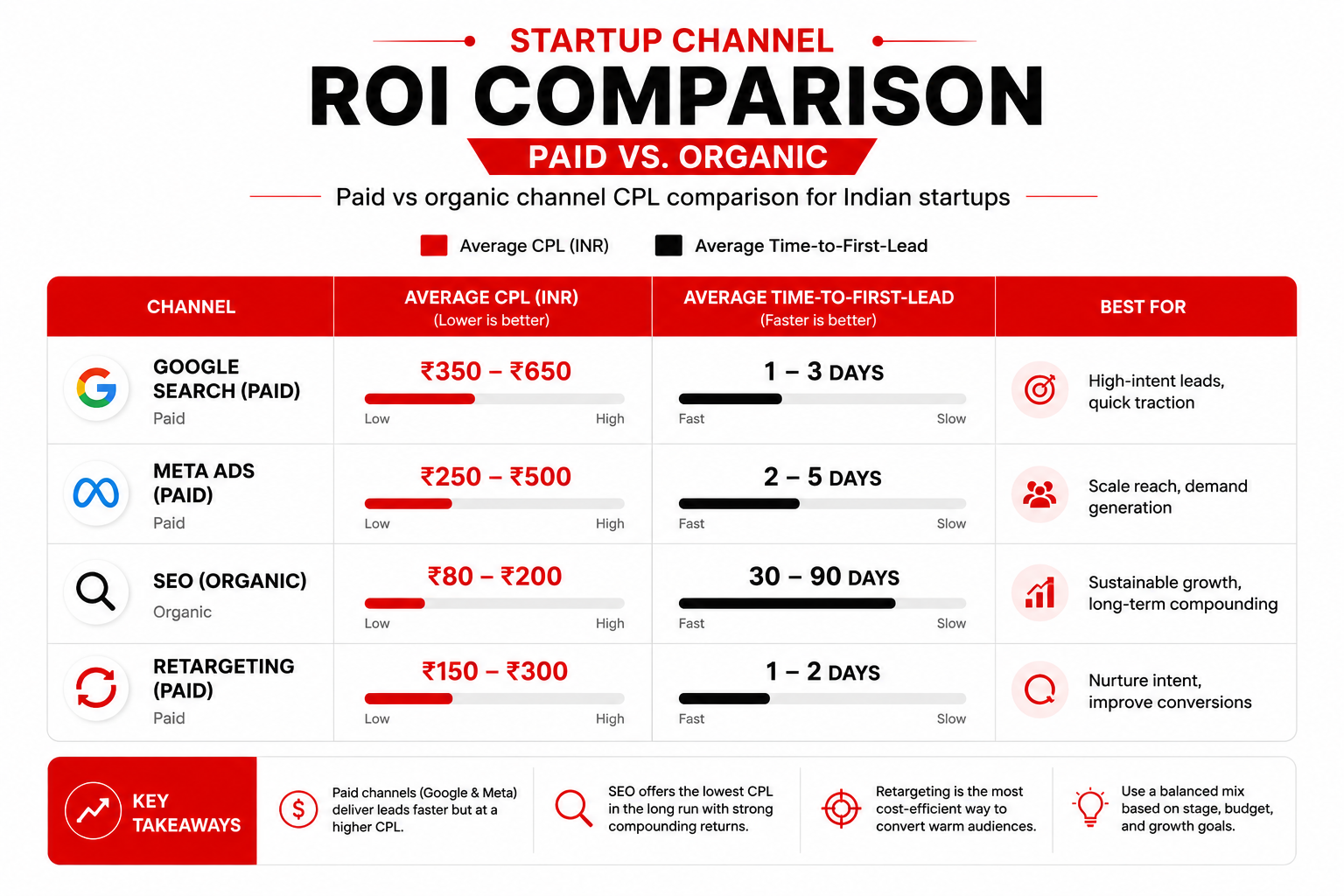
Direct answer: Before a startup spends on paid media, two organic channels deserve investment first: search engine optimisation and conversion-optimised landing pages. These don’t deliver overnight results. But they compound. A well-structured SEO foundation means every rupee you eventually spend on paid media is landing on a page that converts. Without it, you’re pouring into a leaking bucket.
The nature of digital marketing services for startups has shifted significantly. Buyers in India are now searching in conversational, intent-heavy ways, and they’re looking for answers in Google’s AI Overviews, ChatGPT, Perplexity, and Gemini, not just the traditional blue links. A startup that builds topical authority early earns organic citations from these AI systems. That’s a distribution that costs nothing beyond the investment in content.
This isn’t theoretical. Wright Research, a SEBI-registered investment advisory firm, worked with Bright Brain to build an AEO and GEO content infrastructure. Within two months, they were generating over 600 organic users from ChatGPT, Perplexity, and Gemini. Their signup rate improved by 18% and subscription conversions spiked by 33%. That’s startup-scale efficiency: once the content asset is built, it keeps working.
BrightEdge reports that organic search drives 53% of all website traffic across industries, compared to 15% from paid search. For a startup with a limited media budget, a compounding organic channel is a competitive advantage that paid-only competitors can’t replicate quickly.
A landing page that doesn’t convert is not a minor issue. It’s the fulcrum everything else rests on. Before a marketing agency for startups recommends any paid channel, the startup’s landing page needs to pass a basic test: a clear headline, a single CTA, a proof element, and a sub-three-second load time on mobile.
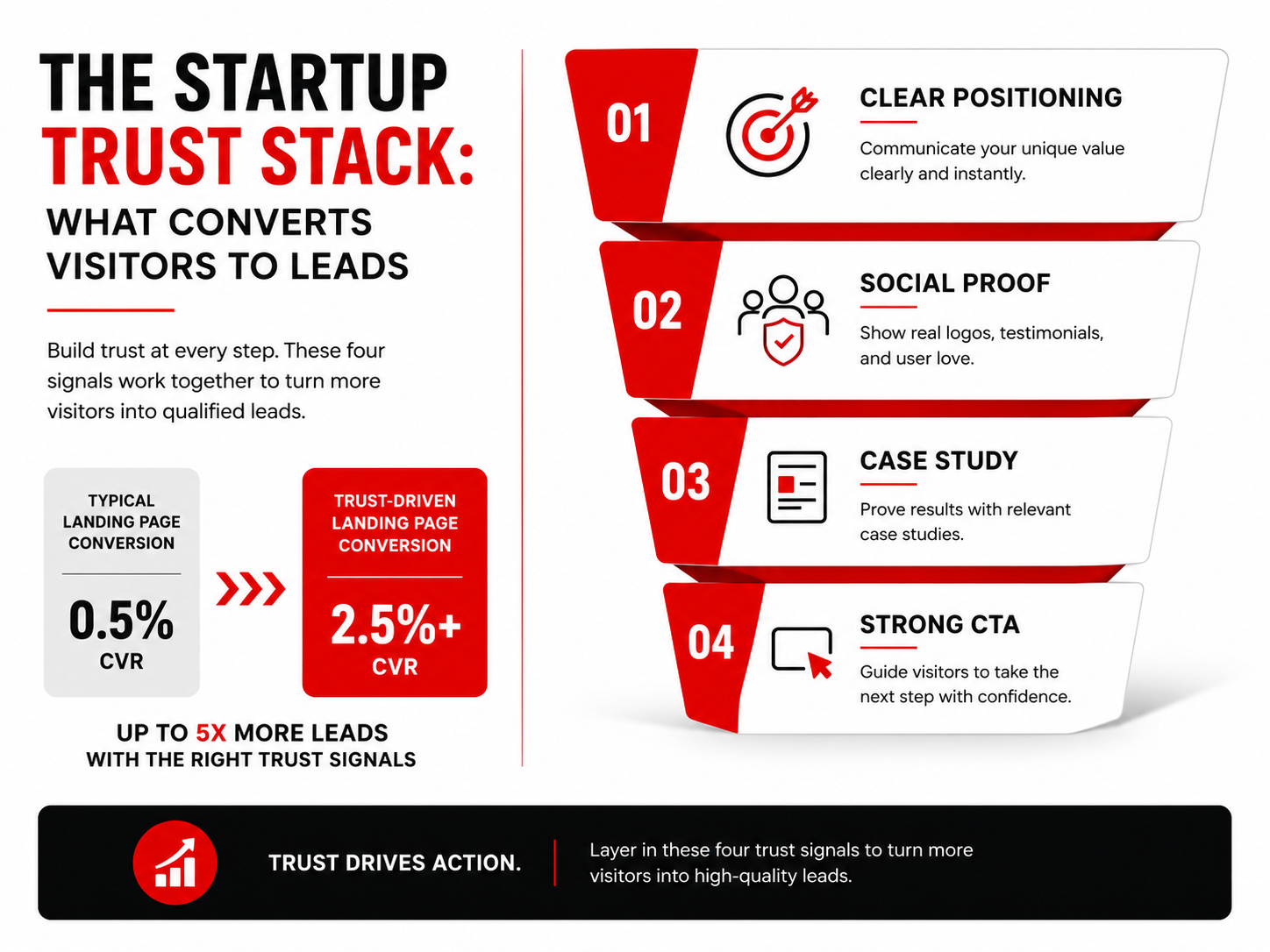
Sub Zero, a B2B industrial brand, moved their conversion rate from 0.5% to 2.5% after Bright Brain restructured their landing page and funnel. Their CPL dropped by 70%, and lead quality improved by 50%. The budget didn’t change. The infrastructure did.
Direct answer: Paid media for startups works best when it’s narrow, fast, and test-driven. Start with one platform, one campaign objective, one audience, and one creative variant. Measure cost-per-lead at day 14. Optimise or kill. Only expand what’s working.
For most Indian startups, Google Search is the right first paid channel. Your buyer is already looking for what you offer. A well-structured search campaign with precise keywords, a strong ad group theme, and a conversion-optimised landing page can generate qualified leads within days, not months.
Choosing a digital marketing agency for startups that understands Google’s Quality Score system matters here. Poor account structure leads to high CPCs and poor Ad Rank. Startups with lean budgets can’t afford to waste money on broad-match keywords and generic landing pages.
Meta’s advertising platform is exceptional for building brand recall and generating top-of-funnel awareness. But for most B2B-adjacent startups in India, it’s a middle-of-funnel tool, not a primary acquisition channel in the early stages. The lead quality from Meta cold audiences tends to need more nurturing before it converts.
The smart approach for a digital agency for startups is to use Meta retargeting from day one. Target people who’ve visited your site, watched your video, or engaged with your content. These audiences convert at two to three times the rate of cold traffic, at a fraction of the CPL.
Ashv Finance, a BFSI brand, worked with Bright Brain on a tightly structured paid campaign. They generated 2,460 leads in one month at a CPL of just Rs 25. Landing page CVR improved by 25%, and CPM dropped by 24%. That’s what precise paid execution, not budget volume, produces.
Direct answer: Buyers trust brands that demonstrate expertise before asking for a commitment. For startups, the fastest route to authority is a combination of content that answers specific buyer questions and credible third-party signals: reviews, case studies, media mentions, and consistent social proof. This layer doesn’t replace paid media. It makes paid media cheaper because trust lowers conversion friction.
Startup marketing in India has a content problem. Most startup blogs are written for SEO volume, not buyer trust. They’re generic, forgettable, and indistinguishable from ten other articles on the same keyword. The startups that build real authority write content that reflects genuine domain knowledge: specific, opinionated, and anchored in real experience.
A digital marketing agency for startups that helps you build this kind of content creates a flywheel. Each piece of content trains Google’s AI systems, earns citations, and positions your brand as the credible answer to the questions your buyers are already asking.
According to HubSpot’s 2024 State of Marketing report, companies that blog regularly generate 55% more website visitors than those that don’t, and B2B companies that publish 16 or more posts per month generate 3.5x more traffic than those publishing 0 to 4 posts. For a startup, even four to six focused posts per month, aligned to high-intent search queries, can compound significantly by month six.
For Mumbai-based and pan-India startups selling to other businesses, the absence of social proof is one of the most common silent conversion killers. Buyers who land on a startup’s page and find no client logos, no testimonials, and no case studies assume either that the brand is too new to trust or that results don’t exist.
Getting even two to three detailed client testimonials and one quantified case study on the landing page can meaningfully improve CVR. This is especially true in categories like SaaS, EdTech, BFSI, and professional services where the purchase decision involves significant trust.
Digital marketing companies for startups that take authority-building seriously treat content and social proof as essential infrastructure, not afterthoughts. Mentoria, an EdTech brand, worked with Bright Brain on a full-funnel strategy. Over four months, their revenue grew by 300%, organic traffic by 55.47%, and leads by 142%. The authority foundation set during the first eight months drove results that compounded for years beyond the campaign.
Direct answer: The right execution order for a startup in India is: fix the funnel first, then SEO, then paid, then retargeting, then scale. Skipping steps in this sequence wastes budget. The most common mistake is starting with paid media before the landing page converts. Do that, and you’re funding a broken funnel.
The best digital marketing agency for startups will not let you jump straight to media buying. They’ll run the diagnostic audit first, fix what’s broken, and only then recommend budget allocation by channel.
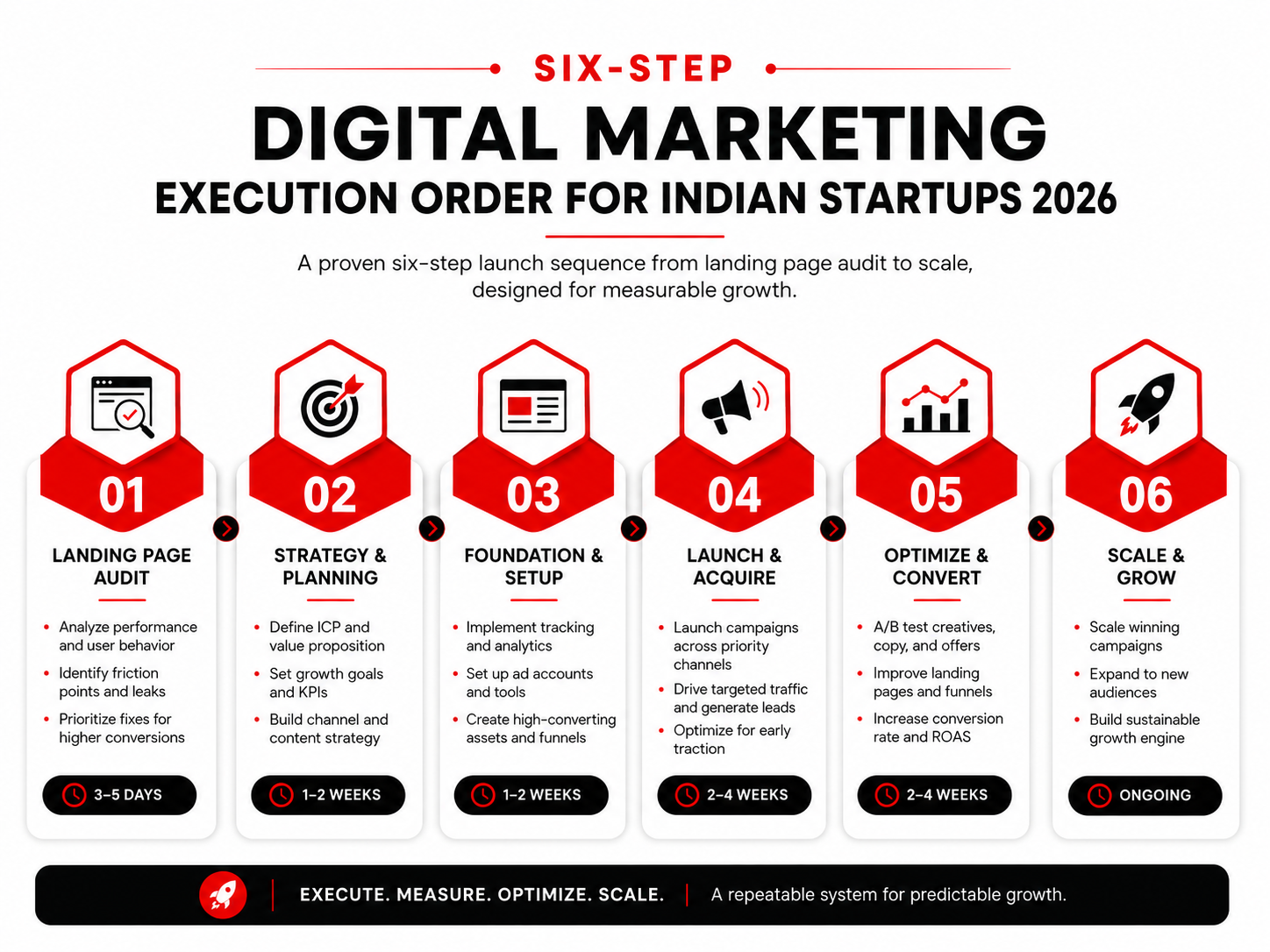
Most startups see meaningful traction in 45 to 90 days when this sequence is followed correctly. The first 30 days are diagnostic and infrastructure. Days 31 to 60 are execution and measurement. Day 61 onwards is scale and optimisation.
Q: What does a digital marketing agency for startups actually do differently from a standard agency?
A digital marketing agency for startups understands unit economics, runway constraints, and the need to prove channel viability quickly. They build lean test-and-measure frameworks before committing budget, whereas standard agencies often default to full-funnel campaigns that take 90 to 180 days to show return. For startups, the speed of learning matters as much as scale.
Q: How much should an Indian startup spend on digital marketing per month?
Early-stage startups in India typically allocate between Rs 50,000 and Rs 2,00,000 per month for paid media, excluding agency fees. The exact budget should be driven by your target CPL and monthly lead target, not an arbitrary percentage of revenue. If your CPL target is Rs 500 and you need 100 leads per month, you need Rs 50,000 in media plus enough for an optimisation margin.
Q: Which digital marketing services for startups give the fastest results?
Google Search Ads and conversion rate optimisation on your landing page give the fastest measurable results, typically within 14 to 21 days of launch. SEO and content marketing take three to six months to compound but deliver far lower long-term CPL. The best approach for a startup is paid media for immediate demand capture and SEO for compounding organic growth simultaneously.
Q: When should a startup consider hiring a marketing agency for startups versus an in-house team?
Hire a marketing agency for startups when you need multi-channel expertise, don’t have the internal bandwidth to manage paid media and content simultaneously, or need to move fast in a competitive market. In-house is right when you’ve already found your winning channel and need to deepen execution in one area. Most early-stage startups benefit from agency support in the first 12 to 18 months before building internal capability.
Q: What are the most important metrics a startup should track in its first 90 days of digital marketing?
Track CPL (cost per lead), CVR (conversion rate on landing pages), lead quality score (self-reported or sales-verified), and cost per qualified lead. Vanity metrics like impressions, reach, and follower count are secondary. If your CPL is within target and lead quality is acceptable, the channel is working. If either is off, find the root cause before spending more.
Q: Are digital marketing companies for startups worth the investment at the seed stage?
Yes, if you choose the right one. Digital marketing companies for startups that specialise in early-stage brands understand budget constraints and build for fast learning. The risk is hiring a generalist agency that treats you like a small enterprise account.